ALTHOUGH archery in civilized countries ranks only as a sport, yet there are some parts of the world where many a small boy will have to shoot at, and hit, his breakfast to-morrow morning with an arrow, before his father will let him eat it. With such a necessity before us, most of us would probably be pretty good archers.
A bow and arrow rightly used will train the eye, strengthen the arm, steady the nerves, and furnish a recreation more useful and no less entertaining than some other sports that by bad associations have become objectionable. But a young lady who one day heard the whiz and felt the thud of a boy’s arrow in her hair did not think that arrow had been rightly used. No one has a right to be careless about anything, and, as to archery, even a common bow and arrow can be used so as to produce death in an instant, to say nothing of putting out eyes and giving bruises by careless shots. There has been more than one game, harmless in itself, turned into a funeral by carelessness.
Nor do we think an arrow rightly used when turned toward an innocent bird, or shot at any living thing simply for amusement or to improve one’s skill. That may do for savages, but not for Christian boys and girls. Unerring skill in shooting will not pay for a heart cruelly hardened to suffering.
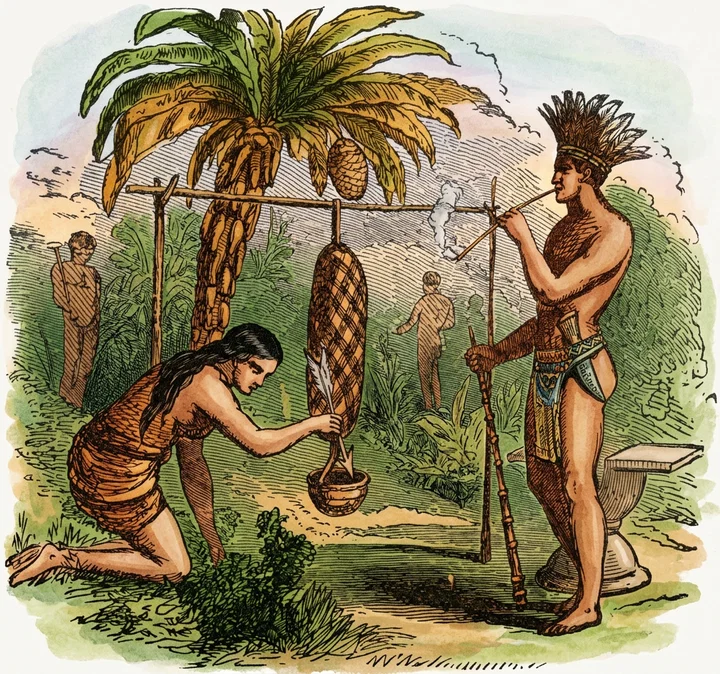
You have all heard of “poisoned arrows.” The process of poisoning is illustrated in the accompanying picture. The Indian gathers deadly herbs and steeps them. He then dips the points of his arrows into the mixture, and sets them carefully aside for future use. It does not take a deep wound then, nor a large arrow, nor a sure aim at a vital part, to do the work. All that is needed is a mere scratch, and the victim often dies within an hour from the time he was hit.
There is another kind of “poisoned arrows.” They are the shafts of envy, or the “arrows of suspicion.” A single word from an envious lip, and some one’s happiness is destroyed, never to be brought back. A single suggestion, something that you “don’t know to be true,” “but if it isn’t so what else can it be?” and the sharp barbed arrow of suspicion has sped to its mark—a character is ruined, a reputation is destroyed, perhaps forever.
Do you ever shoot such arrows? Something is missed from the house, or from the desk at school. It is hunted for. It does not appear. “Well,” says some one, “that was certainly here, and just as certainly it is gone! Somebody must have stolen it, and who has done it unless”—Stop! it may still be found. You may have mislaid it, a rat may have taken it to his nest—but no matter how—did you see the person steal it? “No?” then you have NO RIGHT to carelessly turn toward him a “word” arrow touched with so deadly poison as suspicion. You did not say that he did it. No, but you said enough, fully enough, to poison his reputation.
Then, too, there are boys and girls who seem to think they can say what they will if it is “only in fun.” Hear what the wise man says about this:— “As a mad man who casteth fire-brands, arrows, and death, so is the man that deceiveth his neighbor, and saith, Am not I in sport?”
An arrow wrongly used is a terrible thing, but the most cruel of all is the “poisoned arrows!” No wonder that David prayed: “Hear my voice, O God, in my prayer; . . . hide me from the secret counsel of the wicked, . . . who whet their tongue like a sword, and bend their bows to shoot their arrows, even bitter words; that they may shoot in secret at the perfect; suddenly do they shoot at him and fear not.”
Be careful of your arrows. Do not point them where you have no business to, andp. 210 never use “poisoned arrows,” bitter words, deceitful words, and unkind looks, that pierce the hearts and embitter the lives of those around you.—Sel.