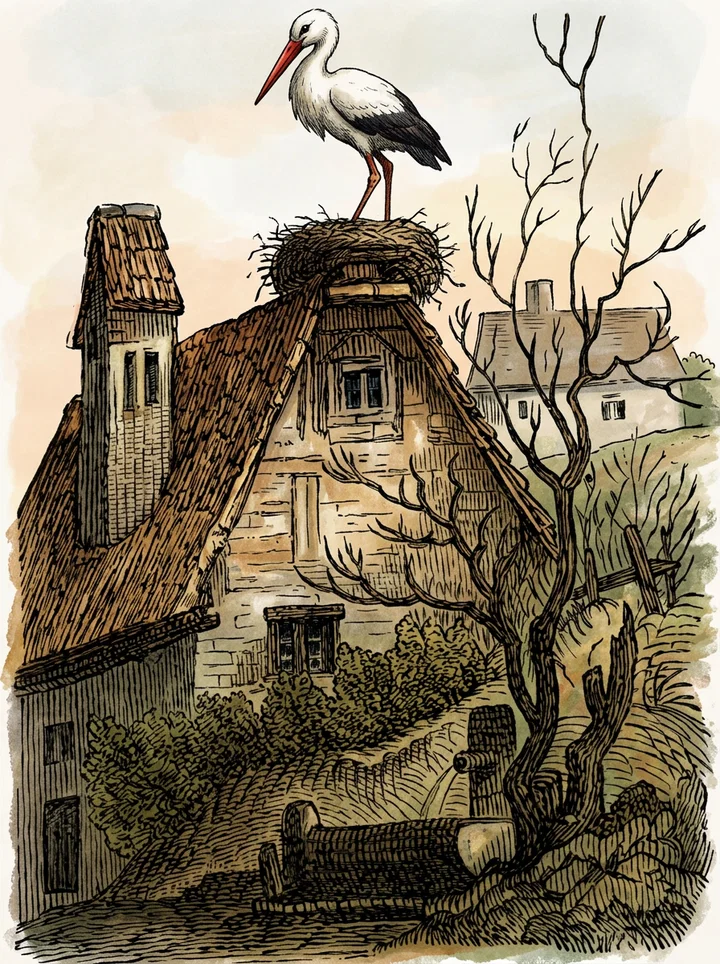
THE STORK
The stork is a very large bird, and all its feathers, except the ends of the wings and tail, are white. His long bill is a bright red, and his legs are the same color, but are not as brilliant. In the Holy Land the stork was well known, and its flesh was not eaten by the Jews. It built its nest on the tall trees, as we learn from the one hundred and fourth psalm: “As for the stork, the fir-trees are her house.” And Jeremiah says, “The stork knows her appointed time,”—the time to go south, and also the time to return. Its winters are mostly spent in Africa, but its eggs are laid, and its young are reared, in the north of Europe and Asia. When the time comes for them to migrate, they go to the appointed gathering-place; but we do not know by what means God makes them to understand this. When all are ready, and night comes on, the leader starts up, and, soaring high in the air, moves off with the flock toward its new home. These flocks often number thousands.
Its name in Hebrew is said to mean mercy or piety, and the character of the bird agrees with its name. According to some writers, the old and infirm storks are assisted on their journey by the younger ones, which allow them to lean their heads, when weary, upon them; or, if the old ones are likely to give out, and begin to lag behind, the others take them on their backs and bear them easily on.
The stork is mild and quiet in disposition, and for ages has been held in a kind of superstitious reverence by the people of the East. When he comes with his materials for a nest, and lights down upon the tops of their houses and begins to build, they call it a good omen, and think it will bring good fortune. The Hollanders erect a false chimney, and the Germans a platform on their houses, to receive these welcome guests.
Children may learn a useful lesson from this strange-looking bird. What is it?—Selected.