GRINDING AT THE MILL

8%

S. D. A. Publishing Association · Battle Creek, Mich. · Nov 12, 1879

FromThe Youth’s Instructor, Vol. 27, No. 45.

Read the full edition

GRINDING AT THE MILL.

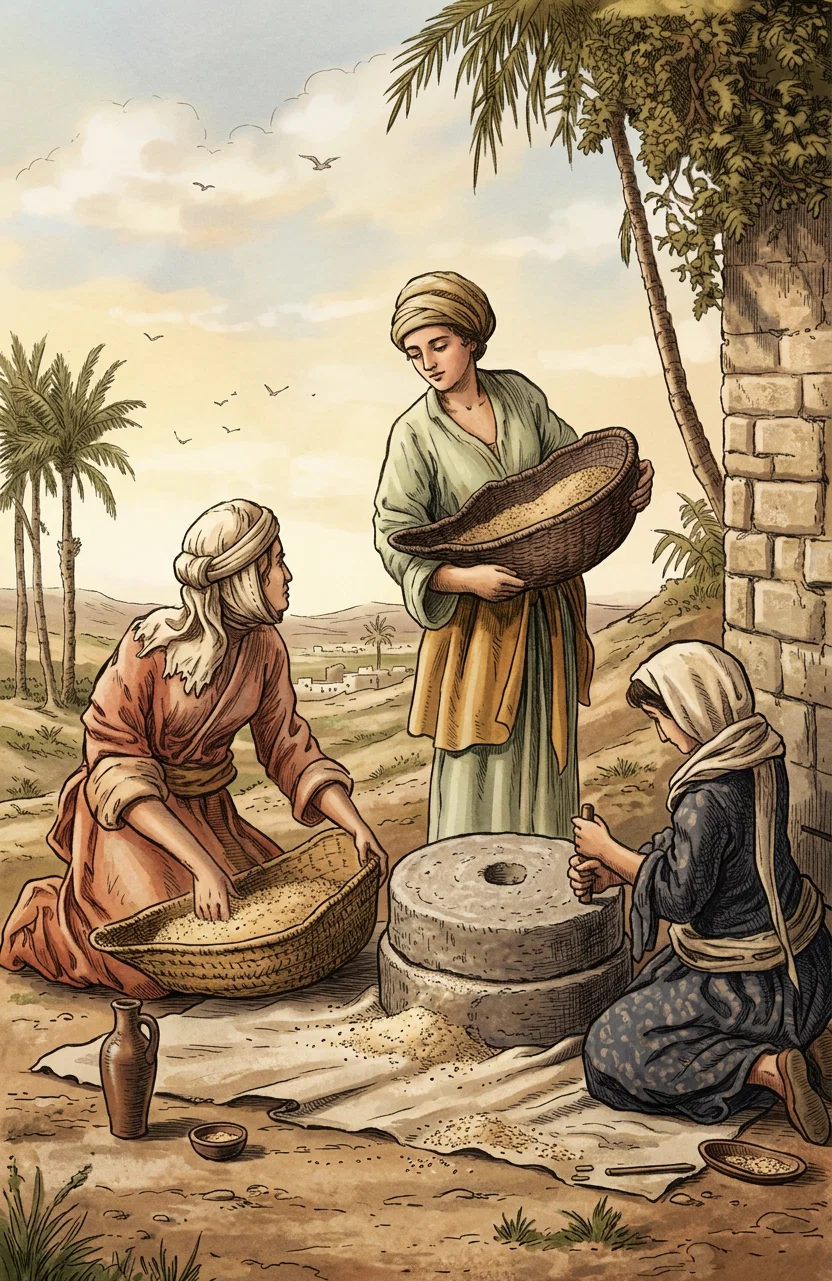
The hand-mills still in use in the East vary little from those employed thousands of years ago. Here is a picture of a scene which might have been witnessed in the time of Moses, and which you might now behold at dawn of day in almost every household, were you in some oriental land.
A lady, writing from India, gives the following description of the manner in which grain is ground in that country:—
Grinding the wheat or rice is the work of women. Among the wealthy it is performed by slaves or the lowest servants. In this warm climate the bread must be baked just before it is to be eaten, and in the morning the first care of the women is to grind flour for the day’s use. Then they must bring water and fuel, and prepare their fire-place, etc., before they can cook breakfast. The men do not wait to take breakfast before going to their work, but return for it or have it sent to them.
Restored with AI
The people of the East have usually but two meals a day. The morning meal is taken at any time between nine and one o’clock, and the evening meal after the farmer leaves his work at dusk, or the shopkeeper his shop.
The hand grist-mill, which is found at every house, consists of two flat, circular stones, placed one over the other, and called the upper and nether millstones. They are from fifteen inches to two feet in diameter, and about six inches thick. From the center of the lower stone rises a pivot on which the upper stone revolves. Near the edge of the upper stone is the handle by which it is turned, and in the center is a hole for the pivot, and also for the grain to fall through upon the stone below. Sometimes one woman grinds alone, but oftener two work together, sitting on the ground with the millstones between them, and both taking hold of the handle and moving it entirely around, to and from them.
In the city there are a few mills which grind flour for market. These are larger, and are turned by oxen, but work on the same principle as the hand-mill. In the mountains I have seen a few small water-mills of very simple contrivance, for grinding corn and wheat. But I have never seen a steam grist-mill in India.
The poor women at the mills often sing cheerfully over their hard task, and the grinding of the millstones gives a low, continuous sound quite pleasant to the ear, more especially pleasing to those who anticipate a refreshing meal from it. To these grateful sounds allusion is made in Jer. 25:10. The Lord told his people, the Jews, that he would “take from them the voice of mirth, and the voice of gladness, and the sound of the millstones.” They would be heard no more in Jerusalem, because the people were to be carried away as captives to Babylon.
Grinding is considered too menial a service for men; hence, when Samson was degraded by the Philistines he was made to “grind in the prison-house.” Judg. 16:21. Jeremiah laments that “they took the young men to grind.” Lam. 5:13.
Since the millstones are so necessary to every household, we can see what a merciful command was that in the Mosaic law, “No man shall take the nether or the upper millstone to pledge; for he taketh a man’s life to pledge;” his family would be deprived of the means of preparing their daily food.
When our Lord would represent the severing of very close relations at the day of Judgment, he says, “Two women shall be grinding at the mill; the one shall be taken, and the other left.” God grant that we may all be found at that day among his chosen.—Exchange.
Restored with AI