The following is one of the most thrilling narratives on record. As a well-known writer has said, “There is nothing in all the records of peril and adventure which exceeds this.” It is the history of nineteen persons,—men, women, and children,—who lived one hundred and ninety-five days, just six months and a half, upon cakes of ice in the Arctic Ocean, and were at last all saved: so wonderful are the mercies of God.

These poor ice-bound prisoners were a part of the crew of the United States Exploring Ship, Polaris, which was locked in the ice, in Smith’s Straits, on the north-western coast of Greenland. It was at the head of Baffin’s Bay, away up in latitude 77° 35' north. The particulars of this narrative are as follows:—
As there were alarming reasons for expecting that the Polaris would soon be crushed by the masses of ice, a large quantity of stores and provisions, with boats, instruments, etc., had been landed on the floe, and a canvas hut built for protection. But scarcely had these measures for safety been taken, when the fury of a tempest suddenly broke up the ice, snapped the ship’s cables, and rapidly bore her away from the floe.
This was in the night, and a blinding snow-storm was upon them. When the vessel thus suddenly disappeared, the men and stores floated off in various directions, and it was only after the most perilous exertions, occupying several hours’ labor with the boats, that the people were finally collected on the main floe. About midnight, thankful that Heaven had spared them thus far, they all huddled together under the scanty protection of some musk-ox skins. This was Oct. 15, 1872.
In the morning after the separation, it was discovered that they were upon an ice-floe about a mile and a half in diameter. The party consisted of ten seamen, among them one of the ship’s officers, two Esquimaux men, with their wives, and five small children,—one of them being a babe only two months old! His name was called Charles Polaris, after the ship upon which he was born. For their subsistence, they had a quantity of canned meat, a few bags of bread, some dried apples, and a sack of chocolate. They had also guns and ammunition, two ship’s boats, kyacks, various instruments of navigation, a tent, and several Esquimaux dogs.
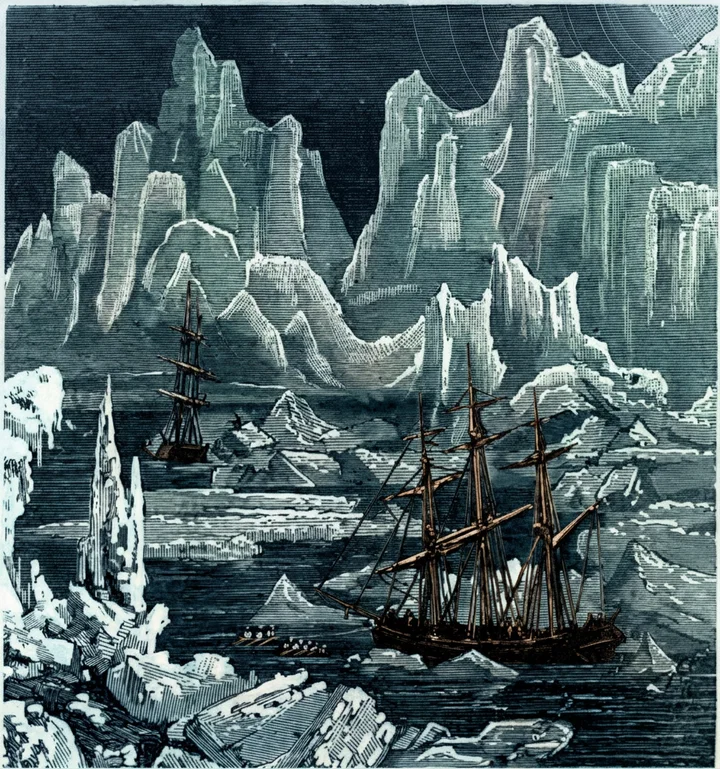
After taking some nourishment, the sailors took their boats and attempted to reach the shore near by, intending soon to return and get their stores; but the continued tempest and moving ice stopped them, and they were obliged to haul up their boats on a floe. To add to their distress, the Polaris was now seen under steam and sail several miles away.
A gale came sweeping down upon them, breaking up the floe, and separating them from one of their boats. They were now left upon a piece of ice only twenty or thirty rods across. Having abandoned all hope of reaching the vessel, they made back to the main floe, and began to prepare for the trials before them. Soon the ice, which had hitherto remained stationary among the bergs, began to drift, drift away, with its living freight upon it.
Several snow huts were now built by the sailors, one of which was warmed by a lamp made out of a meat can, with a piece of canvas for wicking. Through a kind Providence, several seals were caught, which supplied them with both fuel and food. By the first of November the sun had completely disappeared, and they only had twilight, with the moon and stars, for many weeks. The floe party was soon reduced to very scanty rations of food; but they always managed to catch seals or other Arctic game, which saved them from actual starvation. Most of the dogs were shot, as they were too weak to be of use.
The 28th of November, Thanksgiving Day, was duly celebrated by the ship-wrecked company. Their dinner was as follows: Six biscuits, a pound of canned meat, a little soup, and some preserved corn. Thus they feasted, thanking the Giver of all mercies.
Life upon the floe was very simple. Most of the time was spent in the snow huts, it being too dark to move about, even if there had been any motive. Thus the dreary month of December passed by with few events of interest. Christmas was celebrated by the extra allowance of an ounce of bread to each person to make the seal broth thicker.
New Year’s day was the coldest that the party had experienced thus far. The thermometer was very low, not rising above 25°, and sometimes descending to 40° below zero. It was ice, ice, ice, in all directions,—bergs, hummocks, floes, and packs; but still they drifted south along the easternp. 62 coast of Prince William’s Land. They were now about half-way down Baffin’s Bay.
About the middle of January two polar bears came to the huts, and attacked the dogs, but as might be expected, the dogs were so weak that they were quickly worsted in the contest. All this time the party were drifting slowly along, in sight of the western coast, which they judged to be from forty to seventy miles distant. The cold month of February was dismal indeed, but they occasionally caught a seal, which saved them from perishing. At this time they were drifting through Davis’ Straits.
But we have already exceeded our limits, and so defer the remainder of this narrative till next week.
G. W. Amadon.