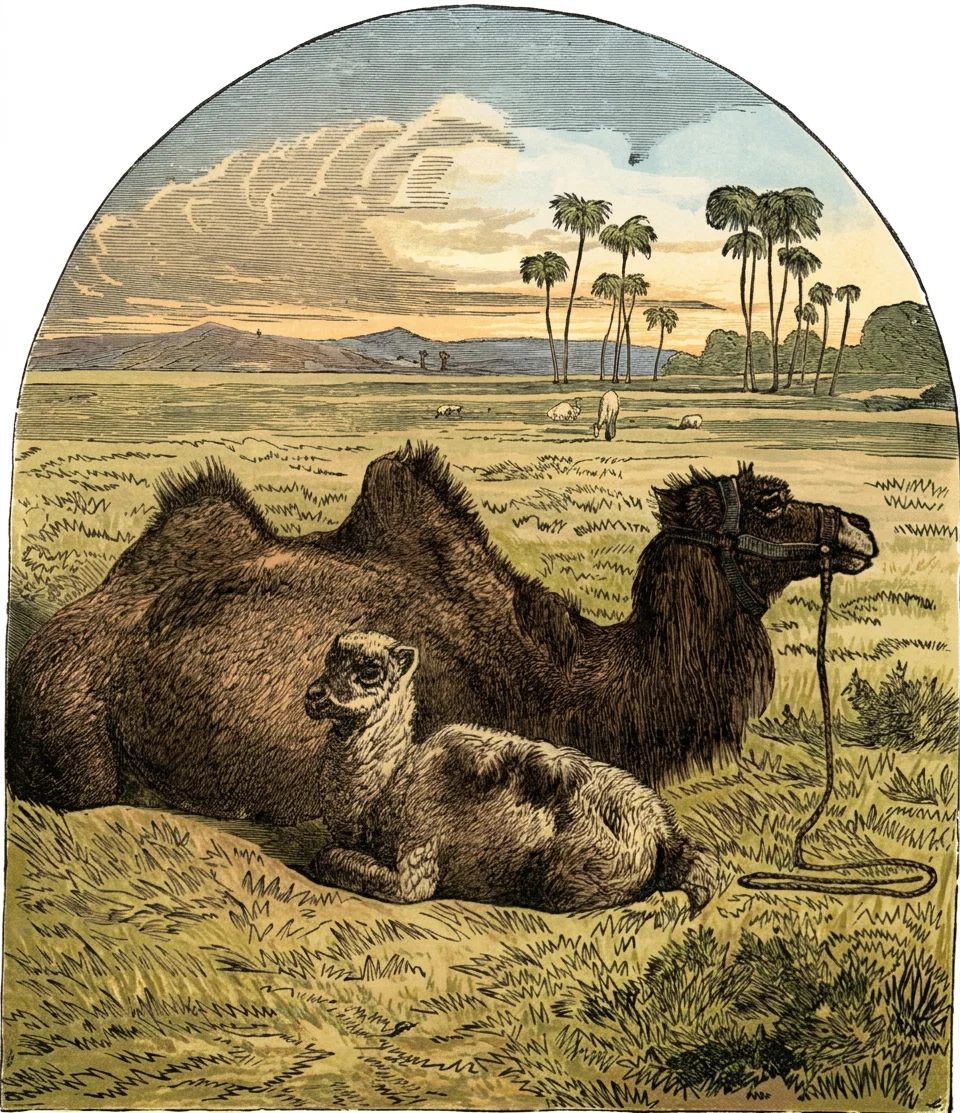
Ships that make long voyages have rooms in which to lay up food, and tanks to contain water for use on the voyage. So has the desert ship, a picture of which you see. This ship crosses land instead of water. A country of plains, of burning sand, and of mountains just as parched, with only rocks instead of trees, without water and without grass, over which you might look as far as you could see, and not meet with a single living being, or anything to show that one had been there, save, perhaps, some scattered bones, that tell a story of hunger, and thirst, and death. Over such a land as this, the ship of the desert takes its way. The Arabs gave the camel this name, for without him they could not safely cross the deserts nor escape their enemies when attacked.
Restored with AI
The appearance of the camel does not at first indicate his many excellent qualities. We are amazed at his great height and curious proportions. He has a long, thin, crooked neck, surmounted by a heavily proportioned head, which, when elevated, is at least nine feet above the ground; a stout body, from seven to eight feet in length, having on the back one or two humps which convey the idea of distortion. But these strange-looking humps are, when he has been well fed, filled with fat, and when he has been traveling for many days with but little to eat, he draws enough food from this storehouse to keep him alive for some time; so that, at times, on long and painful journeys, the fat is used up and the skin falls over like bags on each side, and there is hardly any hump left.
When properly understood, therefore, these apparent blemishes become real beauties, pointing out to us, as they certainly do, God's goodness to the works of his hands.
The animal has also, it is said, the power of laying in store, at one time, enough water for thirty days. For this purpose there is a94large cistern within him, from which, when he wishes, he draws what he needs and pours it into his stomach.
His natural food consists not so much of the herbage of the oasis as the thorny plant of the desert. His teeth are especially formed for such a diet, whilst his cleft upper lip enables him to nip off the tender shoots of shrubs, and to browse with comfort on the leaves of the date and tamarisk.
If the camel's feet had hoofs like those of a horse, they would soon become parched and cracked while going over the desert; but the feet are very large, and the under part is covered with a soft, spongy, elastic texture, and therefore spreads out at each step according to the pressure made upon it, thus giving the animal a firm footing on the sand, while the callous skin with which its surface is covered prevents any suffering or the slightest inconvenience being caused by the heat. The rough, callous surfaces on the chest of the animal and on the joints of his fore and hind limbs are the points on which the animal rests when it kneels for its load, or lies down for repose. They are, in fact, natural cushions, not produced by its habit of kneeling, as some have supposed, for the young camel is born with them, and, therefore, they are really the natural badges of his servitude to man.
The camel is trained to hard work when very young. His master throws a stout cloth over his back when he is kneeling, and on each corner puts a heavy stone. When the young camel can lift this easily, heavier weights are put on; and when he is used to these, the trainer places a large saddle upon his back, loads it, and takes him out into the desert.