PART FIRST.
What abundant food for thought is contained in the above phrase. Immediately the mind grasps the idea that color was bestowed upon animals by the All-wise Creator, not merely, as it were, by fancy or caprice, but in direct benevolence, giving them a better chance of lengthening their lives. Proofs of this theory are very numerous.
Perhaps the most striking illustration of this fact may be found in the insect world. Here, grays, and browns, and olives harmonize with lichens, and wood, and stone, affording the creatures so colored a good means of concealment. And yet some insects are exceedingly conspicuous, as witness the brilliant tints of many species of butterflies. But this, so far from disproving the theory, tends, as we shall see, to confirm it.
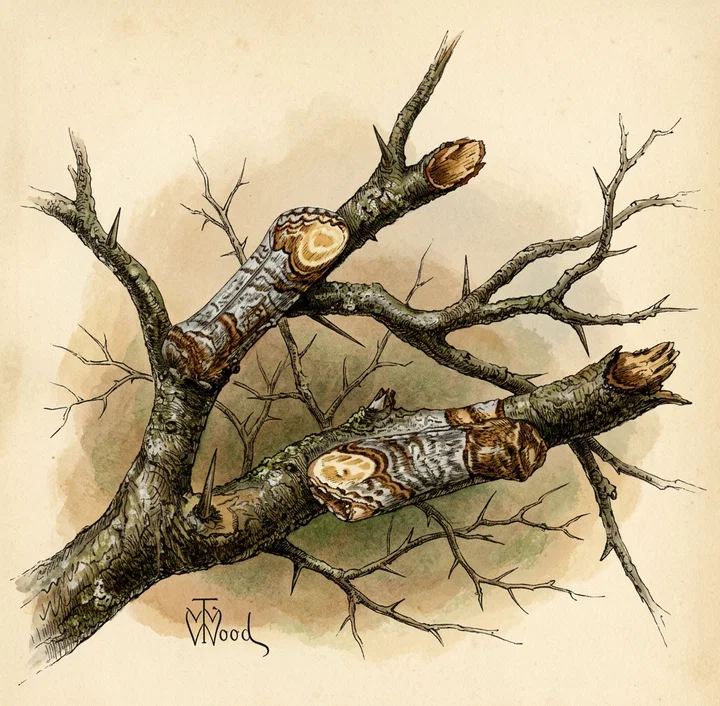
As may be seen from the illustration, the Buff-tip moth so contracts its wings as to look exactly like a large piece of broken stick, the yellow patch at the extremity of the wings giving the appearance of the freshly broken end.
The Lappet-moth, when at rest, so disposes its rich brown wings as to seem, both in shape and color, like a dead leaf.
In the case of other moths, we have those which settle among lichens and in the trunks of trees, being almost entirely concealed by the colors by which they are surrounded. Some, which strongly resemble bits of mortar, make stone walls their favorite resting-place. It has been noticed, also, that moths which are on the wing in autumn and winter, partake of the prevailing hues of these seasons,—autumnal moths are generally yellow and brown, like much of the foliage then visible, and many winter moths are of gray and silvery tints.
Gorgeous colors, however, as we have said, are no evidence of non-protection. These best harmonize with the bright and vivid hues of the leaves, the flowers, and the sky. The most wonderful, perhaps, of all imitative insects is the leaf-butterfly of India. This is a rather large and handsome butterfly, of a deep bluish color, with a broad orange band across the wings. It is thus very conspicuous; but it flies rapidly, and in a zigzag manner, so as to be caught with great difficulty.
It is when at rest, therefore, that it requires protection, and this it obtains by its color and markings on the under surface, and by its peculiar habits. The upper wings have an acute lengthened apex, which is exactly the shape of the tip of the leaf of many tropical trees and shrubs; while the hind wings are produced into a short, narrow tail, which well represents the stalk of a leaf. It always settles on an upright twig or branch, holding on by its fore-legs, while its body, concealed between the lower margin of the wings, rests against the stem which the extremity of the tail, representing the stalk, just touches.
The tropics abound with examples of insects equally well-protected. The best-known are the leaf-insects of the genus phyllium, whose wings and wing-covers are broad and flat, shaped and veined exactly like leaves, while their legs, head, and thorax have all flat dilatations, like the stipules of many plants; and the whole being of the exact green tint of the foliage of the plant they live on, it is actually impossible to detect them when they are not in motion.
The walking-stick insects, or spectres, are equally curious. These are long, cylindrical insects, often nearly a foot in length, and of the exact color of pieces of greenish or brown sticks. If they have wings, these fold up closely, and are concealed under wing-covers of the same stick-like appearance; while the head and legs are so shaped and jointed as either to fit closely on to the stick-like body, or to appear like branched twigs. These creatures hang about shrubs in the forest, and can seldom be distinguished from small twigs and branches which have fallen from the trees overhead. They remain quite motionless during the day, and feed at night. They hang across the foliage, holding on by two or three of their legs only, while the others are closely fitted to the body, and they thus give themselves that unsymmetrical appearance which belongs to accidentally broken twigs.
Wonderful indeed are the works of the Maker of all!—Arthur's Home Magazine.