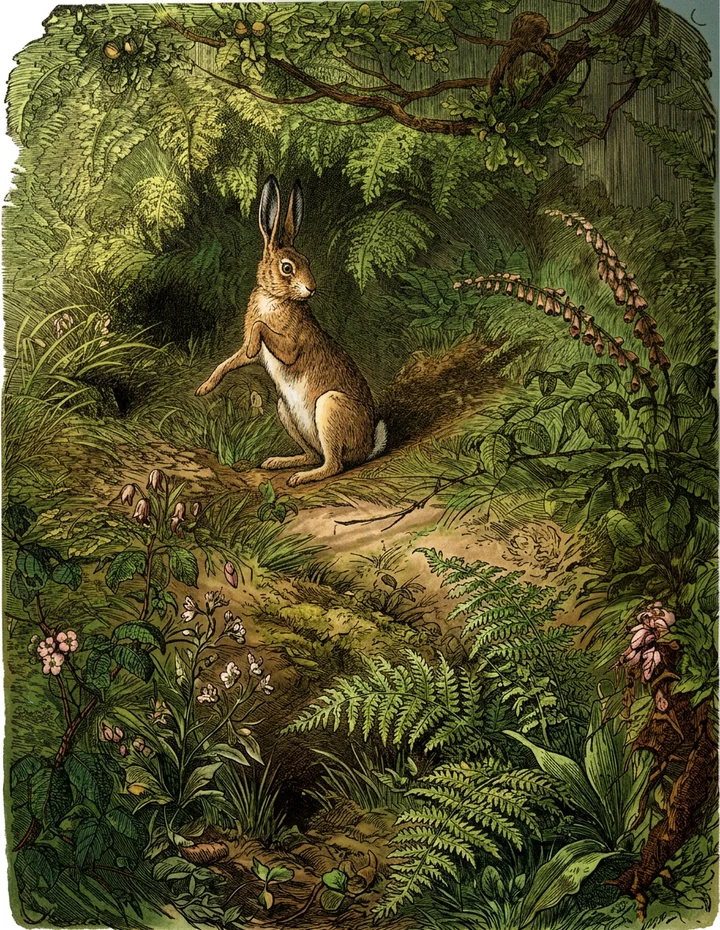
The hare is very much like the rabbit. It is a little larger, and is known by a black spot at the tip of its ears. It does not burrow in the ground as rabbits do, but makes its nest, or “form” as it is called, in the grass. It is very timid. In England rich men hunt it, for sport, with dogs and horses. It is hard to understand how grown-up men can take pleasure in hunting down a poor timid hare. It is cruel and senseless sport. We trust that no boy in the INSTRUCTOR family ever hurts an animal for pleasure or mere sport.
Here is a little poem about the hare which we take from the Canadian S. S. Advocate, and which we believe will please you if you read it carefully through:—
Beyond the palings of the park, A hare had made her form Beneath a drooping fern, that gave A shelter, snug and warm.
She slept until the daylight came, And all things were awake; And then the hare, with noiseless step, Crept softly from the brake.
She stroked her whiskers with her paws, Looked timidly around With open eyes, and ears erect That caught the smallest sound.
The field-mouse rustled in the grass, The squirrel in the trees; But the little hare was not afraid Of common sounds like these.
She frisked and gamboled with delight, And cropped a leaf or two Of clover and of tender grass, That glistened in the dew.
What was it, then, that made her start, And run away so fast? She heard the distant sound of hounds, She heard the huntsman's blast.
Hoy!—tally-ho!—hoy!—tally-ho! The hounds are in full cry; Ehew! ehew! in scarlet coats The men are sweeping by.
So off she set with a spring and a bound, Over the meadows and open ground, Faster than hunter and faster than hound; And on, and on, till she lost the sound, And away went the little hare.