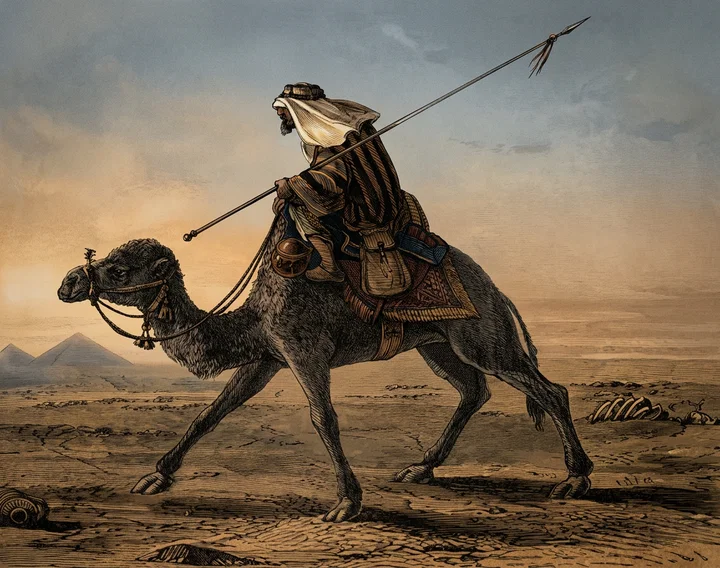
Ships that make long voyages have rooms in which to lay up food, and tanks to contain water for use on the voyage. So has the desert ship, a picture of which you see. This ship crosses land instead of water. A country of plains of burning sand, and of mountains just as parched, with only rocks instead of trees, without water and without grass, over which you might look as far as you could see, and not meet with a single living being or anything to show that any one had been there, save, perhaps, some scattered bones, telling a story of hunger and thirst and death! Over such a land as this, the ship of the desert takes its way.
The Arabs gave the camel this name, for without him they could not safely cross the deserts, nor escape their enemies when attacked. The camel was born for the desert, and its features, that look so homely to us, when we study them, seem beautiful in their usefulness. That strange-looking hump is, when the animal is well fed, filled with fat; and when he has been traveling for many days with but little to eat, he draws food from this store-house enough to keep him alive for some time; so that, at times, on long and painful journeys, the fat is used up and the skin falls over like bags on each side, and there is hardly any hump left. He has also, it is said, the power of laying in store, at one time, enough water for thirty days. For this purpose there is a large cistern within him, from which, when he wishes, he draws what he needs, and pours it into his stomach. He feeds on the coarsest food, that a horse would not touch, such as thistles and thorns.
In Turkey, Persia, Egypt, Arabia and Barbary, all kinds of goods are carried by camels. The wild Arabs often attack travelers, and to avoid them, merchants and others about to cross the deserts, join themselves together in caravans. These caravans have always more camels than men. Each camel is loaded according to his strength; the larger ones carrying from a thousand to twelve hundred pounds weight, and the smaller ones from six to seven hundred.
The Arabs say that the dromedary will keep up a hard trot for twenty-four hours, and then having swallowed a ball or two of paste made of barley, and a little powder of dry dates with a bowl of water or camel’s milk, will seem as fresh as ever.
If the camel’s feet had hoofs like those of the horse, they would soon become parched and cracked while going over the desert; but the feet are very large, and the under part is covered with a long, tough, and yielding skin, which helps them to go easily and safely over dry, hot, stony, and sandy places. On top, the feet are divided into two parts, the ends of which are guarded by small hoofs. There are seven different kinds of camels, but the Bible speaks of but two,—the Arabian camel, or dromedary, of which we have a picture, and the Bactrian camel, which, unlike the dromedary, has two humps instead of one.
The dromedary is the swiftest, but not so strong as the two-humped camel, which is used more for burdens. The height of the dromedary, from the top of the bunch to the ground, is about six feet; and from the head, when it is raised, to the ground, is about nine feet.
The camel is trained to hard work when very young. His master throws a stout cloth over his back when he is kneeling, and on each corner puts a heavy stone. When the young camel can lift this easily, heavier weights are put on; and when he is used to these, the trainer places a large saddle on his back, loads it, and takes him out into the desert.—Little Christian.