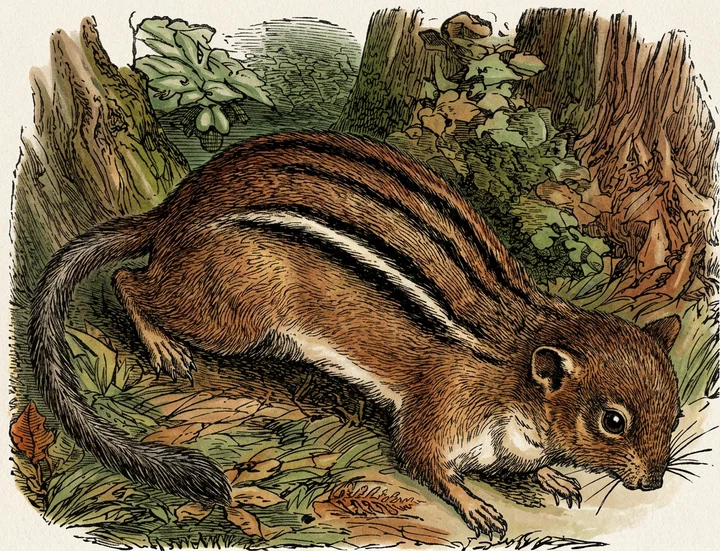
GROUND SQUIRRELS.
Most of the children will recognize in the picture above, the little ground squirrel, perhaps best known to them by the name of “chipmonk.” They are smaller than the red squirrel, and are not so bright colored. You can always know them by the five black stripes running from the neck almost to the tail. The two stripes on the sides are separated by a white line, as you see in the picture. They are innocent little creatures, and do hardly any damage to the farmer, for they do not disturb the grain until it is ripe, and only gather their winter store from what is left on the fields by the harvesters. They do not climb trees as other kinds of squirrels do, but make their nests in the roots and in old stumps, where they stow away nuts, wheat, corn, cherry-stones, and grass-seed, to live on during the cold months of winter.
They are very playful, and it is amusing to see them standing upright on their hind legs on some old stump, looking as sober and dignified as a deacon, and cheeping at you like a chicken, until you come too near, when away they go to their nests before you can tell which way they went. Perhaps this is what has led the boys to call them “chipmonks.” Sometimes they will not go to their nests, but will run along the fence or stone wall, cunningly peeping out here and there, and then darting back again, as though playing hide-and-seek with you. Often, too, a couple of them may be seen racing around a stump or stone-heap, and like boys playing tag, when one has fairly touched the other, he turns and is himself chased; and so they keep up the game until tired out.
Now, boys, since these little creatures do no harm at all, and are so pleasant to watch and study, don’t you think it is cruel to kill them just to see if you can throw or shoot straight enough to hit them? And when you see a boy doing so again, will you not ask him to put down his gun or stone, and watch their play while you tell him how harmless the little fellows are; and how hard they work all through the warm weather to gather food, so that they may live to another summer to amuse us with their frolic? *