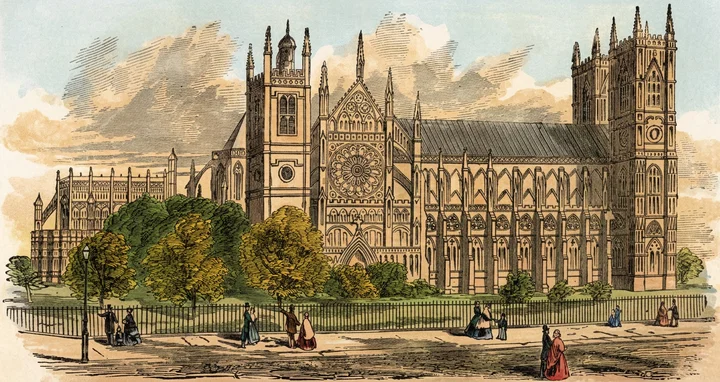
ONE of the oldest churches in the world is Westminster Abbey, in London. It is thought to have been commenced sometime in the seventh century, but has been repaired and added to, at many different times since. It is built in the form of a Greek cross. Our picture shows the northern side of this magnificent structure, but gives only a poor idea of its vast size. The two towers seen to the right of the picture mark the front of the building, which faces toward the west. The height of these towers is two hundred and twenty-five feet. The length of the building is between four and five hundred feet, and its extreme width about two hundred feet.
At either end of the building and in various portions of the sides, are immense windows of stained glass, adorned with painted figures of marvelous brilliancy and beauty. Perhaps the most interesting of these is the great south window, which contains full-length representations of Abraham, Isaac, Jacob, Moses, Aaron, and others of the patriarchs. The “rose window,” in the north side, and the “marigold,” in the south side, also give Scriptural incidents.
As the visitor enters the Abbey, he is struck with the immensity of the place. It appears larger than it really is, owing to the dim light which enters through the stained glass windows. A grand view stretches away amid wonderful aisles, arches, and forests of columns, almost as far as the eye can reach. Everywhere—along both sides of the length of the building, in chapels and under the marble floor—are the tombs, tablets, statues, monuments, and inscriptions of the illustrious dead. Among these are the British poets, artists, and worthies, from Shakespeare’s time to the present. The English sovereigns, from Edward the Confessor to Queen Victoria, have been crowned here, and here many of them have been buried, some with and others without monuments. As the guide conducts you through the various chapels, he points out to you the numerous sarcophagi [stone coffins] of the former kings and queens of England who here lie in dust.
Religious services are held daily in the Abbey, and on Sunday they are numerously attended, though the audience-room is so large that the voice of the preacher can be heard by only a part of the people present. One who has been to London during the past year thus speaks of his visit to this world-renowned place of worship:—
“On the first Sunday in July we attended divine service in Westminster Abbey, and heard Canon Farrar preach an earnest and very appropriate sermon. It was, however, with peculiar feelings that we listened, surrounded as we were by the tombs of a host of Britain’s distinguished dead,—kings and queens, warriors, heroes, and poets, almost without number,—all silent in the dust, yet proclaiming the brevity of human life, and the vanity of human honor and glory and fame. But blessed be the assurance that the righteous shall be held in everlasting remembrance, and that their names shall never perish!”
During the last summer, Dr. Arthur Stanley, long the loved and honored Dean of Westminster, and widely known for his eloquence of both tongue and pen, died very suddenly, and was laid to rest in the old Abbey through whose aisles his voice had so often echoed. Canon Farrar, mentioned in the extract above, was his friend and fellow-worker, and often preached from his pulpit.
E. B.