THE RABBIT

11%

S. D. A. Publishing Association · Battle Creek, Mich. · Oct 12, 1881

FromThe Youth’s Instructor, Vol. 29, No. 41.

Read the full edition

THE RABBIT.

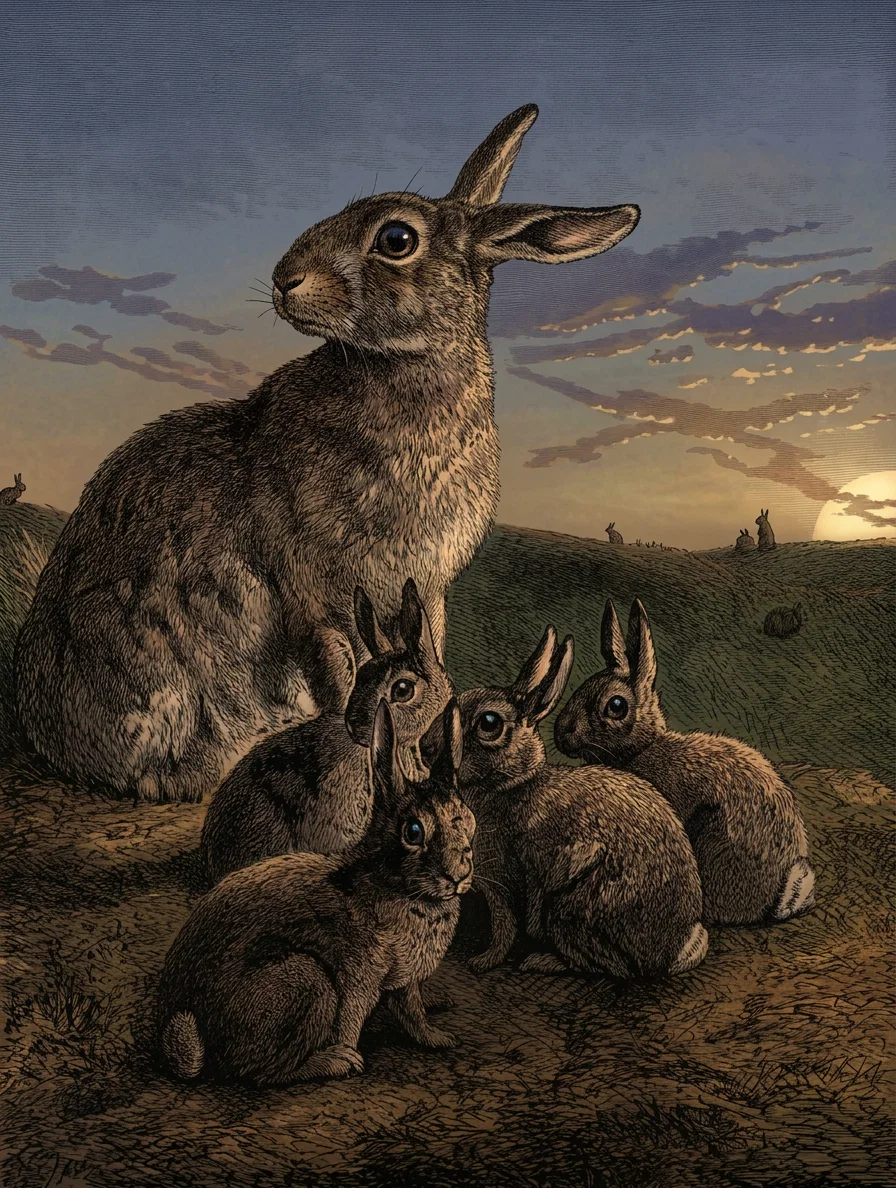
RABBIT is the name commonly given to several species of the hare family. The pretty little creatures are found in almost every part of the world, although they are said to be natives of Spain. They are of many different colors and shades,—black, brown, gray, white, spotted, etc.
Rabbits build their nests in the ground, usually in meadows, but sometimes they are found in cultivated fields at the foot of a hill of corn, or some other plant that will afford them shelter. A few days ago a nest of young rabbits was plowed out from under a hill of sage in the middle of the field. There were four of the little fellows snugly hid away in a nest made of light brushwood, and lined with thistle-down. They were so young that their eyes were not yet open, and it seemed sad to give them so rude an introduction to the ways of the world; but after replacing the nest as carefully as possible, and marking the spot so as not to disturb it again, we found them all right and able to run about, on visiting them a few days later.
During the summer and autumn months, when there is plenty of clover, the rabbits fare pretty well, and they are somewhat shy of the farm buildings; but when the fields have all been cleared, they venture into the orchards and gardens, where they feed on the apples, and the leaves of the garden vegetables. They are especially fond of cabbage.
Although the rabbit is a very harmless-appearing animal, yet he sometimes does a great deal of mischief. In the winter, when the snow is deep and he can find nothing to eat, he gnaws the bark from the young fruit-trees, frequently destroying an entire orchard.
The rabbit is a very timid creature, and is usually so wild that the comparison “wild as a hare” has come to be a common one. When tamed, however, it often comes to be a very affectionate little pet. The poet Cowper, who lived in England about one hundred years ago, had a pair of them of which he was very fond; and as he lived alone most of the time, his rabbits were a real comfort to him. He is said to have spent several hours a day with them, feeding them and watching their pretty gambols; and when one of his pets died, he wrote a pretty little poem about it. This certainly shows the poet to have been a very kind-hearted man.
Restored with AI
In these mild October days, when the summer’s work is done, and everything snugly stored away for winter, or later on, when the first light snow has fallen, the farmer lads like to get together and go hunting the rabbit and other small game. Of course this is fun for the boys, but I fear the tender-hearted poet would feel like reproving them for killing his pretty pets. And really, boys, does it not make you hard-hearted to find your sport in destroying life? Did you ever think that perhaps life was as dear to the little rabbit as to you? Think of it next time the one you are chasing looks at you so appealingly out of its great, frightened eyes, and see if you cannot find better sport. E. L.
Restored with AI