BLUE JAYS

10%

S. D. A. Publishing Association · Battle Creek, Mich. · Jun 14, 1882

FromThe Youth’s Instructor, Vol. 30, No. 24.

Read the full edition

BLUE JAYS.

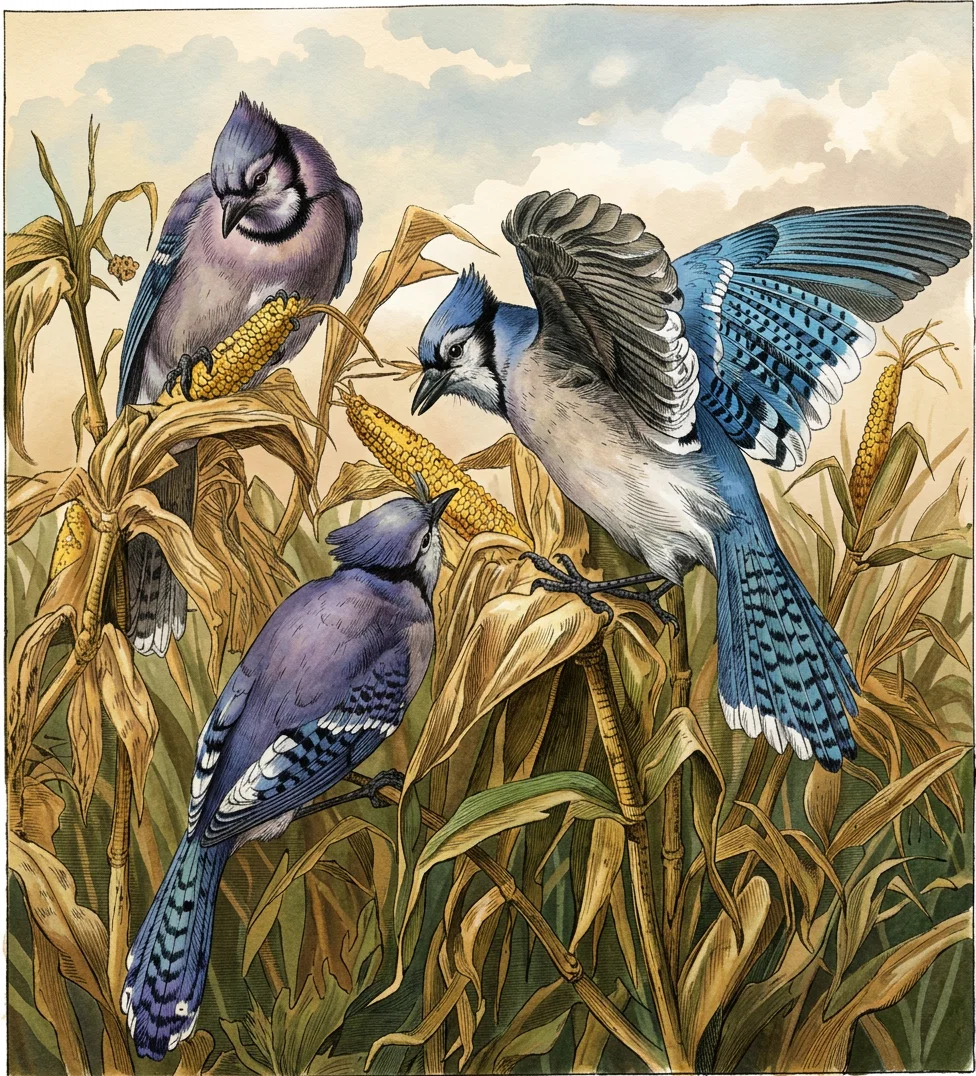
A few need to be told the names of the birds seen in the picture, for blue jays are common in all parts of North America. To those who are ignorant of their mischievous pranks and cruel habits, their appearance is very beautiful; but on a close acquaintance, as is the case with many people, their good looks are spoiled by their bad actions. The upper part of the body is a light, bluish purple, the lower part or breast is pure white, and the throat bluish white. On the head is a pretty crest of light blue or purplish feathers, which the bird can raise or lower as it pleases. The neck is adorned with a jet black collar, while the eyes are hazel. The prettiest parts of the bird are its wings and tail. These are part azure and part light blue, crossed by black bars, and most of the wing feathers and all but the two middle ones of the tail, are tipped with white.
Having now described their handsome clothes, let us learn some of these birds’ naughty tricks. While gracefully hopping from branch to branch, tossing up their little heads, and singing and chattering, the little hypocrites are all the while on the watch for some other bird to stray too far from its nest, when one or a half-dozen of the jays will dart over to the deserted home and seize the eggs to devour. Or if the eggs are hatched, and the little ones are reaching up their open mouths for the food which they think their parents have brought them, the heartless robbers will carry them off bodily and pick their bones. They seem to expect from other birds the same treatment of which they themselves are guilty, for they build their own nests in the tops of the loftiest trees, the cedar being their favorite home.
Restored with AI
To this retreat they glide very secretly and silently, though in all other places they are very noisy and boisterous. But one day Mr. Jay came to his home and found Mrs. Jay folded in the embrace of a great black snake. He immediately sent up a scream that sounded through the woods and brought to his aid two fellow-jays. All three attacked Mr. Snake with open beaks, but before they succeeded in killing him the poor mother-bird died. The grief of the bereaved jay was very intense, and perhaps as he viewed her lifeless body, and the five unhatched eggs in the nest, he learned a practical lesson from the text, “With what measure ye mete it shall be measured to you again.”
Although cruel and without pity, yet the blue jay is no coward. Besides waging battle with the mole, the mink, the weasel, the owl, and scores of other tribes, it even attacks the lightning winged and lordly hawk. A dozen jays are often seen at the opening of some hollow stump, whither some trembling flying-squirrel has taken refuge. There they will watch for hours, and should the captive trust to his regained strength to escape their power, he no sooner emerges from his prison than his eyes are plucked out, and his quivering flesh becomes food for a dozen mouths.
The blue jay is hated and feared not only by the animals which it attacks and robs, but by the hunter and farmer as well. A hunter’s form among the trees is the signal for a wild scream of alarm on the part of the jay, which often starts the deer at whose heart the hunter’s rifle is being aimed; and oftentimes the bullet intended for the deer, takes revenge in the body of the jay. But if the hunter has succeeded in obtaining his game, he is not sure of keeping it. If he leaves it hung up in camp until the hunt is over, he may come in any time to find it torn in pieces and half consumed by jays; and they even become so audacious as to snatch the meat from the boiling kettle, and take it out on the snow to cool before eating. The pine-log cutters of the north are often robbed so seriously by flocks of these persevering birds as to be reduced to suffering. But the jay does not confine its diet to animal food. No sooner does the farmer sow his grain or plant his corn than does the jay “raise” it in a very different manner than was intended by the owner of the soil. They often take upon themselves the task of harvesting the farmer’s crop, too, as they are seen doing in the picture. Yet the bird is not wholly without use, for in carrying nuts of all kinds to supply its winter’s need, it often drops them in its passage and thus plants many a useful tree. Indeed, one careful observer says that in a few years’ time the jays alone would in this manner replant all the cleared lands.
In one thing the blue jay shows better judgment than the ant or squirrel. Instead of heaping his provisions in one place where some accident might deprive him of all, he hides them here and there in a thousand different spots. One would think that he would forget where he had put them. But this he is never known to do, and will even remember their location from one winter to another. Blue jays are often tamed, and come to think very much of their owners. They will also learn to talk, and are very proud of their accomplishment, being extremely anxious to exhibit their skill to every one who will listen. Like many orators, the larger their audience the greater their eloquence.
After all that we have found that is bad about the bird, yet certainly there is much about him to admire and interest. C. H. G.
Restored with AI