WATCHING THE BIRDS.
By S. E. S.
No doubt many of the boys and girls who read the INSTRUCTOR have spent many happy hours during the spring that has just gone from us, in lying under the trees and watching the birds over head. How joyfully we welcomed them that first morning that we were wakened by their sweet songs! Then what a commotion there was among the newly opening leaves as the little inhabitants of the trees were choosing their mates and the places where they should build their nests. Then we watched them gathering the dry last year's grass, and tiny twigs, and the horse hair from the barnyard, and perhaps bits of string that we hung for them on the limbs of the trees. How shyly they eyed us as we did so, and then while we watched them from around the corner of the house, how they twittered, and fluttered, and hopped nearer and nearer until with a dive they seized it, and darted away to weave it in with the grass and twigs and hair to make their summer home.
Then they grew more still and we knew that if we should climb the trees and take a peep at their homes, we could count one, two, three, and maybe four and five little blue, or brown, or white, or spotted eggs, according to whether they were robins, or sparrows, or some other kind of bird. And, perhaps, knowing that they could not count their eggs, and so would not miss “just one,” we took one from the nest of each kind of bird we could, and so had an egg museum. And how we felt toward those cruel boys who robbed our pets of all their eggs, and perhaps of their nest too. Then, on going out one morning, we saw a mother-bird standing on the edge of one of the nests, with a worm in her mouth, and we saw three or four little open mouths stretching up for it, and when we threw out some crumbs, the old birds, instead of eating them on the spot, carried the largest pieces up to their little family. Perhaps, too, some of you were so kind and gentle with the birds that they were no longer afraid of you, but would come to your hand for food, and after flying away south for the winter, would come back the next spring and build in the same old tree or porch again. You then thought how much nicer it was to watch the birds living so free and happy, than to have them shut up in a cage, only you wished they could stay all through the winter. Well, can we not learn a useful lesson from them even if they are only with us during the summer? God, who made us, and the fruits for us to eat, and the animals and plants to feed and clothe us, made the birds and flowers for our pleasure and enjoyment, and not for that alone, but also to teach us how to live at peace with each other, and how kind and obliging we should be to our playmates.
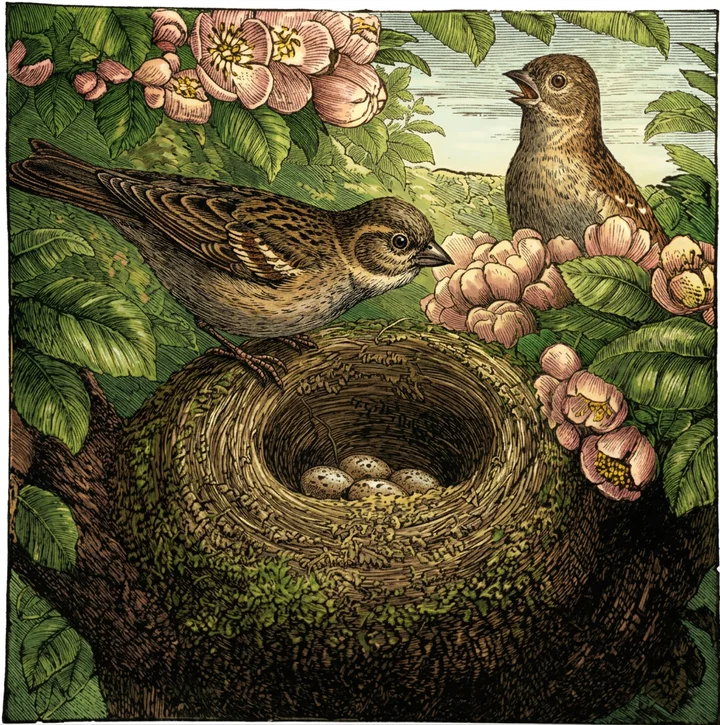
Again, as we look at Mr. Sparrow in the picture, singing so joyously to his mate, who is feeling very proud of her four speckled eggs, we are reminded of what Jesus said so many hundred years ago:—
“Are not five sparrows sold for two farthings, and not one of them is forgotten before God? . . . Fear not therefore; ye are of more value than many sparrows.” S. E. S.