THE MOCKING-BIRD

11%

S. D. A. Publishing Association · Battle Creek, Mich. · Jul 12, 1882

FromThe Youth’s Instructor, Vol. 30, No. 28.

Read the full edition

THE MOCKING-BIRD.

EARLY on a pleasant day In the poet’s month of May, Field and forest looked so fair, So refreshing was the air, That, in spite of morning dew, Forth I walked where tangling grew Many a thorn and breezy bush; When the redbreast and the thrush Gayly raised their early lay, Thankful for returning day.
Every thicket, bush, and tree Swelled the grateful harmony; As it mildly swept along, Echo seemed to catch the song: But the plain was wide and clear Echo never whispered near. From a neighboring mocking-bird Came the answering notes I heard.
Soft and low the song began: I scarcely caught it as it ran Through the melancholy trill Of the plaintive whippoorwill, Through the ringdove’s gentle wail— Chattering jay and whistling quail, Sparrow’s twitter, catbird’s cry, Redbird’s whistle, robin’s sigh; Blackbird, bluebird, swallow, lark, Each his native note might mark.
Oft he tried the lesson o’er, Each time louder than before. Burst at length the finished song; Loud and clear it poured along; All the choir in silence heard. Hushed before this wondrous bird, All transported and amazed, Scarcely breathing, long I gazed.
Now it reached the loudest swell; Lower, lower, now it fell, Lower, lower still; Scarce it sounded o’er the rill. Now the warbler ceased to sing; Then he spread his russet wing, And I saw him take his flight Other regions to delight. —J. R. Drake.
Restored with AI
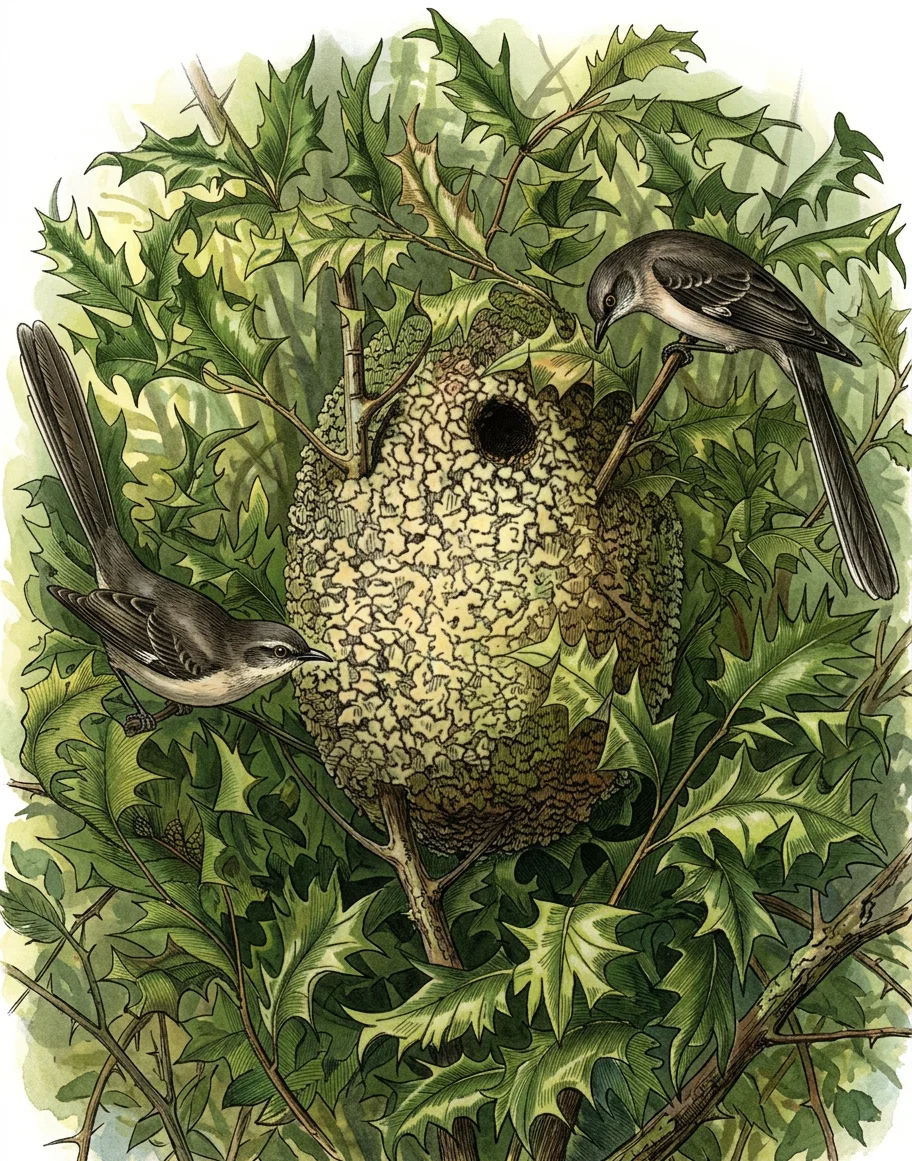
In the picture can be seen a pair of these wonderful birds, and their peculiar shaped nest, much resembling that of the swallow. Their power of imitation is something astonishing, and many amusing stories are related of their mischievous pranks. Mr. Wilson, in describing the habits of this most wonderful of all the feathered tribe, says: “He whistles for the dog; Cæsar starts up, wags his tail, and runs to meet his master. He squeaks out like a hurt chicken, and the hen hurries about with hanging wings and bristled feathers, clucking, to protect her injured brood. The barking of the dog, the mewing of the cat, the creaking of the passing wheelbarrow, follow with great truth and rapidity. He even repeats the tune taught him by his master, though of considerable length, fully and faithfully.”
Besides having the power of imitation, the mocking-bird has a song of his own, which rivals that of the nightingale in mellowness, modulations and gradations, extent of compass, and brilliancy of execution. Indeed, some who have heard both, regard the song of the mocking-bird as far sweeter and more enjoyable than that of the far-famed songster of the moonlight night.