SPIDERS
By C. H. G.
MANY will wonder what can be said that is interesting about “those disgusting creatures.” But if instead of crushing under your foot the first one you spy, you will follow it to its home, and there study its habits, you will discover more intelligence in the hitherto despised animal than you have given it credit for. Even Robert Bruce, by watching a spider, learned a lesson of perseverance which enabled him to regain the throne of Scotland. And who knows but some of the INSTRUCTOR family may learn by the same means some important lesson in life.
Instead of having the animal itself described, you will in this talk be told some things about their homes and habits. We have all brushed down many a spider’s web, little knowing how much labor it has cost the tiny creature to make it, nor suspecting the pleasure it would afford us to watch the operation. These webs are all made of silken threads, which are spun by the animal itself, and are of two kinds,—one a smooth, dry thread which does not stick to the animals’ feet, while the other is composed of a gluey substance which adheres to everything it touches. The spider uses the smooth thread to make his scaffolding, and to travel on while building his web, which is composed of the gluey thread, and entangles in its meshes whatever insect comes in contact with it. These threads, though so minute as to be hardly seen singly, are sometimes composed of as many as a thousand strands coiled into one, and are very strong for their size. So skillfully do these creatures construct their webs that even a large “bottle fly” finds it very difficult to escape from one before the ferocious householder will pounce upon him and inflict his deadly wound.
After his house is built, the owner destroys most of the smooth threads used in constructing it, and stations himself on one side of the web, where he is apparently asleep. But if you will examine closely, you will see that he is spread out with his eight legs upon as many different threads, and as his feet are the most sensitive part of the body, let any of the threads vibrate ever so slightly, and he is instantly on the alert. He runs rapidly to the center and looks for the cause. If some unwary fly has with limb or wing touched one of those fatal threads, he is immediately pierced with the spider’s poisonous fang, one wound from which will cause death. After the conquest, if the spider is not then hungry, he winds several threads about his prey and hangs it up for a future meal, when he will suck the life blood from the body and leave its dry and crisp carcass as a warning to others not to pass that way.
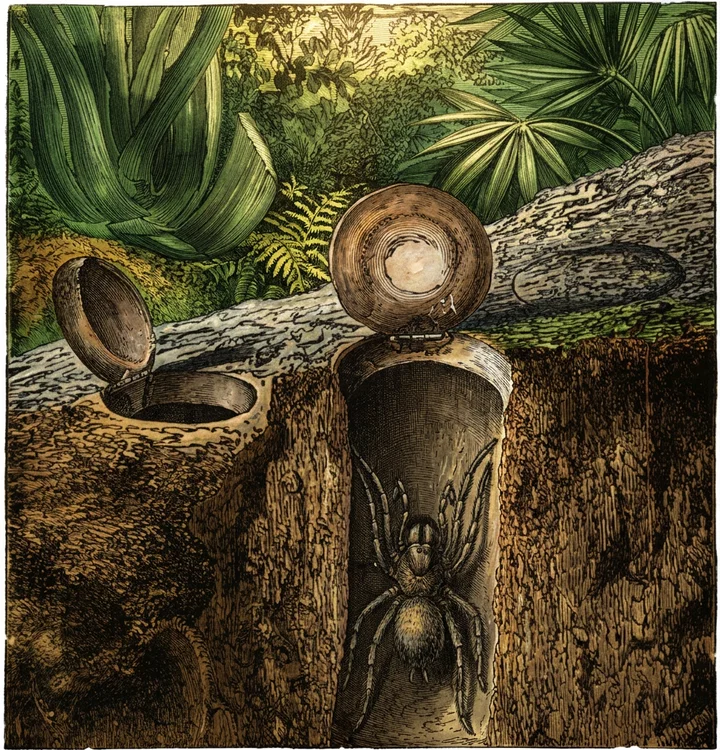
But all spiders do not live in webs nor use their silk for the same purpose. Some, like the one in the picture, build their houses in the ground. These they line with a silken tube, forming at its entrance a movable lid, composed of earth and silk, and attached to the silken lining by a sort of hinge. This cover closes whenever the spider enters or leaves the house, and so perfectly does it fit that when closed, its existence would hardly be detected.
This kind is called the Mining Spider, and is found in the south of Europe. Some species use their silken threads merely to wind around their victims, and others to travel by. They descend by their thread head downward, but climb up on it head upward, rolling it into a ball during the ascent. When they wish to go from tree to tree, some let go a thread in the direction of the wind, and when their delicate sense of touch tells them it has reached the object, they pass over it. In this way they travel long distances without descending to the ground, their tiny cables being frequently seen in dewy mornings of spring or autumn. Some small gossamer spiders even speed through the air, buoyed up by their light threads.
These little creatures are very cleanly in their habits, spending much of their time in removing the dirt and dust from their bodies by means of tiny toothed combs and brushes, with which they are supplied by nature. Many curious stories are told of their ingenuity and intelligence. A prisoner in the Bastile so nearly tamed a spider that at the call of a musical instrument he would come to devour the flies caught for him by the prisoner. Many attempts have been made to use their silk in manufacturing, but without success. But though not proving useful in this direction, they are put to good service in some parts of South Africa, where they grow to a large size, and are gathered by the natives for food. C. H. G.