THE APOSTLE JOHN

14%

S. D. A. Publishing Association · Battle Creek, Mich. · Nov 29, 1882

FromThe Youth’s Instructor, Vol. 30, No. 48.

Read the full edition

THE APOSTLE JOHN.

AMONG the most favored of our Lord’s disciples were James and John, sons of Zebedee and Salome. Their father was a fisherman, living at Bethsaida on the shore of the Sea of Galilee, and his sons followed his occupation until our Lord, at the beginning of his ministry called them to follow him, and become “fishers of men.” They then left their nets in the boat with their father and his hired servants, and, together with their partners, Simon Peter and Andrew his brother, accompanied Jesus on his travels. In the Bible record of the choosing of the twelve apostles, the names of Peter, James, and John are mentioned first, and these three seem to have enjoyed special honors and privileges. They alone witnessed the transfiguration of Christ, and they alone saw his agony in the garden. James and John were especially zealous for their Master, and it was probably on this account that “he surnamed them Boanerges, which is, The sons of thunder.”
healing the sick, and carrying the news of salvation through Christ to those outside of Jerusalem. Twice they were imprisoned together, and once “the angel of the Lord by night opened the prison doors and brought them forth.” In the midst of these persecutions, the life of John was saddened by the martyrdom of his brother James, who was the first of the twelve to suffer death in the service of his Master.
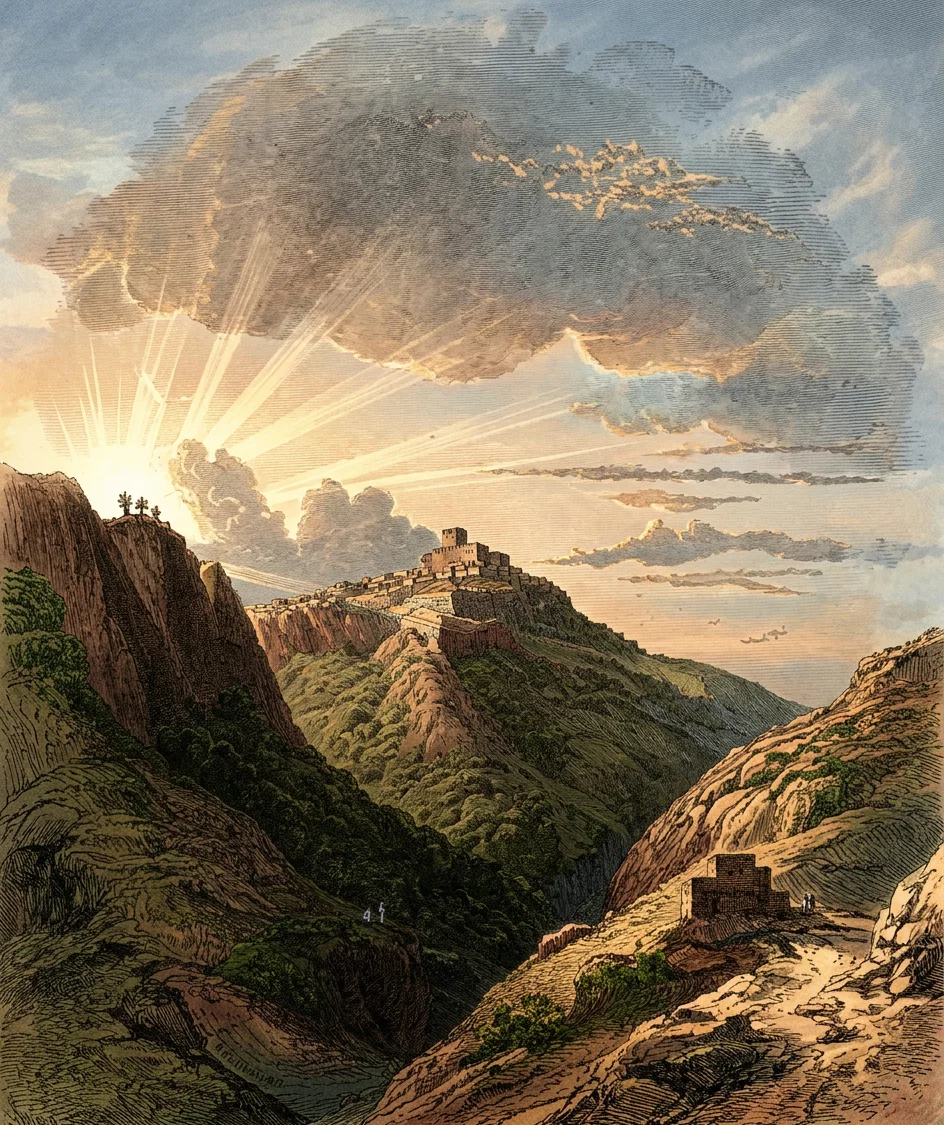
ISLE OF PATMOS.Restored with AI
ISLE OF PATMOS.
John remained in Jerusalem for many years, a pillar of the church there. He at length removed to Ephesus, though at just what time is uncertain. Here he spent many years in laboring among the churches of Asia Minor. Under the cruel persecution of Christians by the Emperor Domitian, the life of John was sought in many ways. It is said that at one time he was cast into a caldron of boiling oil, but was miraculously preserved from injury. He was afterwards banished to the Isle of Patmos, where he was put to hard labor in the mines. Patmos is a rocky, desolate island rising out of the Archipelago, or Ægean Sea. It is about twenty-eight miles in circumference, with bold, deeply indented shores, and was used by the Romans as a place of banishment for criminals. The principal town is situated on a high and steep hill, now crowned by a fortress-like building called the Monastery of St. John. Half-way down this hill is a natural grotto overlooking the sea, where tradition tells us John saw the wonderful vision recorded in the book of Revelation.
John afterwards returned to Ephesus, where he lived to a very great age, so that he could scarcely go to the assembly of the church without being carried there by his disciples. Being now unable to make long discourses, his custom was to say in all meetings, “Little children, love one another.” And when they wondered at the frequent repetition of these words, he was wont to answer: “This is what the Lord commands you; and this, if you do it, is sufficient.” There is some dispute about the exact date of his death, but it was probably about 100 A. D. He was no doubt buried just outside the city of Ephesus, as several ancient historians speak of his tomb as being there in their day. C. H. G.
Restored with AI