HUMBLE-BEES

10%

S. D. A. Publishing Association · Battle Creek, Mich. · Aug 30, 1882

FromThe Youth’s Instructor, Vol. 30, No. 35.

Read the full edition

HUMBLE-BEES

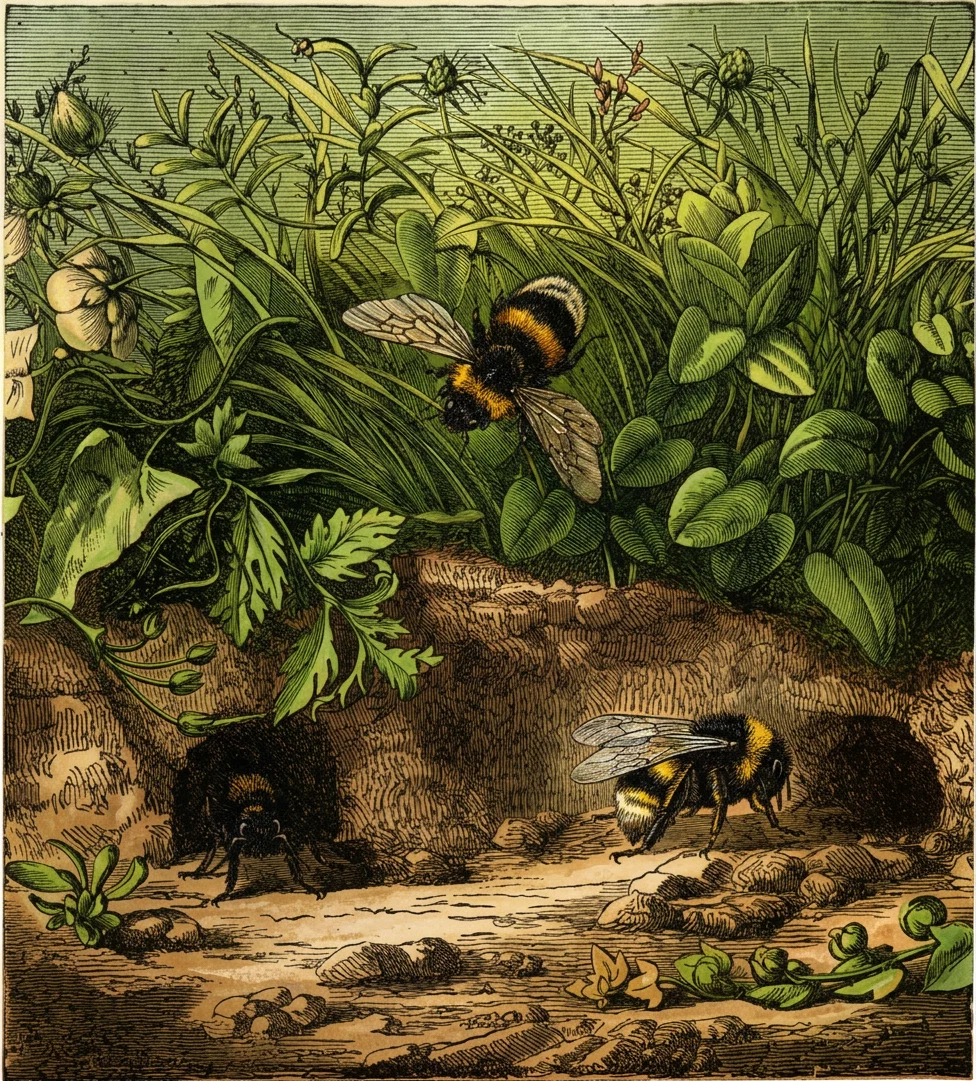
Perhaps one of the most interesting studies in connection with the animal kingdom is that of bees and their habits. Many learned men have spent hours in watching the little creatures, especially “hive bees.” To help them in doing this, glass hives have been made, through which all their curious movements can be easily seen. The picture gives a view of another class of bees, which all will recognize as “humble-bees,” or as they are often called by school-children, “bumble-bees.” There is less known concerning the habits of this class, than of the hive bees, but perhaps if they could be watched, their ways would prove as interesting as those of their neighbors.
Restored with AI
Humble-bees are easily distinguished from hive bees, by their much larger size, their hairy bodies, and the peculiar humming noise which they make as they are flying from place to place in search of honey. They always live in families, or societies, numbering from fifty to two or three hundred. In the fall all but five or six out of each of these large families perish. Each of the few survivors that remain over winter, founds a new colony in the spring. At that time it is a common thing to see single humble-bees prying into every hole and crevice in the earth, searching for a place in which to make their summer home. These they usually build in the earth, at a depth of from one to two feet, in meadows and plains. Often, however, they make their nests in stone piles, brush heaps, piles of old straw, and places of like character. Their favorite home is in the side of some bank, into which they will burrow, and store their food. Here they adorn their house with moss, fastening it to the ceiling and walls with a kind of wax which they have the power to make. The bottom they strew with leaves, on which are placed irregularly shaped brown wax cells, which are to contain their young, and afterward their honey. The entrance to these retreats are oftentimes long, winding tunnels, which enable them to defend themselves and their young from their enemies. For bees, as well as other animals, have enemies. In the meadows their nests are made somewhat differently. There they make a hole in the ground, wider than it is deep. With the dirt they take out, aided by wax and moss, they build a dome over the excavation. Then they line and carpet it as before stated.
There is one class of humble-bees, called “carders,” that have a very amusing way of building. The dry grass and shreds of moss of which their nest is built, after being carded, or worked into rolls, is pushed by the first bee back to a second, which passes it to a third, and so on till the nest is reached. They work in long lines, the head being turned away from the nest and toward the place where they get their material. Their domes are often seen rising four or six inches above the level of the fields and meadows.
The brown wax cells first contain the young, which are liberated by the old ones gnawing at the cells. The empty cells are then filled with a kind of honey, which quite resembles hive honey in sweetness and fragrance. They obtain it by licking the sweet juices from flowers, and storing them in a little bag which they bear. When this bag is full, they return to the nest, and empty it into a cell, closing the mouth of the cell with wax when full. As the majority of the bees do not survive the winter, the nest is seldom used a second time.
As a general thing, humble-bees are quiet and harmless, though those known as the “orange-tailed humble-bees,” are quite fierce, and possess a powerful sting, which they use very freely whenever they imagine their rights have been invaded upon.
There is a class of humble-bees in Egypt, called the “banded bee,” which are raised for their honey. They are kept on board of boats, which float up and down the river Nile, so as to allow the bees to gather honey from the flowers along the banks.
C. R. G.
Restored with AI