OVER THE HILLS

5%

S. D. A. Publishing Association · Battle Creek, Mich. · Feb 28, 1883

FromThe Youth’s Instructor, Vol. 31, No. 9.

Read the full edition

OVER THE HILLS.

LET us suppose, that we are many, many miles from here, away over the seas; no matter just now how we came here, but we will have a fine time to-day riding among the hills.
Rajah has just gone for the mules; and when he gets them saddled, we’ll start, and leave the others to pack up the tent and come by-and-by.
Restored with AI
This is a nice morning for a ride; the sun is bright, and the air clear. Hark! do you hear that bird singing away up in the top of that tall tree? He’s glad it’s a fine morning, too.
Here come the mules; now let us start. Rajah must go to show us the way, so we will not get lost. We are going to a little village, and will pitch our tent outside, and stay all night. It will take us about two hours to get there; but if you will keep your eyes open, you may be able to see the houses quite a while before we come to them.
Do you see the nice fields of wheat and barley on each side of the road? The people tend them well, don’t they?
“What are those small trees growing up near that pile of rocks?”
Why, those are wild olives. Rajah says that pretty soon we shall come to a place where the cultivated olives grow. The only difference between them is that the wild olives are not so good as those that people raise. The blossoms, as you see by this tree at your side, are yellow when they first come out, but by-and-by they will turn white, with a yellow center. The fruit looks like a plum, and when ripe, is black. The olive oil that we get in America, is made from fruit like this.
“Can people raise this tree in America?”
Yes; in the southern part of California, where it is warm all the year, they raise a great many olive trees.
“The trees just ahead of us look like the oak trees that grew on grandpa’s farm.”
They are oak trees; and you will see many of them around here, though they are not so large as those at home.
Now we have come into a broader part of the valley, and after we get past these few high hills, keep a sharp lookout to see something new.
“Oh, I see; it’s the town! What a queer looking place!”
Yes; it is different from American towns. Here comes a man with a pair of loaded mules; perhaps he is going to his home among the hills, or may be he will sell his stuff in a neighboring town. He has on a long flowing robe and a turban of gay cloth wound around his head. His shoes are odd looking, too; they are just broad, thick soles tied on with strings. All the people wear them, and call them sandals.
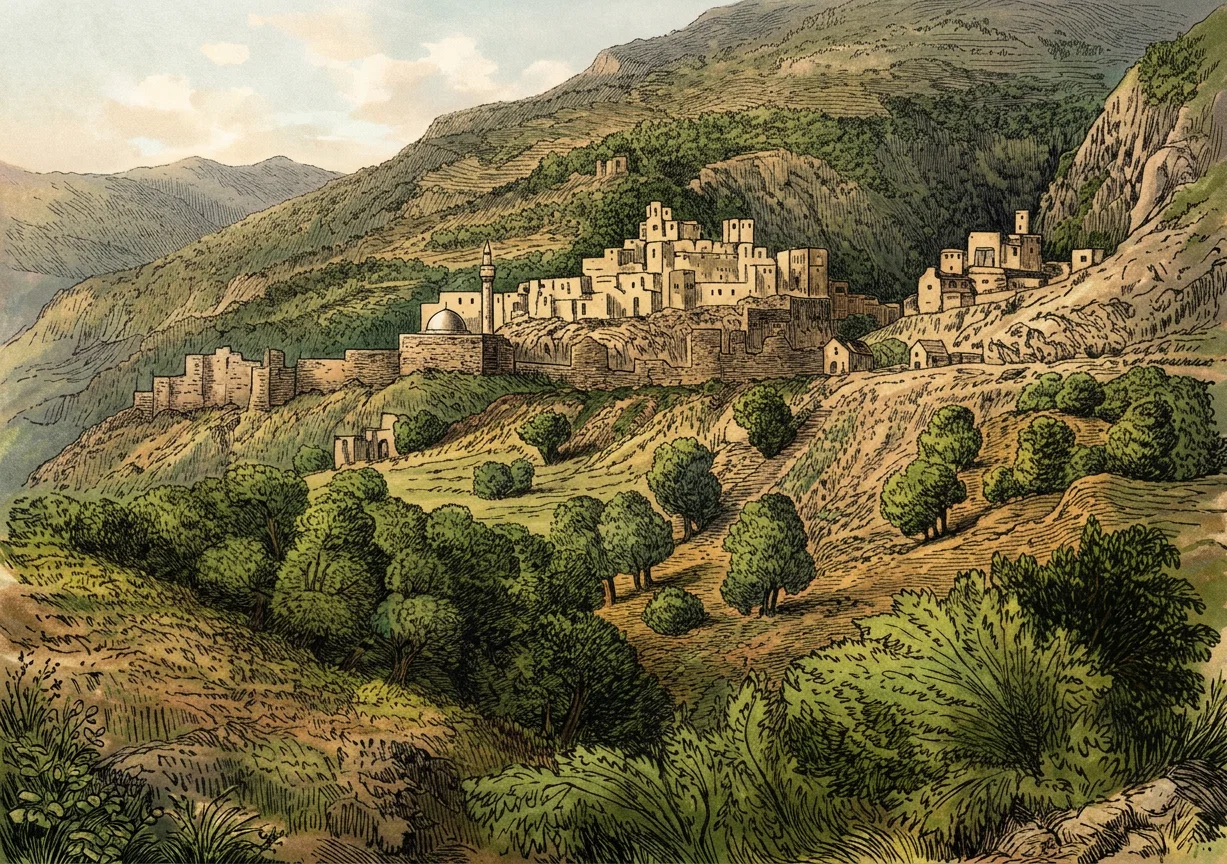
Now we are near enough to the town so that you can see the houses plainly. They look very neat and clean. You see they are square, and built of whitish stone. As we ride through the main street of the village, it doesn’t look so clean as it did farther off; for the streets are all narrow, and quite dirty.
Since we have been riding so far, we will leave the mules with Rajah, and go up the hill,—for the village is built on the side of a hill and in a valley,—and get a drink from the fountain. The people do not have wells in their door-yards, but there is one large fountain in the village, and all carry their jars there to fill them. Here comes a woman with an earthen jar full of water on her head. You will see a good many women and girls with these on their heads or their shoulders.
This is the fountain, and as there are a number of women coming, we will wait here awhile and watch them. They are much better looking than the women where we camped last night, don’t you think so? Rajah told me the women of this town were prettier than those of any town around here.
I had forgotten to tell you the name of this place; may be Rajah told you. It is Nazareth. There is nothing in the town itself so very pretty, but it is made interesting by a wonderful little boy who lived and grew up here a long time ago. His father was a carpenter, and built houses like these.
If you are ready, we will get another drink of this cool, soft water, and then go and see if the tent has come. While Rajah is putting up the tent, you may get your Bibles, and see if you cannot find something about this little boy; and in the morning, when we go up to the fountain again, we will talk more about him.
W. E. L.