About nine miles above St. Paul, Minnesota, and about half a mile from the Mississippi River on the west side, are the beautiful and widely renowned Falls of “Minnehaha,” in a small river bearing the same name. The accompanying picture gives but a poor idea of this beautiful water-fall.
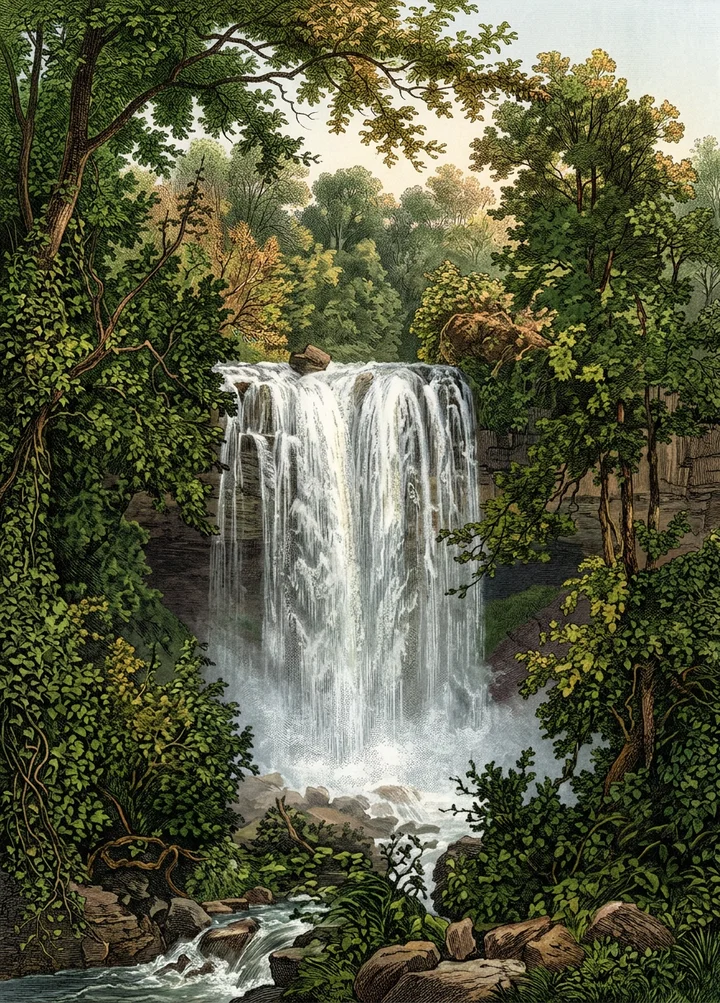
A semi-circular limestone cliff forms the brink of the falls, and partly encircles a chasm, or basin, into which the water plunges and flows away in a narrow, rapid stream. At the brink, the sheet of water is said to be about eighty feet in width, and it is about sixty feet in perpendicular descent, and is so thin, and in such a constant quiver, as to suggest the idea of the shaking out of the folds of white lace, and fully justifies the beautiful appellation, Minnehaha (Laughing Water.)
A flight of sixty-one steps leads down to the bottom of the chasm, where a small bridge crosses the river a few rods below the falls. The sandrock underlaying the limestone cliff has been so worn away that one who has sufficient nerve to do it may pass completely round behind the falls.
The pleasing and yet sad traditions associated with the place, and the picturesque scenery surrounding it, rendered it a sacred and favorite camping-ground of the Indian in the past, and now make it a popular place of resort for the race that has supplanted him in its possession. Longfellow, in his poem entitled “Hiawatha,” relates an Indian tradition in which a young Ojibwa brave is represented as having won as his bride a beautiful Dakota maiden, whose father, an arrow-maker, lived near the falls whose name she bore:—
- *
“There the ancient arrow-maker Made his arrow-heads of sandstone, Arrow-heads of chalcedony, Arrow-heads of flint and jasper, Smoothed and sharpened at the edges, Hard and polished, keen and costly.
“With him dwelt his dark-eyed daughter, Wayward as the Minnehaha, With her moods of shade and sunshine, Eyes that smiled and frowned alternate, Feet as rapid as the river, Tresses flowing like the water, And as musical a laughter; And he named her from the river, From the water-fall he named her, Minnehaha, Laughing Water.”
But those who figured in the traditions circling round the sacred name have long since gone to the “happy hunting grounds,” and other feet tread within the precincts of the hallowed place. From this scene of beauty, we revert, in thought, to that happy land of which the poor Indian has such rude conceptions, where no shadow shall dim, and no sorrow circle around the lovely places of the earth. Reader, will you be there? A. SMITH.