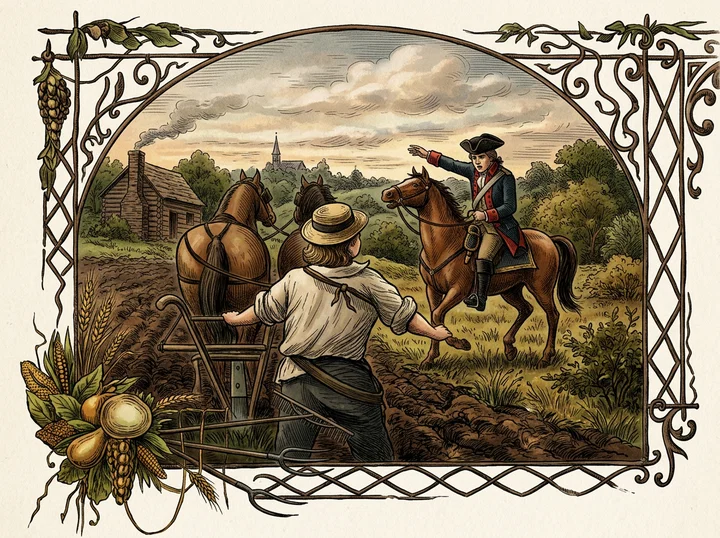
Perhaps you will think this is an odd little picture, and that there is not much about it to interest you,—only a boy plowing and a man on horseback talking to him. But when I have told you a little story, perhaps you will see more in the picture.
Many years ago our fore-fathers left England and came to America, which was then all one great forest. They landed at different places along the coast, and made themselves homes in the wilderness. Some of them came that they might find a place to worship God as they thought right. You were told a few weeks ago about one colony of them, who came over in the Mayflower, and settled at Plymouth, and how they kept their first Thanksgiving. Others came because they thought there would be more chance for poor men in a new country where land could be had for nothing.
Though so far away from England, these colonists were still British subjects, and had to do just as the king of England said. At first they were so few and weak that he paid little attention to them; but after a while they began to prosper, and to clear large farms, and build villages and cities. Then the king sent men to rule over them, and to make them pay taxes to help him carry on wars, and enable him to live in luxury. These governors were many of them very cruel and unjust, and by the consent and wish of the king of England, they troubled and harassed the colonists in every way they could think of.
Finally the people would stand it no longer, and made up their minds to have a government of their own, and be independent of England. This of course led to a war with the British, who were not at all willing to give up their rule over the colonists. Now the British had large, standing armies all ready for war, and plenty of money to help them, while the colonists had only themselves and very poor weapons. When it was decided to try to raise an army to fight the English, messengers were sent all through the colonists to rouse the men for war. There was no time to lose, and men left their work just where it was,—their corn half hoed, the plow in the furrow,—and bidding their families a hasty good-bye, started off “to whip the British.” In the picture, the messenger has just come to the boy who is plowing in the field, and he will away to the house to tell his father and brothers.
Well, it was a longer and harder struggle than either the British or the Americans had supposed it would be. The colonists had many hardships to endure, and often suffered from cold and hunger; but the thought that they were fighting for their homes and the liberty of their dear ones made them very brave and daring. At last, after eight years, the British were driven away, and the men still living could go home to their families once more. What a happy time that must have been, when fathers, husbands, and brothers came marching home with the glad news, “The British are beaten, and we are free!”
Ever since then we have been a free nation. But while we enjoy the blessings of liberty, we must not forget that our fore-fathers fought and bled and died to gain us this freedom. If you will read the history of the Revolutionary War when you are older, you will learn many more things than I have room to tell you here. E. B. G.