THE Dead Sea fills up the southern end of the Jordan valley. The mountain chains which shut in the valley become here steeper, wilder, and bleaker. In some places they rise in lofty precipices of naked rock from the bosom of the waters; in others they retire, forming wild nooks and yawning ravines, fitting homes for the wild goats which still inhabit them. The scenery of the lake is bare and desolate, but grand. The water is clear and sparkling, a deep and beautiful azure when the sky is cloudless, but reflecting vividly every changing hue of the firmament. In summer, when the heat is intense, a thin, whitish, quivering vapor hangs over the surface of the water, and gives a strange dreamy indistinctness to the mountains. At the northern and southern ends, the flat plains are parched and barren, in part covered with fine sand, and in part with a white nitrous coating like hoar frost. Brackish and sulphur springs occur at intervals around the whole borders of the lake. Some of them are warm, and send up clouds of steam. At one or two places along the western shore, and also at the southern end of the lake are slimy pools and marshes, whose exhalations of sulphuretted-hydrogen taint the atmosphere for miles. Strewn along the northern shore, especially near the mouth of the Jordan, lie large quantities of drift-wood, brought down by the swollen river, and it is everywhere encrusted with salt crystals. The great depression, the fierce rays of an unclouded sun, the white soil below reflecting the sun’s rays, give the whole basin of the Dead Sea a temperature like that of a furnace. Never did I suffer so much from intense, suffocating heat as during the days I spent on the shores of this lake.
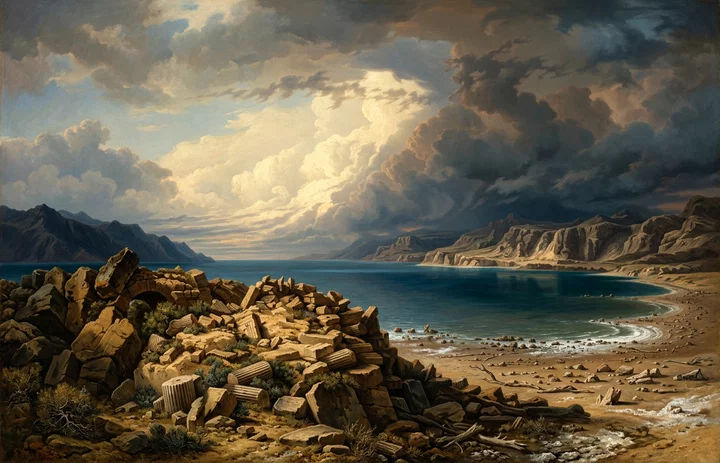
Yet still it cannot be called a “sea of death,” in that sense in which travelers in former ages were wont to represent it. It has been stated that no vegetation could exist along its shores, and that no bird could fly over it; that, in fact, its poisonous exhalations are fatal alike to animal and vegetable life. This is altogether untrue. At every little fountain along the shores, the vegetation has a tropical luxuriance. I have seen the oleander dipping its gorgeous flowers into the lake; and I have seen the willow and the tamarisk, and numerous other shrubs flourishing where their stems were at certain seasons immersed in the waters. The cane-brakes on the shore abound with wild fowl; and occasionally flocks of ducks may be seen swimming far out on the sea. The water, however, is intolerably salt and bitter, and no fish could live in it. Yet it is not altogether destitute of living creatures, a few inferior organizations having been found in it by recent naturalists. Its specific gravity is so great that the human body will not sink in it. I have tried it myself, and can, therefore, testify to the truth of the fact. This is easily accounted for. The weight of water increases in proportion to the quantity of salt it contains in solution. Ordinary sea-water has about four per cent of salt, whilst that of the Dead Sea contains more than twenty-six per cent.
—Porter.
This sea is forty geographical miles in length, and its greatest width is nine miles, although these dimensions vary somewhat according to the time of the year. Its greatest depth is about thirteen hundred feet; and the surface of the sea is some thirteen hundred feet below the level of the Mediterranean Sea, thus making it the most depressed sheet of water in the world. For this reason it can have no outlet; but though the Jordan and its tributaries daily pour an immense amount of water into the sea, the evaporation is amply sufficient to carry off the supply.