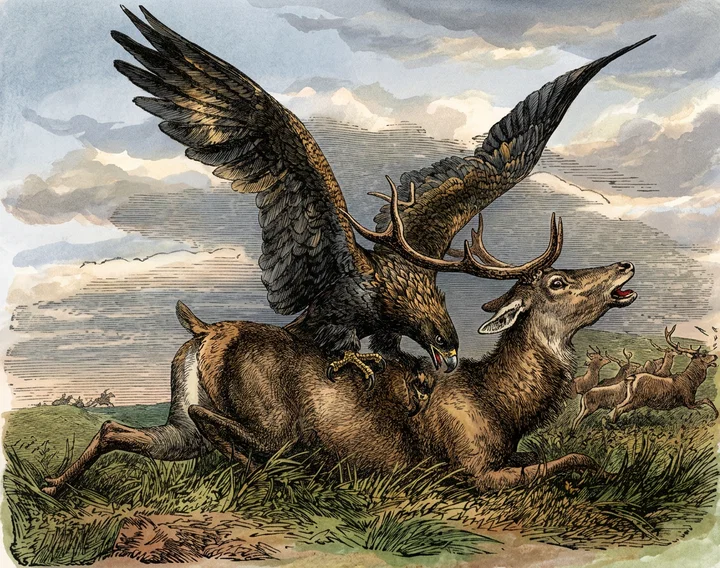
Here we have a picture of the eagle, the king of birds. Would you not like to hear something about him? Eagles are very large birds, quite often measuring three and one-half feet from the head to the tail, and nine feet from the tip of one wing to the other. You can see in the picture that they have very strong, hooked beaks, and powerful claws. The tail is short and stiff, and their legs are feathered down to the toes. The head and neck are so thickly covered with feathers that they come out over the eyes, making a kind of roof to protect them from the sun. The beak is covered at its base by a yellow skin, and in this skin are the nostrils, through which the bird breathes. You can see them in the picture.
Did you ever watch a bird asleep, and see how well he kept his balance, and did not fall off from his round perch? And you have often wondered how he could sit there so easily, haven’t you?
Perhaps you have watched some of your hens when they were walking across the barn-yard. If so, you have noticed that when biddy raised her leg, her toes all drew in, and that as soon as she put her leg down straight, her toes all flattened out again. People who have studied a great deal about birds and fowls tell us that the cords in a bird’s leg are so fixed that when he bends his leg, he cannot keep his toes straight if he should want to, and that when he puts his leg out straight, his toes will straighten out too.
Now, when the bird is asleep on his perch, his weight bends his legs, and so makes his toes curl round the roost all the tighter; and the sounder asleep the bird gets, the tighter he will cling to his perch.
This curious power of his claws is what enables the eagle to hold his prey so firmly. When he is away up almost out of sight, he can see down on the plain, and know when there is anything there for him to eat. Should he see any game, he comes down so silently and rapidly that he captures his prey before they are aware. If you look in the picture, you may see the hunters in the distance, almost specks, they are so far away. They are on a deer hunt, and the eagle is on one, too. He has probably been sailing up above the hunters’ heads for a long time, watching for a chance to get a meal. At length he pounces down upon this deer. He strikes his claws, or talons, as they are called, into the deer, and sinking down with all his weight, clasps them far into the sides of the animal. He does not let go his hold until the deer has ceased to breathe; then he commences to tear him to pieces. The eagle’s mate is probably close by to help him eat the deer. The eagle hardly ever uses his beak to kill his prey.
He is very fond of fish, but is not a good fisher, so he steals from other birds. Soaring far above a river or lake, he sees below him a company of fish hawks quietly fishing in the water. With a piercing scream the eagle swoops down and lights on the top of a tall tree. He keeps quiet now, and the fish hawks think there is no danger. Watching his chance, he soon sees a fish hawk rising out of the water with a silvery fish in his claws. Suddenly darting toward the fish, the eagle seizes it in his talons, and flies away with his prize. He is so much stronger than the hawk that the poor bird is glad to get rid of his enemy so easily.
Eagles build very curious nests. They usually choose for a building spot some ledge of rock or the top of a tall pine, where nothing can climb up to disturb them. Their nests are made of sticks rudely put together, with an inside lining of moss or hay. They do not build new nests every year, as many birds do, but come back to the old one, and build another on top of that, so that after a time their nests are piled up several feet deep.
They lay but two or three eggs. The little eaglets are rather homely, the beak and claws being much larger accordingly than the rest of the body. The eagle is very good to his family, and keeps them well supplied with food. He never quarrels with his wife, and they live together to a great age very happily. W. E. L.