Written for the INSTRUCTOR.
HERALDS OF SPRING.
At the close of the long dreary winter, with what delight is heard the twitter of the first robin swinging in the tree-top. Perhaps it is days or even weeks before another song is heard, and then he comes, bringing with him a host of his relatives and friends. Now we know that the reign of the winter king is over, though he at times disputes the milder sway of the south wind by sending little flurries of snow and chilling blasts. Yet the warm breath of the spring will finally drive the stormy old man in his tattered robes back to his home among the icebergs.
Not alone by the return of the feathered tribe is spring heralded. The buds of the maple swell and burst into bloom. The flowers are so small that many never notice them; yet when viewed under the microscope, they are as beautiful as a rose. The beech trees and the oaks begin to put forth tiny buds, and the bare scraggy forest dons a dress of the most delicate pink, yellow, and green.
The little flowers, that have lain all winter under their blanket of leaves, waiting for the south wind to wake them from their sleep, open their drowsy eyes. Let us take a short ramble among the forest trees to see what spring has brought us.
There, down close by the roots of the trees, as if clinging to them for protection, blossoms the little blue liverleaf, the first among early spring flowers. You may know it by its three-lobed leaves that have kept green all winter. Near by, sheltered by friendly bushes, nod the pale anemones to their delicate cousins, the wind-flowers. They look so much alike that they might almost be taken for the same plant, yet a close examination shows a difference in the finely cut leaves. The anemone generally bears but one flower, while the wind-flower has a cluster of blossoms, and so delicate are they that a rough touch is sufficient to scatter the snow-white petals.
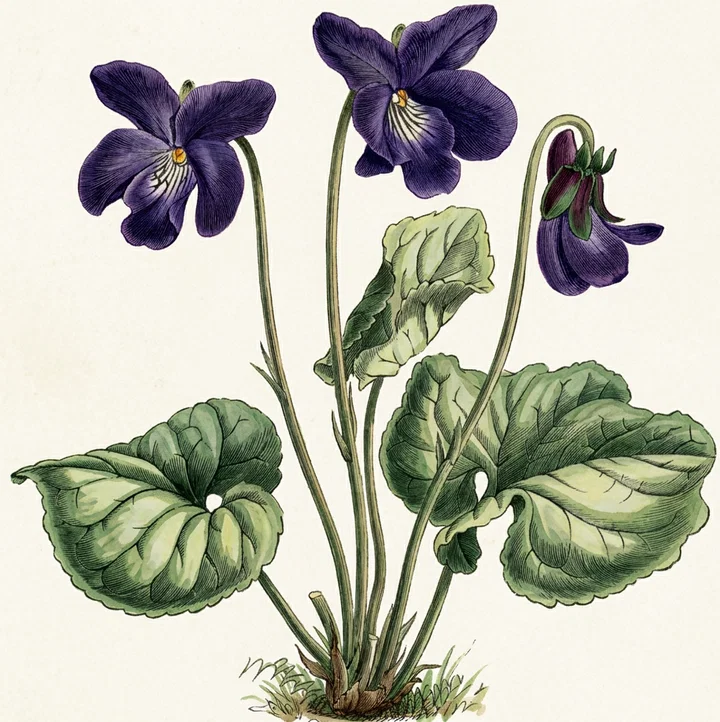
By the brook-side grows the water-cress, and the cross-shaped flowers of the crinkleroot. Farther on, the violets, with their almost human faces, peep out from sheltering green leaves. Here we find several kinds, growing side by side like brothers and sisters,—yellow, white, and blue,—most of them with rolling green leaves, and a few light blue ones with the green leaves slashed up, looking not unlike birds’ claws. In the picture on this page is a good representation of the common blue violet. Here is a large bunch, and we’ll
“Pluck the violets blue,— Ah, pluck not a few! Knowest thou what good thoughts from heaven the violet instills?”
The spice-bush fills the air with its fragrant odor. The bloodroot, growing near the old stone, opens its dainty white blossoms and broad leaves in the warm sunshine. On digging up a plant, the running rootstock seems almost as hard as a bone, while the juices drop from the wounded part red as blood, thus giving this curious plant its name.
Very beautiful after the winter snow is this resurrection of the flowers, yet how many people pass heedlessly by all these tokens of a Father’s tender care! May we learn to find the hidden lessons in the flowers, “sermons in stones, and good in everything” that God has made.
“Not useless are ye, flowers, though made for pleasure, Blooming o’er hill and dale, by day and night; On every side your sanction bids us treasure Harmless delight!”
“Your voiceless lips, O flowers! are living preachers; Each cup a pulpit, and each leaf a book, Supplying to the fancy numerous teachers, In loneliest nook.”
W. E. L.