It was nearing the noon of a bright day in June, and the sun of that Eastern clime shone with all its wonted strength, when a company of men might have been seen wending their way on foot along a dusty and well-traveled road. One among their number they appear to regard as a kind of leader, and all seem to listen eagerly to his every word. As, one after another of them has occasion to ask him some question, he is addressed as “Master.”
Their road at first leads through a hilly country, and valleys and hillsides are decked with a profusion of wild flowers of the brightest colors; while dashing little brooks hurry down the declivities. In the fields the husbandmen are toiling; some of the hill-sides are terraced and planted to grapes, while on others, more rough and stony, sheep and goats are pastured. As they journey, numerous small villages look down upon them from their perches on the hill-sides.
At last, after leaving the hilly country and traveling for a few miles over a pretty little plain, their road makes a turn to the left, and enters a narrow valley, which passes between two mountains, Ebal and Gerizim, the same which Moses, the great law-giver, saw from Mount Pisgah’s height, and pointed out as the place where the blessings and curses should be pronounced.
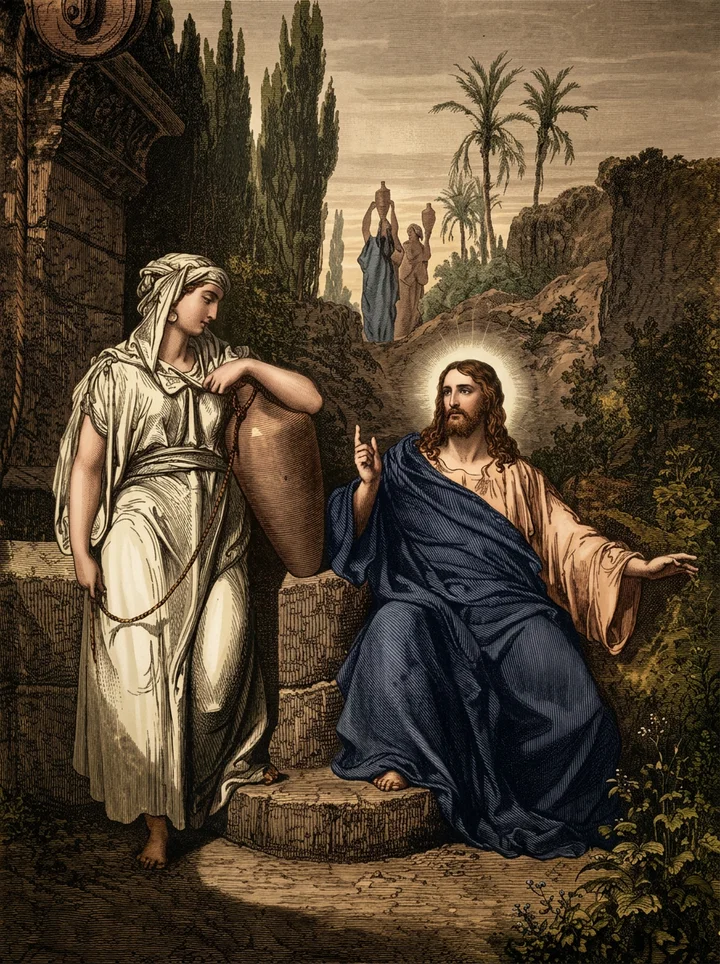
When the patriarch Jacob returned from Padanaram, with wives, children, and herds, he made his first tarrying-place in this valley of Shechem; and though it abounds in flowing fountains, he there dug the well which still bears his name, at the foot of Mount Gerizim, just where the road turns. When our travelers come to this well, they stop to drink of the clear, cool water; and being “wearied with his journey,” the “Master” rests here on the curb of the well, while his followers go to a town nearly a mile farther down the valley to buy some food for their dinner.
It was now about noon, at which time the women of the city were accustomed to come to the well to draw water, for they thought there was no water so good as that from the well their father Jacob had dug. And there came a Samaritan woman to the well, with her pitcher in her hand; and the weary traveler asked her to give him a drink. This led to a conversation between them, during which he told her so many things about her past life that she said to him, “Sir, I perceive that thou art a prophet.” He told her also of the water of life, of which if a man drank, he should never thirst again. She seemed much perplexed to know what he really meant; and finally, as if to quiet her own doubts, said, “I know that Messias cometh, which is called Christ; when he is come, he will tell us all things.” And to her great surprise the traveler said, “I that speak unto thee am he.”
Just then the disciples returned with food, and wondered that their Master talked with the woman; but they said nothing. And the woman ran into the city and told her friends to come with her, and see a man who had told her all things that ever she did. She soon returned to the well, followed by a company of Samaritans, who besought Jesus so earnestly that he returned with them to their city, Sychar, where he tarried two days, and taught them. The result was that many of the people of the city believed in Christ as the Saviour of the world. So it came to pass that the Samaritan woman, coming to the well to draw water, found for herself and the people of her town the water of everlasting life.
At the return of the Jews from captivity in Babylon, there arose a feud between them and the Samaritans because the latter were not allowed to help in rebuilding the temple. This had grown more and more bitter from age to age, until in the time of Christ “the Jews had no dealings with the Samaritans.” It was usual for the Jews in traveling from Judea to Galilee, to cross the Jordan and go through Perea, the land east of the river, in order to avoid the hated Samaritans, who had often attacked and even killed the Galilean Jews who ventured to pass through the country on their way to the Passover. But Jesus had good reason at this time for passing through Samaria. He had a message for some of these very people. There were chosen ones of God in Sychar who were to be led by him to a knowledge ofp. 66 eternal life. It was here, too, that he taught to all mankind that grand lesson of human equality, and spoke those sublime words which can never grow old: “God is a Spirit, and they that worship him must worship him in spirit and in truth.”
“By the well-side, O my Father, Let me drink and drink again, Of the water Jesus gives me, From the never-failing spring.”
E. B. G.