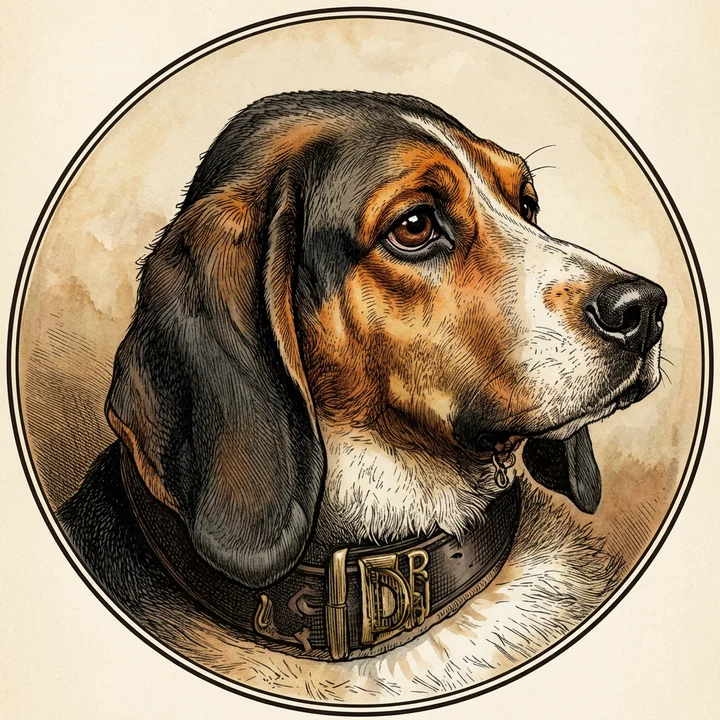
WHAT a noble-looking dog this is! He looks up at you with his great brown eyes just as if he were ready to speak. He looks something like a hound; for his ears are long and drooping, his nose is quite long, and the shape of his head and mouth is like a hound’s. A full-blooded hound, however, has close, short hair. All dogs do not look like this one. The greyhound has a longer and more pointed nose, and a narrow head. His hair is short and fine, and of a gray color. The Italian greyhound is small and delicate; and many ladies have him for their pet parlor dog.
The blood-hound is larger and stronger than the greyhound, and is quite savage. These dogs are noted for their keen scent, and when they once get on the track of game, they do not give up until they have found what they are looking for. When the people who lived in the South kept slaves, they had large packs of blood-hounds with which they used to hunt out and capture slaves who tried to run away to the North for their freedom. These dogs are so strong and run so fast that they can tire out a horse. If they are looking for some lost person, and have had a smell of his shoes or clothes, away they go, sniffing along the ground till they find him, no matter how many people have walked over the same ground since that person has.
Another very useful dog is the St. Bernard, or Alpine dog. The monks who live in the convent of St. Bernard on a high mountain in Switzerland, where the snow is deep, find these dogs very useful in hunting for travelers who have lost their way on the mountains. The dogs start from the convent in pairs, one having a cloak strapped to his back, and the other a small flask of wine fastened to his neck. When they find the traveler half perishing with the cold, they arouse him, and lead him back to the convent. If he has fallen, and been covered up by the snow, they can find him by their keen scent, and will paw him out, all the while barking till the monks in the convent a mile off hear and come to help them. One of these dogs, who died in trying to save a frozen man, had saved twenty-two lives.
Far to the north, in the Arctic regions, where there is snow and ice all the year, people use dogs for horses. These dogs look so much like wolves that even their owners can hardly tell the difference. They are not gentle like the dogs we have. Six or more of these dogs are hitched to a sledge, and are guided by the voice of their leader. One traveler says that six of these dogs drew him on a heavily loaded sledge, in two weeks, between seven and eight hundred miles. He says he never heard the Esquimaux speak in any but sharp, harsh tones to their dogs, and that for this reason the dogs are cross and hard to manage.
In hilly countries where a great many sheep are raised, the shepherd dog is very common. These are large, shaggy dogs, very courageous and powerful. They have been so carefully trained that two such dogs could take care of a large flock of sheep, bringing them all back to the fold safely at night-fall. They will even kill a large wolf if he tries to harm any of their sheep.
Then there is the well-known Newfoundland dog. These are fine dogs to have, because they are so good-natured and patient. They are large and shaggy, and of a black and white color. They know a great deal, and many interesting stories are told about them. A lady who had one of these Newfoundland dogs, was one day taken very sick. She was alone, and did not know how to let her husband know that she wanted him. At last she wrote a note, and putting it in the dog’s mouth told him to take it to the store where her husband worked. In a few minutes he came back with the gentleman and a doctor. This same dog was very careful not to let any stranger touch his master’s things, and one day when a wood-cutter came to split the wood, he had to leave the work undone because the dog would not let him touch the axe.
The people who lived in Egypt when the Israelites were there, used to worship the dog. They built the city of Cynopolis in his honor, and worshiped him there. They used to sacrifice certain kinds of dogs, and then wrap their bodies in linen cloth with rich spices, thus embalming them the same as they did the people when they died. Some of these dog-mummies are still to be seen in Egypt.
W. E. L.