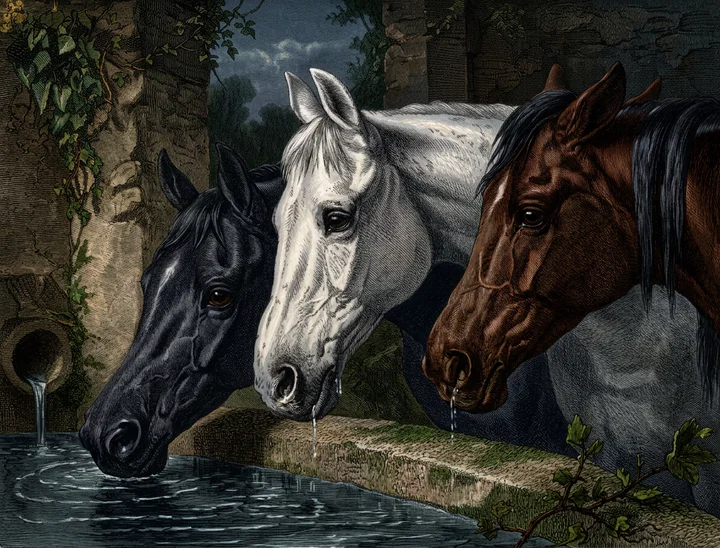
HORSES are found in every quarter of the globe, and in some countries vast herds of them run wild on the plains. These herds sometimes number many thousands, and are subdivided into several companies, each having a leader, while one acts as commander of the whole herd. This “commander-in-chief” is able in some unaccountable way to give orders to his followers; and when moving from one grazing ground to another, the herd presents the appearance of an army, each leader heading his proper line and keeping it in order. It is necessary for them to preserve this discipline for their protection. If they straggled off, each in a separate way, they would fall an easy prey to their enemies,—the wolves, pumas, and jaguars, which sometimes attack them even when in droves.
In Tartary, horse-hunting is a very common sport. The animals are captured by the aid of a falcon, which is trained to settle on a horse’s head, and flutter his wings about its face, until the hunter comes up to secure his prize. Not only do the Tartars ride their horses, but they drink their milk, and eat their flesh, so that a horse-hunt is often conducted as a food-procuring expedition.

The wild horses found on American prairies are called mustangs. They are used mostly for saddle horses, and are extremely tough and enduring. They are usually caught by the aid of the lasso. This is a long rope with a slipping noose at one end. A rider will throw a lasso quite a distance with such exactness that the noose will fall over the head of a mustang, and fasten around its neck. The more he plunges and pulls, the tighter the noose draws; he strangles, and after a time is thrown, when he is in the power of his captor.
There are as many different kinds of horses as there are uses to which they can be put. Most noted for swiftness is the Arabian horse. Its body is very light, its neck long and arched, its eye full and soft, and its limbs delicate and slender. This class is the one generally used in England for racers. Another horse highly prized in that country is the hunter. The body of the hunter should not be so long as that of the racer, and requires greater compactness, so as not to be tired out by long rides over ploughed grounds. A comparatively large foot is required, in order to prevent its being destroyed by the rapid alternation of hard and soft ground which the animal is required to traverse. The low shoulders of the racer would be injurious in a hunter, on account of the trying leaps which it is often called upon to perform.
But one rarely wishes to ride more than eight or ten miles an hour, and on a journey not more than six or seven. Fast horses are not even in their speed; and although they can perform extraordinary feats, they are not good travelers on long distances. For all common uses, then, the hackney, or road horse, is far more valuable. This horse, though not speedy, is generally a pleasant traveler, and is safe, good tempered, and enduring.
A very elephant among horses is the English dray-horse. Its great size is not needed so much for the amount of pulling which it performs as to withstand the jolting or battering of the tongue or shafts that takes place on the paved streets of large cities. The dray-horse is a very slow animal, and its pace cannot be quickened even if the load be light. Its breast is very broad and its shoulders thick and upright, the body large and round, the legs short, and the feet extremely large.
The Shetland pony is the smallest of horses. It is a native of the Shetland Islands, which lie north of Shetland. There the ponies run wild, and may bep. 98 owned by any one who can catch them. For its size the Shetland pony is very strong, and has been known to trot forty miles in a day, with a man on its back.
The horse has from time immemorial been made the servant and companion of man. Besides being the most useful, it is also the most noble and beautiful of animals. By nature it is patient, kind, affectionate, and willing. It often shows an almost human attachment for the members of the family by whom it is owned, following them about the yard and the fields like a dog, placing its head on their shoulders as if to caress them, and allowing even the children to play around its feet, and mount its back two or three at a time. So attached does the Arabian horse become to its owner, that should he be thrown from its back, the animal will stand quietly until he gains strength to remount; and cases have been known in which, his master having been killed in battle or murdered in some wild place, the horse would stand guard over the body until, if not forcibly removed, he would himself pine away and die. The horse is also possessed of considerable intellectual power, having been trained to do very wonderful things, besides doing many clever things without being taught.
The Rev. J. G. Wood in a work on Natural History says: “The horse is mostly fierce because it is nervous, and bites and kicks, not because it is enraged, but because it is alarmed. Restore confidence, and the creature becomes quiet without any desire to use its hoofs and teeth in an aggressive manner.” There are few animals which are more affectionate than the horse, as will be acknowledged by any one who has possessed a favorite horse, and treated it with uniform kindness. The infliction of pain is a clumsy and barbarous manner of guiding a horse, and we shall never reap the full benefit of the animal until we have learned to respect its feelings, and to shun the infliction of torture as a brutal, a cowardly, and an unnecessary act. To maltreat a child is always held to be a cowardly and unmanly act; and it is equally cowardly and unworthy of the human character to maltreat a poor animal which has no possibility of revenge, no hope of redress, and no words to make its wrongs known. Pain is pain, whether inflicted on man or beast, and we are equally responsible in either case.”
In most of our large cities, societies for the prevention of cruelty to horses and other animals have been organized, and well named “Humane Societies.” Even little children have become enthusiastic members, and have done much in their way to help in bringing about kinder treatment for the poor, overworked horses who must daily, year in and year out, drag the street-cars, drays, and omnibuses up and down the streets, that men may ride and rest. Surely such kind servants should never receive cruelty or neglect at our hands.
C. H. G.