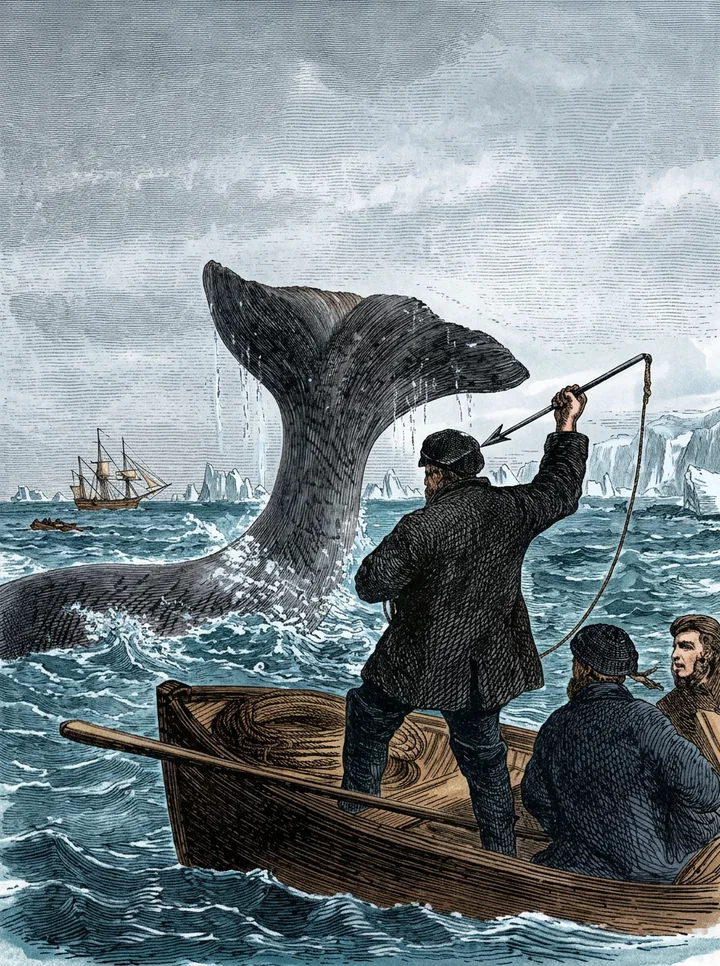
Probably most of the boys and girls who see the picture on this page will say to themselves, “My! what a great fish that is!” If so, they will make a mistake, for the whale is not a fish at all. Though he lives in the water, he cannot, like a fish, breathe under the surface, but has to come up to the top of the water, and there do what the sailors call “spout.” That is, he throws out water he has taken in, and breathes in his lungs full of fresh air. The stream of water which he throws out, goes up a long ways into the air, and makes a loud noise, so it can be heard and seen quite a distance off. Another difference between this animal and a fish is that the whale has legs. They are not of much use, however; for when a whale gets grounded on the shore, he cannot get away until the tide rises again, or some big wave comes rolling in and lifts him back to his proper home. The men seen in the picture are whalers, that is, men who spend their time in catching whales. Their ship is seen in the distance, and also another boatful of men who are coming to help catch the whale. As these ships go sailing through the northern seas, they keep a man on top of one of the masts to look out for whales. When he sees one spouting, he cries out, “There she spouts!” The sailors on deck at once shout back, “Where away?” The man at the masthead tells them which side of the ship the whale is on, and then the boats are lowered into the water, part of the crew leap into them, and off they pull in hot chase. They carry with them in the boat several stout poles pointed at one end with a sharp iron, and with a long rope fastened to the other end. These poles are called “harpoons.” When the men in the boat come up to the whale, one of them stands up and hurls a harpoon into its side. The frightened creature starts off over the water at a furious rate, dragging the boat after it by the rope hitched to the harpoon. It is often so angry with pain that it lashes the water into foam with its huge tail, and sometimes it hits the boat and dashes it in pieces, and then the men are often drowned. Sometimes the whale goes down, down into the deep ocean, hundreds of feet. This the sailors call “sounding.” When it sounds, the men let the rope run over the edge of the boat, knowing that the whale must come up soon to breathe. Every time they get a chance, the men send a new harpoon into the whale, and finally it becomes so weak from loss of blood that it is easily killed.
After the whale is captured, it is put to many uses. From its fat is made whale oil. From its tail, glue is made. And the whalebone, which you have all seen, is taken from the roof and sides of its huge mouth. This bone is boiled, and then colored black, as we see it. So we see that none of God’s creatures are made in vain. C. H. G.