THROUGH the center of Scotland runs from east to west the chain known as the Grampian Mountains, which divides the country into two sections. The northern division is the more mountainous and elevated, and is called the Highlands; while the southern part is known as the Lowlands. The Highlands abound in lakes and grand and picturesque scenery. Many thrilling tales are related of the feuds among the clans anciently inhabiting this wild, rocky region. The Lowlands, though less mountainous, possess much beautiful scenery, and are of great historic interest on account of the many battles that have been fought on their green plains by the hardy mountaineers who tried for so long to preserve the independence of their country against the inroads of British invaders.
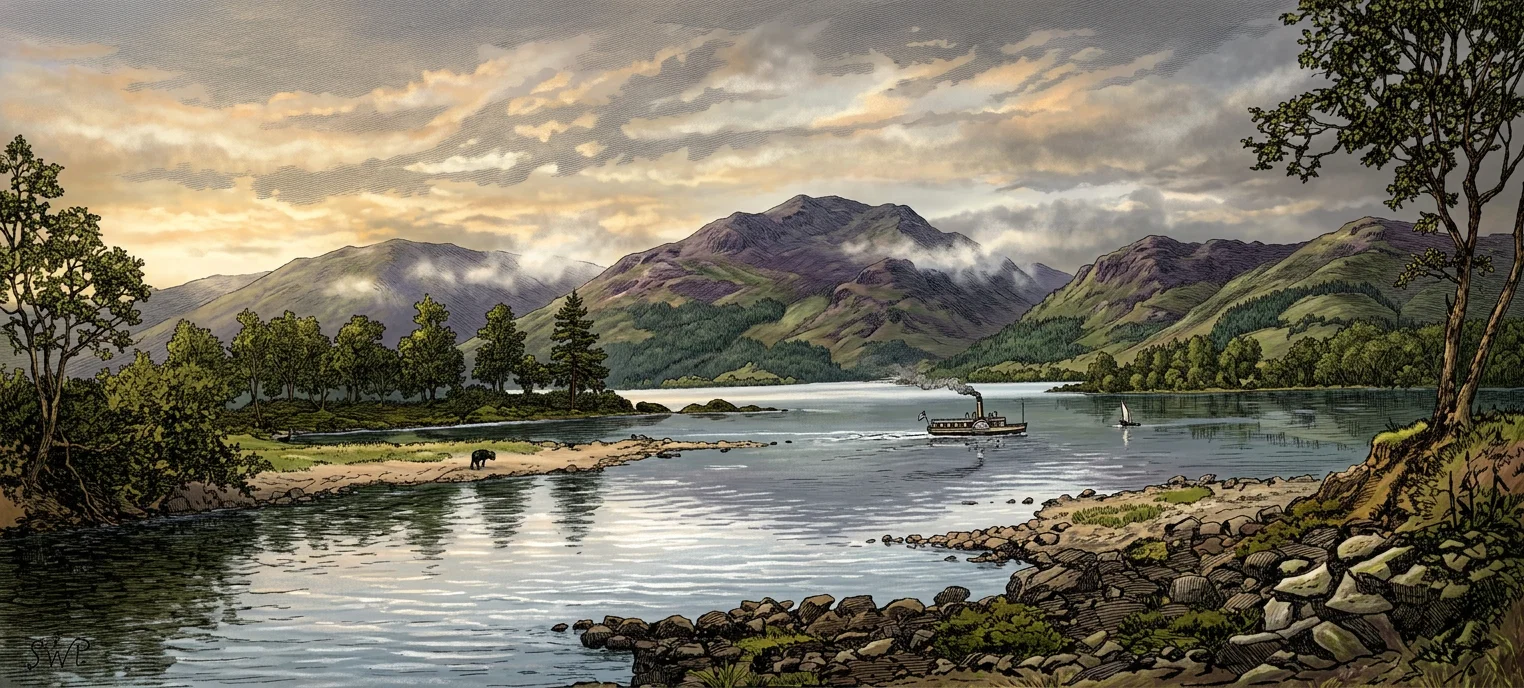
Near the northern border of the Lowlands, and about twenty miles northwest of Glasgow, is situated the largest lake in Scotland, a view of which is given in the accompanying picture. Loch Lomond, which is the Scotch for Lake Lomond, is about twenty-five miles in length. It is shaped something like a long wedge, the sharp end lying to the north, and about a mile in width, while the southern end is about seven miles wide. The lake contains thirty islands, among which a small steamer plies, giving travelers an opportunity of enjoying the varied scenery without the labor of rowing. Every year brings scores of sight-seers to the borders of Loch Lomond, to gaze on the wild and picturesque masses of mountains bounding the lake on the north; the high table-lands to the south, dotted with villas; to wander among the ancient ruins on the shores; and to catch the fine trout with which the lake abounds.
Restored with AI
But not alone for its beautiful scenery is this lake and its vicinity famous, nor is this the chief attraction that calls to its shores nearly every one making a tour of the Old World. Scotland's bard, Sir Walter Scott, in his songs of the early struggles of his countrymen for freedom, has pictured every hill and lake and glen in all the region round, from Stirling's towers to the farthest rill that feeds Loch Lomond's waters. So vividly has he done this, that he who visits these places involuntarily looks around, almost expecting to see the very warriors and women, horses and hounds, with which the songs of the poet have peopled this region. He thinks he hears the pibroch of grim Roderick and his fierce followers,—
“The Saxon scourge, Clan-Alpine's pride,
The terror of Loch Lomond's side.”
Quite likely one of the hills seen in the picture is Ben Lomond, the Scotch for Mt. Lomond. When it is known that this hill is nearly 3,200 feet above the sea, the force of the allusion to it in the following lines will be seen:—
“Of stature tall, and slender frame,
But firmly knit, was Malcom Graeme.
Each pass by mountain, lake, and heath,
He knew, through Lenox and Monteith.
Right up Ben Lomond could he press,
And not a sigh his toil confess.”
But of wilder scene and more tender memory is Loch Katrine. This beautiful sheet of water lies but a short distance from Loch Lomond. Around it rise Benvenue, Ben-an, and Ben-ledi. A beautiful picture of this lake is presented in the following lines:—
“And thus an airy point he won,
Where, gleaming with the setting sun,
One burnished sheet of living gold,
Loch Katrine lay beneath him roll'd,
In all her length far winding lay,
With promontory, creek, and bay,
And islands that, empurpled bright,
Floated amid the livelier light,
And mountains, that like giants stand
To sentinel enchanted land.
High on the south, huge Benvenue
Down on the lake in masses threw
Crags, knolls, and mounds confusedly hurled,
The fragments of an earlier world.
A wildering forest feathered o'er
His ruin'd sides and summit hoar,
While on the north, through middle air,
Ben-an up-heaved his forehead bare.”
C. H. G.