MANY, many years ago the Lord’s people were slaves in a strange land, where they were very cruelly treated. But they cried to the Lord and told him all their troubles, and finally he raised up a man to lead them out of bondage.
There were a great many of the people, and they had a good deal of trouble in getting away from the king of the land, who wanted them to stay and build cities and towers, and do his other hard work for him. But the Lord helped them through all their hard places because they were his people, and brought them safely out of the land of Egypt by the hand of his servant Moses.
There was a great multitude of men, women, children, and cattle, and they all traveled on foot and camped out at night. There was no trouble or confusion about the way they were to go, or the proper time for breaking up camp; for the Lord set a pillar of cloud to go before them by day and a pillar of fire by night. When that pillar rested, the people went into camp; when it moved forward, the people journeyed as it led. After traveling several weeks, they came to a mountain in the desert, and here the pillar rested for a long time, nearly a year. While there, the Lord called Moses up into Mount Sinai, and told him many things which he was to teach the people; and once he spoke to them by his own voice and gave them the law of the ten commandments, which we now have in our Bibles. He also wrote what he had spoken, on tables of stone, and gave them to Moses, so that the people might not forget it.
While Moses was up in the mount, the Lord gave him directions for making a place where God was to be worshiped. The building was not called a church, as we call such places now-a-days, but a tabernacle. It was something like a tent, and could be taken down and moved when the people journeyed. The sides were of boards of a very fine wood called shittim wood, and were overlaid with gold on the inside. These boards were all set in sockets, so that they would stand firm without being nailed or fastened in any way, and yet could be easily taken down. Inside the boards were hung beautiful curtains of fine linen, embroidered with blue and purple and scarlet.
The tabernacle had nothing that could be really called a roof, but four different coverings were spread over it, one above another. The first, or inner one, was of fine linen embroidered, like the curtains hung around the sides; the second was of a coarse cloth made of goats’ hair; the third was of rams’ skins dyed red; and the fourth, or outside one, was of badgers’ skins.
There were two rooms in the tabernacle,—the “holy place” and the “most holy place.” In the most holy place was kept the ark, a beautiful chest overlaid with gold inside and out, and having a solid gold cover. This the Lord had Moses make to hold the tables of stone on which he had written the ten commandments. In the holy place was a great golden candlestick, with which the place was lighted; a table, where bread was kept always fresh before the Lord; and an altar, on which was burned sweet incense. All these were covered with gold. Between the two rooms of the tabernacle was hung a curtain even more beautiful than the others, and called a veil.
Around the tabernacle was a large yard called a court, and in this was another altar, where were offered the animals which the people brought for sacrifice. You see they had a different way than we do of worshiping the Lord in those days. Ask some one to tell you about it, if you do not know already.
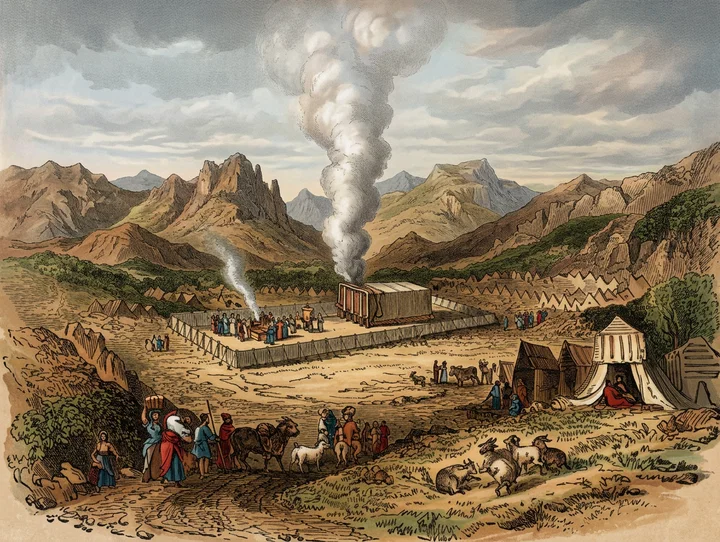
Some one has made a picture of the tabernacle, as nearly as we can make out how it looked by what the Bible says about it; and we have given it to you on this page. If you look at the picture carefully, you will see many things to interest you besides the tabernacle itself. The tabernacle was kept for many years, and finally carried with the Lord’s people into the land of Canaan, where it was still used till the temple was built at Jerusalem.
Perhaps some of you will wonder where Moses got things to make so beautiful and costly a building away off there in the wilderness. The Bible says that the people gave them from the little they had brought away with them from Egypt. Quite likely they brought to Moses many things which they would have liked to keep for themselves. But the Lord told Moses he was to take no offering that was not given “willingly.” There is a great deal of meaning in that. I wonder if any of us ever give unwilling service to our parents or to the Lord! E. B. G.