Written for the INSTRUCTOR.
CORINTH
LET every one who intends to read this article get his atlas and find the map of Greece. You will notice that about midway north and south, the country is cut nearly in two by the waters of the Ægean and Ionian seas. The lower part is thus made a peninsula, which is joined to the mainland by a narrow isthmus, ten miles long, and from four to seven in width. On this neck of land was situated the celebrated city of Corinth, with its two seaports,—Cenchrea, some eight miles distant on the eastern coast, and Lechæum, on the western coast, about a mile and a half away.
The situation of Corinth was one of the finest in all Greece. From its location we readily see that all the land traffic to and from the lower peninsula must necessarily have passed through Corinth. This, with the advantages of its two seaports, made it a very important commercial city. The town was built on a high tableland just at the foot of Acrocorinthus, a mountain which towered on the south, and overlooked the city spread along its northern base. This mountain rises 2,000 feet above the sea, and the ascent is so circuitous as to make the distance four miles. On the top was situated the citadel of the town, which is said to have been the strongest fortress in Greece. The sides of the mountain are so steep and precipitous that a few soldiers could hold the castle against a whole army. The prospect from this height is said to be one of the finest in the world.
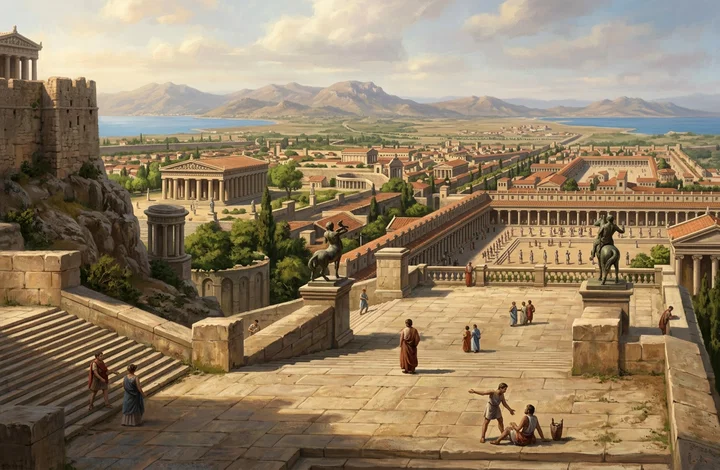
Corinth was five miles in circumference, and where not sufficiently defended by nature, was fortified by a wall. In the year 268 B. C., this city, then in the pride of its glory, was taken by the Goths, and the town and the citadel on Acrocorinthus were burned. The numerous statues with which the sides of the mountain were studded, were melted by the fierce heat, and afterward formed the celebrated Corinthian brass. The town lay thus in ruins for one hundred years, when Julius Caesar had it built afresh, and peopled it with a Roman colony. It soon became as rich and populous as ever; and as is almost always the case with people and empires, with plenty came pride, luxury, and corruption, until Corinth had the reputation of being the most dissolute city in Greece. It had temples to Venus and Neptune, and other heathen deities. Some of these buildings were very magnificent. In the picture on this page is shown the splendid temple of Venus, adorned with armed statues of the goddess. It is surrounded by a row of massive pillars, and looks considerably like the Parthenon, or temple of Minerva, on the Acropolis at Athens. The magnificent open courts shown in the forefront of the picture are probably theaters for some of the numerous feats, wrestlingp. 150 matches, and contests, of which the Grecians were so fond. The view here given is said to be a good representation of ancient Corinth as seen from Mount Acrocorinthus.
To the left of the temple may be seen the stadium, a place prepared for the national games and races, for which Greece was so famous. These stadiums were common in nearly all Grecian cities, but that at Corinth was quite a famous one. An open space was laid out, generally from 600 to 700 feet long and one-third as wide, and rounded at one end. Around this was built a wall, but no roof covered it. On each side of the inclosure ran an ascent, or kind of terrace, covered with seats and benches, upon which were seated those who came to witness the games and races that were carried on in the center. At one end was the starting point; at the other, the goal. Opposite the goal, on one side, were the seats of the judges; and on the other, an altar for priestesses, the only women allowed to be present. The stadium was named from stadium, a Roman measure of 607 feet, which was originally the prescribed distance round every race-course. Crowds attended these contests, among whom were the most distinguished men of the nation.
The city was still in the days of its prosperity, in A. D. 52, when the apostle Paul made the visit to Corinth recorded in Acts 18. Here he tarried for a year and a half, preaching to both Jews and Greeks the gospel of Jesus Christ, laboring with his hands, meanwhile, to support himself. He here found friends in Aquila and Priscilla, at whose house he made his home, and with whom he worked at the humble occupation of tent-making. His preaching must have been somewhat successful; for we read that “many of the Corinthians, hearing, believed and were baptized.” And at one time, when Paul was almost discouraged because of the treatment he had received from the Jews there, the Lord appeared to him in a night vision, and told him not to be afraid, but to speak boldly, and hold not his peace; “for,” said the Lord, “I have much people in this city.”
While at Corinth, Paul wrote the epistles to the Thessalonians, and during another visit there, the epistles to the Galatians and Romans. He seems to have felt a very tender and fatherly regard for these Corinthians. In the years 59 and 60 A. D., he wrote two letters, or epistles, to the church at Corinth, in which he once and again refers to his stay with them. It is interesting to notice how many figures of speech the apostle obtains from the habits and customs of these people with whom he was so long associated, and especially from the public games and contests which formed so important a feature in the social life of Corinth and other Grecian cities.
So in Heb. 12: 1 the Christian warrior is compared to one who takes part in the public foot races. The throng of spectators is the “so great a cloud of witnesses.” As the athlete lays aside his clothes, and everything that would impede his swiftness, so must the Christian “lay aside every weight,” and “run with patience the race that is set before” him. And in Phil. 3: 13, Paul “presses toward the mark [the goal] for the prize [the victor’s wreath] of the high calling of God in Christ Jesus.” These are but a few of the beautiful figures which will appear in Paul’s writing, to those who care to trace them out.
The former glory of Corinth has passed away. There remains among the ancient ruins a poor little village called Gortho; but few signs of thrift or enterprise are to be seen. Only the Mount Acrocorinthus rises just as grandly as when it looked on the proud city at its feet, and still abundant on the shore are the small green pine-trees which gave the fading wreath to the victors in the games. Those perishing crowns have passed away with the men who wore them; but the “incorruptible crown” of which Paul wrote unto the Corinthians (1 Cor. 9: 25),—that “crown of righteousness, which the Lord, the righteous Judge” will give at the great day, is still laid up for all those who shall come off conquerors in “the race that is set before us.” E. B. G.