Our picture gives a good representation of the cedar birds, or chatterers, though it is difficult to tell why the latter name is applied to them, as they are said to be the most silent of birds at all seasons of the year.
The cedar bird is quite pretty; the upper part of the body is fawn-colored, and the breast is yellow. The wings are slaty-blue, as is also the tail, which deepens into black. The tips of the tail-feathers are bright yellow. On the head is a long, pointed crest, that can be raised up nearly perpendicular. On the shorter wing-feathers are usually found wax-like tips, which are simply extensions of the shaft. These are shown quite plainly on the wing of the lower bird in the picture.
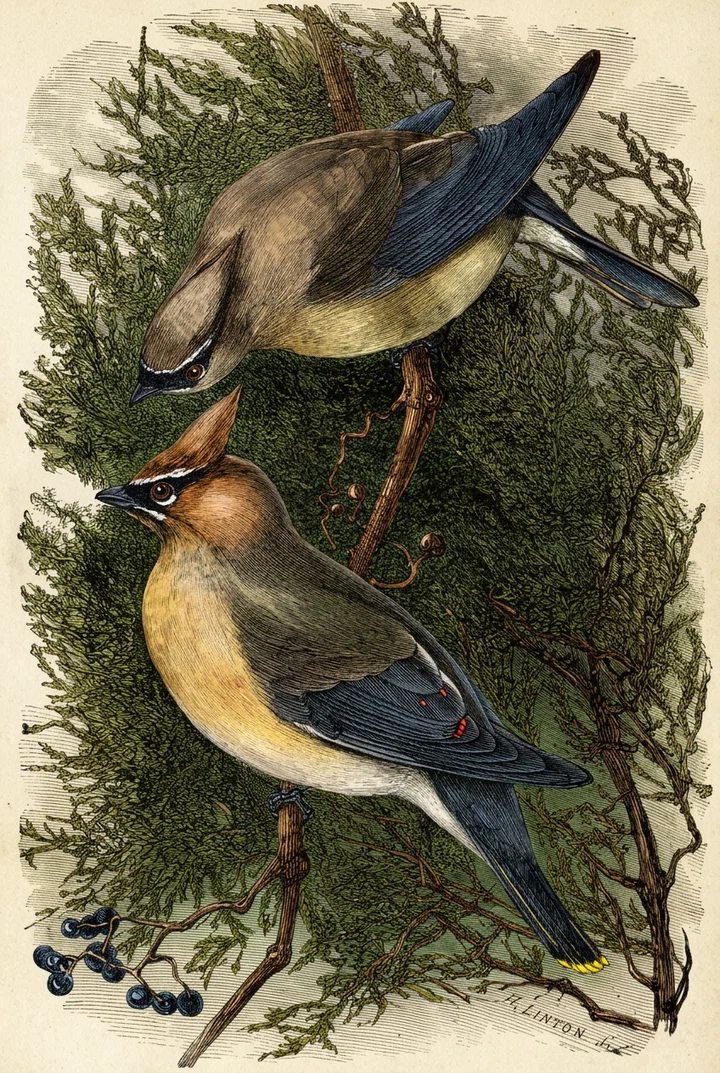
These birds are found in different parts of the United States at different times in the year. In summer they go in large numbers to the Blue Mountains, where they feed on the blue berries growing there in such abundance. Later, in October, they descend to level country, where they eat almost all kinds of berries, but especially those of the red cedar, of which they are very fond. In early summer they begin their robberies among the cherry trees, and nothing will drive them off except a loaded gun. They eat largely of insects as well as fruits.
They build their nests in the month of June, sometimes upon the red cedar, but oftener on some orchard tree. Says an eminent naturalist, who has been an eye-witness to the general habits of the bird: “The nest is large for the size of the bird, fixed in the forked or horizontal branch of an apple-tree, ten or twelve feet from the ground; outwardly and at the bottom is laid a mass of coarse, dry stalks of grass, and the inside is lined wholly with very fine stalks of the same material. The eggs are three or four, of a dingy bluish white, thick at the great end, tapering suddenly, and becoming very narrow at the other; marked with small roundish spots of black of various sizes and shades, and the great end is of a pale dull purplish tinge, marked likewise with various shades of purple and black. About the last week of June the young are hatched, and are at first fed on insects and their larvae, but as they advance in growth, on berries of various kinds. The female, if disturbed, darts from the nest in alarm to a considerable distance; no notes of wailing are heard from either parent, nor are they ever seen, notwithstanding you are in the tree examining the nest and the young. These nests are less frequently found than many others, owing not only to the comparatively few numbers of the bird, but to the remarkable muteness of the species.”
In the fall they have, by their gormandizing, grown to such portly proportions that they offer a tempting mark to the sportsman, who thus supplies the demand for them in the markets of the large towns. W. E. L.