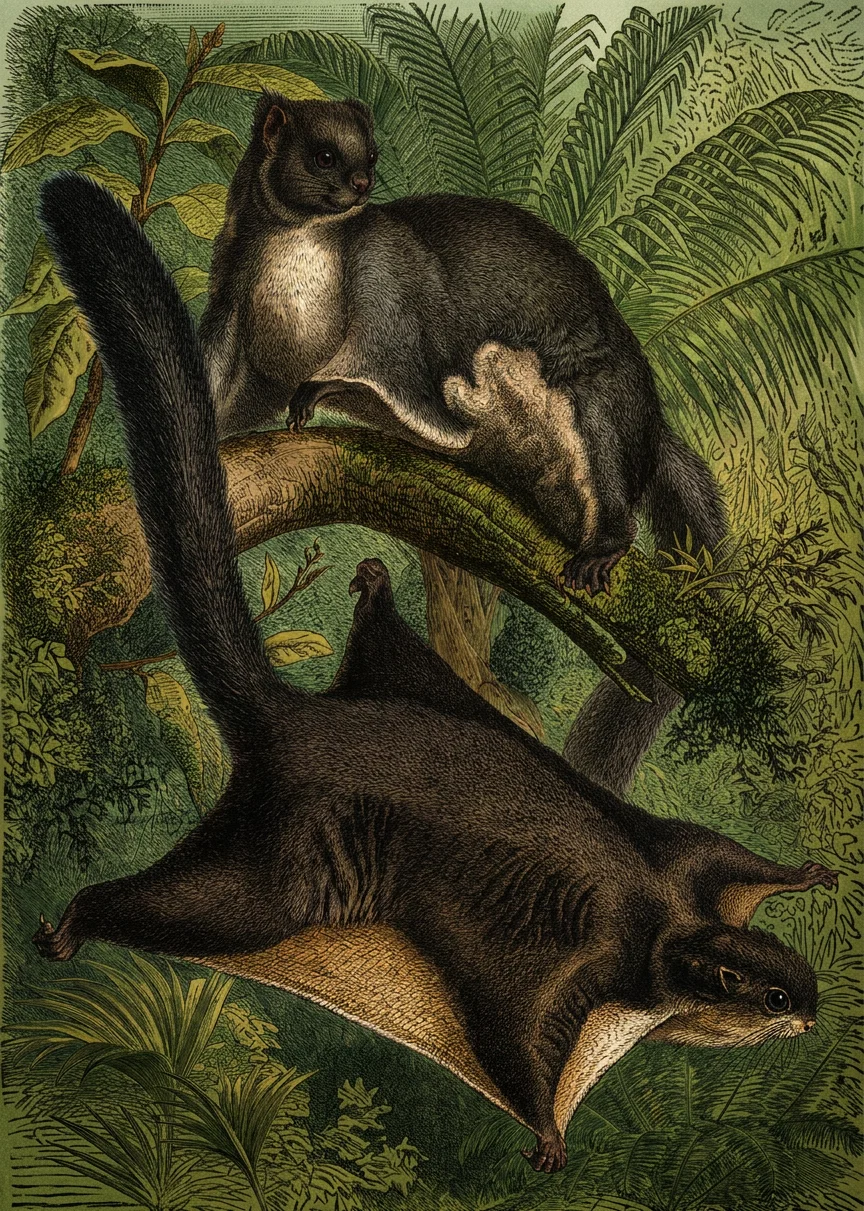
THE FLYING SQUIRREL

13%

S. D. A. Publishing Association · Battle Creek, Mich. · Feb 20, 1884

FromThe Youth’s Instructor, Vol. 32, No. 8.

Read the full edition

THE FLYING SQUIRREL.

Among the many curious and interesting animals which are found in our country, and also in other countries, is the flying squirrel, of which the artist has given us a very good view in the accompanying engraving. There are several species of this queer little creature, all very similar, yet differing in some particulars. They are found not only in America, but in Russia, Australia, India, Java, Siberia, Poland, and other countries, each species showing some little difference in appearance and size.
The principal difference between them and the common squirrels is in the peculiar membrane, or skin, which extends between the fore and hind legs, and by means of which the animal sails in a descending line from a high point to a lower, supported as by a parachute. It is supposed by many that the animal has the faculty of flying like a bird; but this is a mistake. There is nothing resembling the act of flying in its movements, such as is seen in the flying-fish; it simply leaps from a high point, spreading out its legs, and expanding the membrane between them, as shown in the engraving, and sails a distance of forty or fifty yards; and when it wishes to alight, the impetus of its course enables it to ascend in a curved line to about one-third the height from which it started; then running quickly to the top of a tree, it re-descends in a similar manner, and will thus travel a long distance in a few moments without touching the ground.
Restored with AI
The flying squirrel is a harmless and gentle little creature, and is easily tamed. It is a nocturnal animal, rarely appearing until sunset, when its gambols and graceful flights may often be seen in wooded places, as they come out from their hidden retreat in search of food.
One species, found in New Holland, is said to attain to the size of a half-grown cat, and its meat is considered by the natives as excellent food; but as it remains hidden and asleep in its nest in some old hollow tree during the day-time, it is difficult to capture, and so is comparatively safe from every foe, except the ever hungry and ever watchful native, whose eye is capable of detecting almost anything eatable, however deeply it may be hidden from sight. A slight scratch on the bark of a tree, or a chance hair that has adhered to the side of the aperture into which the animal has entered, tells its tale to the native hunter as plainly as though he had seen him enter; and with the most remarkable acuteness, he is able to tell from the appearance of the scratch and the aspect of the hairs, how long a time has elapsed since the squirrel entered its hiding-place. The native climbs the tree until he reaches the aperture, and then with his hatchet strikes the body of the tree to learn the position of the animal in the cavity. Having learned this, he cuts a hole through the side of the tree, and reaching in, he seizes the animal, and jerks it out; and dashing its head against the side of the tree, he drops it to the ground dead.
In almost any public museum in our country, stuffed specimens of this beautiful little creature may be seen and examined, and much may be learned in regard to its peculiar habits. J. W. B.
Restored with AI