MEDUSÆ

10%

S. D. A. Publishing Association · Battle Creek, Mich. · Mar 12, 1884

FromThe Youth’s Instructor, Vol. 32, No. 11.

Read the full edition

MEDUSÆ

WERE we to walk along the sea-shore after the tide has gone out, we might often see, “lying immovable upon the sands, gelatinous, disc-like masses of a greenish color and repulsive appearance, from which the eye and the steps instinctively turn aside.” And were we to carefully put one of these seemingly dead bodies back into its watery home, we would doubtless be more than surprised to see it, after a few minutes, riding the waves like an azure bell, fringed with delicate silvery threads.
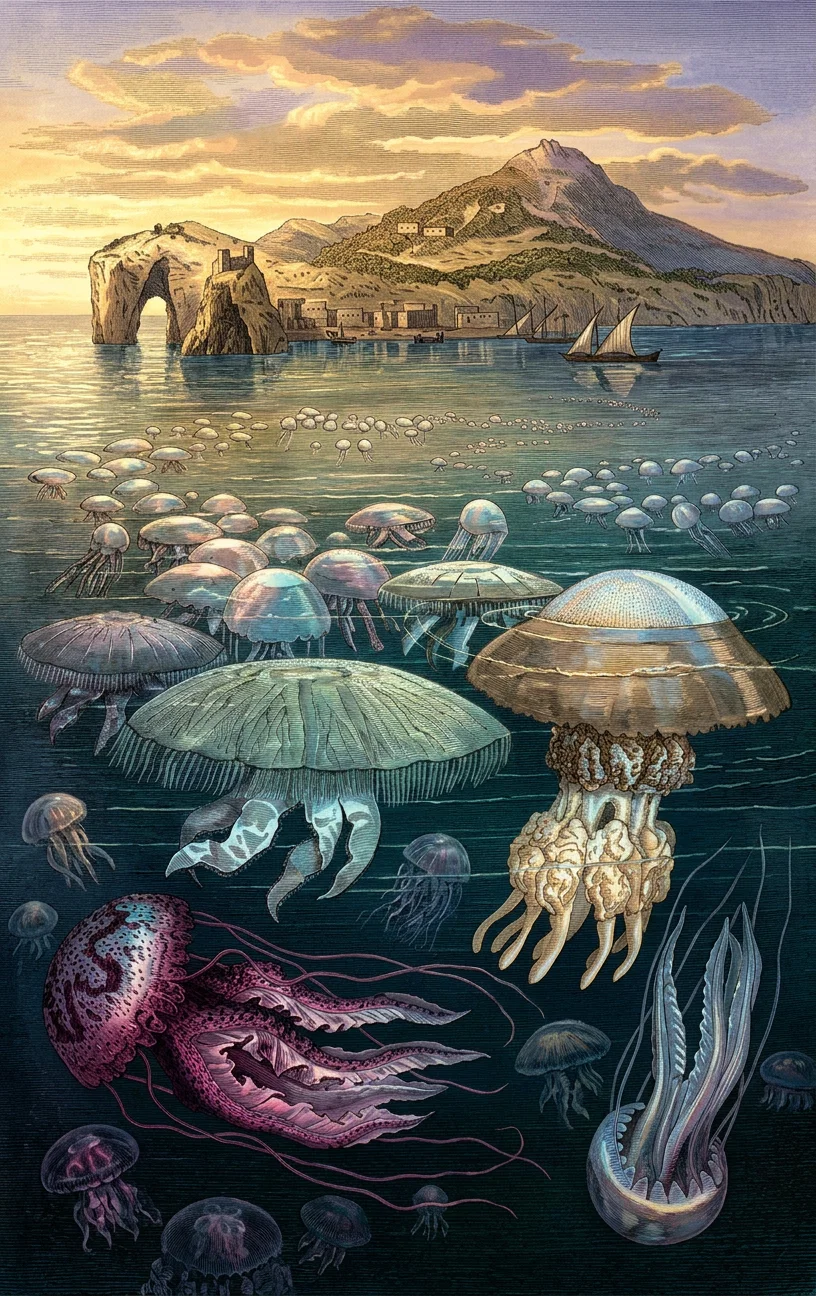
These beautiful and graceful little creatures are called Medusæ, because the ancients thought the dainty fringes hanging around the edge of the umbrella-shaped animal, resembled the snake-like locks of a fabulous person called Medusa, who was said to change all who looked at her into stone.
The Medusæ are composed of a jelly-like substance, mostly water. They are frequently as clear as crystal. Sometimes they are opaline, and occasionally of a bright blue or a pale rose color. So delicate are these little creatures, that a morsel of one might be dissolved into water by the mere heat of our hands. When cast upon some inhospitable beach, the sun’s rays are sufficient to dry up these living soap-bubbles. In the lower part of the animal is the mouth. Though these little creatures are so soft and delicate, they are very voracious, and devour the small molluscs that come in their reach, at one mouthful.
These animals are so soft that they could not rest on the ground, so they are obliged to keep in constant motion. To do this, the edges of the disc approach quite near to each other, forcibly ejecting a part of the water contained in the body, and so moving the animal in an opposite direction. It then expands, and repeats the motion; thus they make long voyages over the water. This expanding and contracting movement has given them the name of Sea Lungs.
Restored with AI
But notwithstanding the Medusæ are such innocent looking creatures, they inflict on sea-bathers and fishermen who may happen to come in contact with them, the most terrible stings. Says a popular writer, who had the misfortune to come in contact with one of these creatures: “Its presence is so much to be dreaded that no one who has once suffered from the lash of its envenomed filaments will venture to bathe without keeping a careful watch on the surrounding water. At its first infliction, the pain is not unlike that caused by the common stinging-nettle, but rather sharper, and with more of a tingling sensation. Presently it increases in violence, and then seems to attack the whole nervous system, occasionally causing severe pain to dart through the body, as if a rifle-bullet had passed in at one side and out at the other. Both the heart and lungs suffer spasmodically, and the victim occasionally feels as if he could not survive another minute. These symptoms last for ten or twelve hours before they fairly abate, and even after several days the contact of the clothes is painful to the skin.”
Medusæ are found not only in our own seas, but under the burning sun of the equator, and in the cold waters of the Arctic Ocean. They are seldom seen alone, but generally travel in large fleets, as is shown in the picture on the first page. Says a naturalist: “There are few more beautiful sights than to stand on a pier head or lie in the stern sheets of a boat, and watch the Medusæ passing in shoals through the clear water, pulsating as if the whole being were but a translucent heart, trailing behind them their fringes, and rolling gently over as if in excess of happiness. At night, the Medusæ put on new beauties, glowing with phosphorescent light like marine fire-flies, and giving to the ocean an almost unearthly beauty, that irresistibly calls to mind the ‘sea of glass mingled with fire.’”
W. E. L.
Restored with AI