ALLAN'S GARDEN

4%

S. D. A. Publishing Association · Battle Creek, Mich. · Mar 19, 1884

FromThe Youth’s Instructor, Vol. 32, No. 12.

Read the full edition

ALLAN'S GARDEN.

ALLAN! Allan!” called Mrs. Gray from the back door. Allan left the windmill he was making in the barn, and went to see what his mother wanted.
“Take the little tin pail,” said she, “and go over to Mrs. Smurthwaite’s, and get me some yeast. Don’t spill it; and hurry right back, for I want to set some yeast myself.”
There was nothing Allan liked better than to go over to Mrs. Smurthwaite’s, for she lived almost a mile off, and the path to her house ran along the trout brook in the meadow, and through the woods. So he went merrily down the road.
“Halloo,” said Johnnie Smurthwaite, from his perch on the gate-post, as Allan came up the path. “I say, Allan, do you know there’s a minister stopped at our house, and he’s going to preach at the school-house next Sabbath? We’re going to have a Sabbath-school.”
“O good!” cried Allan, and he would have said more, but the minister came down the path then, so he turned and went into the house.
It was a rare thing for them to have a visit from a minister; for they lived in the heart of the White Mountains, seven or eight miles from any railway station.
“I wonder,” thought Allan, as he scuffed his bare toes in the dust, on his way home from Sabbath-school the next Sabbath, “I wonder how the man thinks we’re going to get any money to put into the Sabbath-school. He said we ought to bring our pennies to the teacher every Sabbath. And then he said, too, we ought to save some money to send papers and tracts to people that didn’t know about the things God has written in the Bible, and try to get them to love and serve him. Guess he never lived on a New Hampshire farm, or he’d know we couldn’t dig up money like potatoes. Why, the leaves are half gone from my speller, and pa can’t get me another.”
So he put his hands in his pockets, and began to whistle; but he couldn’t help thinking of what the man had said about giving, for he had talked to the children as well as to the older people, and Allan knew very well just what he meant.
Restored with AI
“Father,” said Allan the next morning as his father went out to the barn to milk the cows, “can I have that strip of ground out by the wood-pile for my very own!”
“Why do you want it, my son?” asked his father.
“Well,” he replied, shifting to one foot, “I want to make a garden, and sell the things down in the village.”
“What are you going to do with the money?”
“I want to earn some money to give. The minister told us, you know,” he added, as his father looked puzzled.
“Well, I am willing, but I don’t think you’ll raise much off from that piece of ground.”
But Allan was bound he would; so taking his spade and wheelbarrow, he went to the barnyard, and wheeled several loads of manure to his garden, and dug it in carefully. Then he went to his mother, and begged some garden seeds. He took great pains to plant his seeds well, and after they began to grow, he spent most all his spare time in hoeing and weeding his garden. How the vegetables grew!
“I declare!” said Mr. Gray, one day, “I shall begin to be sorry I let you have so rich a piece of ground.”
“That’s because it’s a missionary garden,” said Allan.
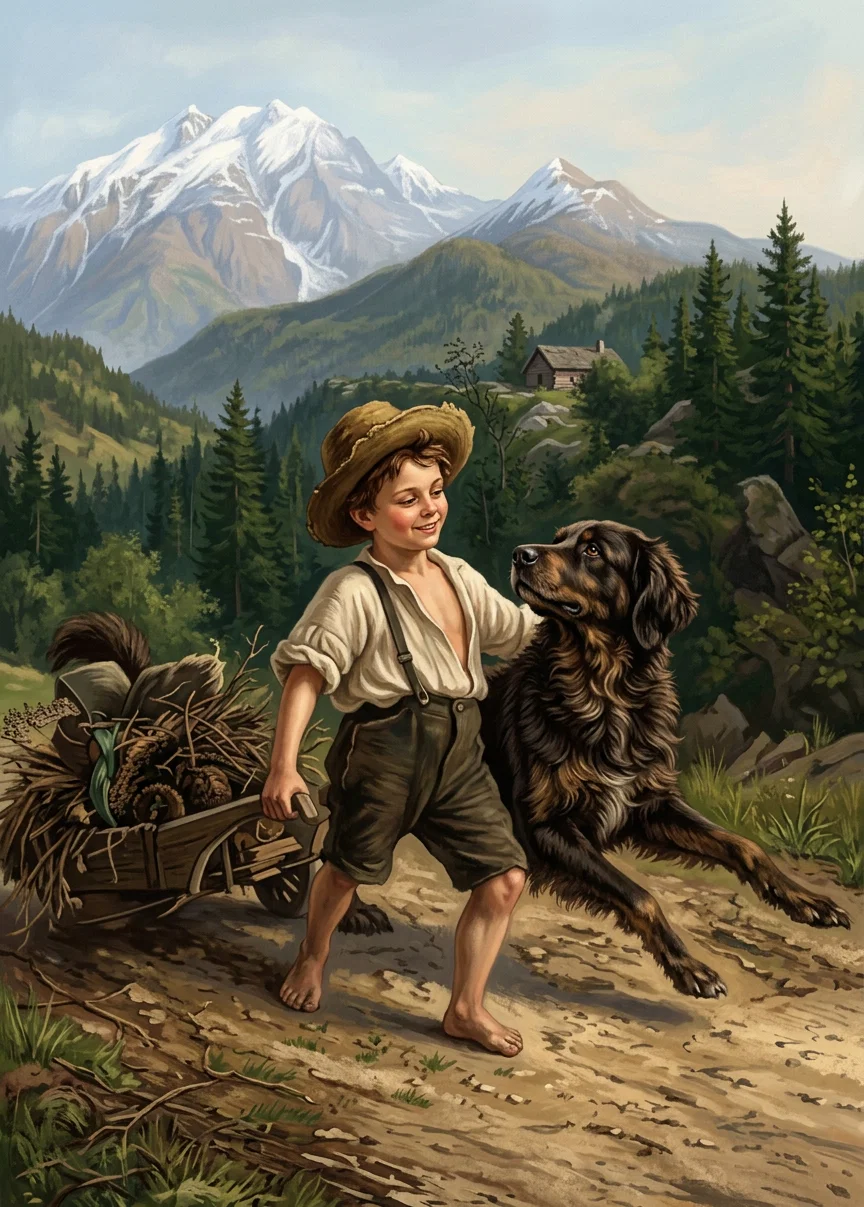
When the things were large enough to sell, Allan, early every morning, washed some of them up nicely, and piling them on his wheelbarrow, he and his dog Rover trudged down the mountain road to the village three miles away. He never failed to find a ready sale for his vegetables, because they were so large and clean.
When the minister came back in the fall to make another visit, Allan had quite a little money saved up for him.
“Did you ever hear of any other boy who had a missionary garden?” asked the man, as Allan handed him the money and told him how he earned it.
“No, sir,” said Allan.
“A long time ago,” said the man, “a little boy asked his father for a piece of land, to use just as you have used your ground,—for a missionary garden. He raised potatoes, and sent the money to a school in Cornwall, where heathen boys are educated. His name was William E. Dodge. He is dead now; but through all his busy life he never forgot to be kind and helpful to all who needed help. He became wealthy, but he remembered to do good. I hope you will be as useful as he has been.”
“I will try,” said Allan.
Allan has grown to be a large boy now, but he remembered what the minister said to him, and he is always ready with his earnings and with his hands to do good to other people.
W. E. L.
Restored with AI