When Columbus and his companions first landed upon the wilderness shores of this continent, they found its vast forests inhabited by a strange, wild class of beings, differing widely in almost every phase of life and habit from the people of their native land. Columbus and his companions were regarded by them with evident feelings of great superstition, as they supposed the strangers were gods come to their shores, but whether for good or evil they could not tell; and it was with difficulty that Columbus induced the natives to make any acquaintance with his company, or have any intercourse with them; but after a while their fears were so far overcome that they were induced to enter into trading, and thus Columbus procured food for himself and companions.
The origin of the American Indian has been for centuries a matter of debate among the various writers upon the subject. Some have endeavored to prove that they descended from the ten tribes; others, with as little foundation in facts for their theories, have tried to prove that they sprung from the Welsh, the Mongols, or the Malays.
But whatever may have been their origin matters little. The whole continent was occupied by scattered tribes, from the lowest stage of barbarism to a semi-civilized state. Agriculture among them was confined to the cultivation of a few plants,—maize, squashes, beans, tobacco, plantain, etc., and was conducted almost entirely by the women. Their few manufactures consisted of canoes made from bark, or from hollowed trees; lodges, or wigwams, of bark skins; simple garments of furs and skins; and in some parts, of basket-work and rude weaving; weapons; and images, carved, and occasionally hammered and molded.
In general appearance, their skin was brown or cinnamon-hued, their eyes dark, hair long, black, and straight, beard scanty, eyes deep-seated, nose broad but prominent, lips full and rounded, and face broad across the cheeks.
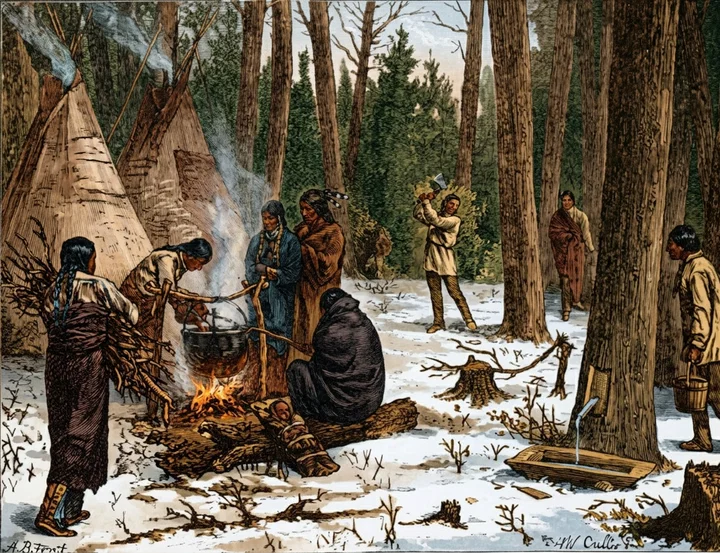
Our illustration shows a family of Indians around their camp-fire in their native forest. They seem to be engaged in making maple sugar, and we are told by those who have seen and eaten it, that they understand the art to perfection.
At first these strange men were friendly to the white men, and did them no harm; but after a time, from one cause and another, they began to show hostility, and all through the history of the early days of the settlement of this country, we find them at times on terms of friendship, and then committing the most horrible acts of cruelty and murder. Naturally the Indian is hospitable, and remembers with gratitude a favor or kindness; and so also does he harbor revenge for an insult or injury received. No doubt the treatment they received at the hands of the whites, often gave occasion for feelings of hostility.
Gradually and steadily other adventurers followed Columbus across the waters to the Western wilderness, to make for themselves homes, and to enjoy the rights and privileges denied them in their native land; and the red man found himself steadily driven from his home and hunting-grounds. He has fought and battled for his rights, but he has not been able to maintain them against his pale-faced foe. As civilization has advanced, he has retreated, fighting for every inch of ground.
The names by which Indian tribes are known to us are a strange medley. Many of them are nicknames given them by the whites; as the Diggers, Blackfeet, Flatheads, etc.; others are derived from some locality near which they reside; as the Delawares, Hurons, and Mohawks. In almost every State in the Union to-day may be found a few remaining descendants of the tribes which once roamed through its forests, and held undisputed title; but the great majority of them are found in the far western States and Territories, where reservations for them have been located by the government. Some of these tribes still remain in their savage state, living by plunder and robbery. Others, through the efforts of the government, and of missionaries who have labored among them, are becoming civilized, and are adapting themselves to the customs of the white man.
According to the estimate of the Indian Department in 1871, the Indian population of the United States was about 350,000. That the race is decreasing cannot be doubted. J. W. R.