In the accompanying picture is given a view of the common wild or Mallard duck, from whose parent stock came our well-known domestic duck. It is really a most beautiful bird; and if it were not so common, would, undoubtedly, receive a greater amount of admiration than at present is given it. Its head and neck are a rich, glossy dark green, with a ring of white around the lower part of the neck. The back is a rich chestnut brown, merging into black on the upper part of the tail. The four central tail feathers are black, and curl over; while the rest of the tail feathers are gray, edged with white. The wings are shining purple, snowy white, and velvety black; the breast is chestnut, and the under part white, penciled with dark lines. So closely do the tame ducks resemble their wild brethren, that an inexperienced eye could hardly perceive the difference between them.
The female is not nearly so beautiful as the male, as her plumage is a dull brown, and her wings but slightly tipped with white.
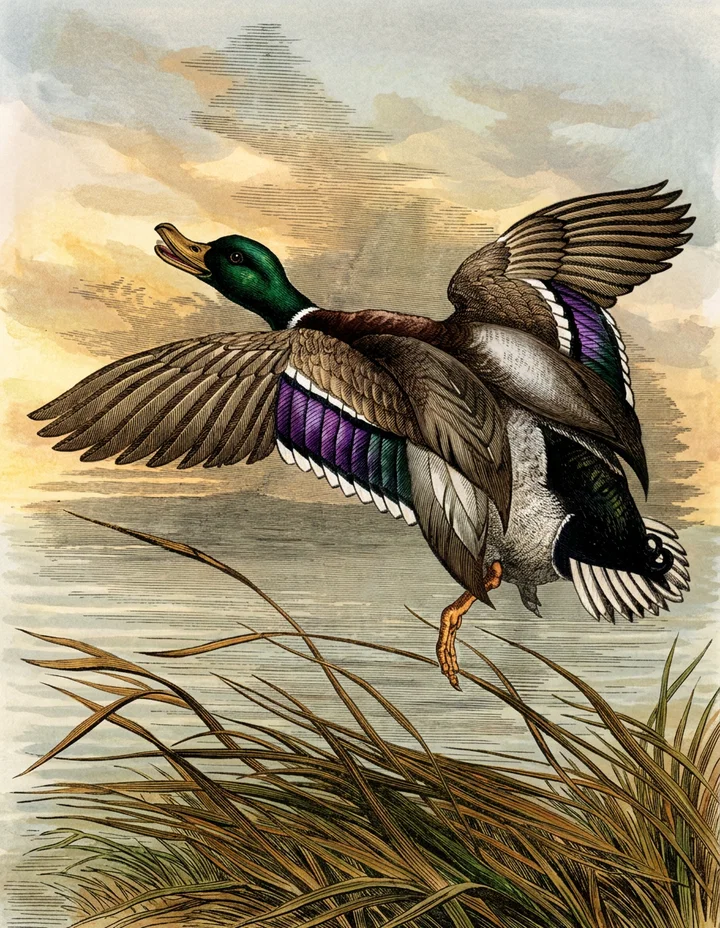
During the summer months, such a change takes place in the plumage of the drake that he can hardly be distinguished from his less pretentious mate. In describing this change, a naturalist says: “About the 24th of May, the breast and back of the drake exhibit the first appearance of a change of color. In a few days after this, the curled feathers above the tail drop out, and gray feathers begin to appear among the lovely green plumage which surrounds the eyes. Each succeeding day now brings marks of rapid change. By the 23d of June, scarcely one single green feather is to be seen on the head and neck of the bird. By the 6th of July, every feather of the former brilliant plumage has disappeared, and the male has received a garb like that of the female, though of a somewhat darker tint. In the early part of August, this new plumage begins to drop off gradually; and by the 10th of October, the drake will appear again in all his rich magnificence of dress.”
Its favorite haunts are on little inland ponds in the western and southern portions of the United States, where it is commonly seen from autumn till spring. It mates and breeds in the far North, usually during the months of February and March, but sometimes at even an earlier period than this.
It builds its nest near the water, close to the ground, in some sedgy, sheltered spot, and there lays its eggs, from eight to eleven in number. They are rather large, and of a greenish white color. The nest itself is made of dried grasses, and is lined with down plucked from the mother duck’s breast. She never leaves the nest for food after she has commenced setting, without her mate first makes sure that there is no danger near.p. 122
The ducks find enemies in water as well as on land, the large fish in the lakes, where they are hatched, being very fond of the young ones.
About September or October the little ducks are full-grown, and, with their parents, fly away to a warmer climate.
Wild ducks are very fine eating, and hunters resort to every device to capture so desirable game. The most common method is to build “blinds” along the shore. These are little coverts made so as to resemble a thick patch of reeds. Behind this the hunter stations himself, with his gun, and shoots them as they fly over. Or he places in front of this innocent clump of rushes a wooden duck as a decoy, and then he has a fine chance to shoot the ducks as they unsuspectingly fly down to make the acquaintance of the stranger. Foolish indeed it seems for them to allow themselves to be led to destruction by painted decoys; yet boys and girls not unfrequently use as little caution in making new acquaintances.
W. E. L.