THEY that go down to the sea in ships, that do business in great waters, these see the works of the Lord and his wonders in the deep.” But not these alone. All who go to the seashore in the vacation days of summer must also be impressed by the beauty and majesty of the sea.
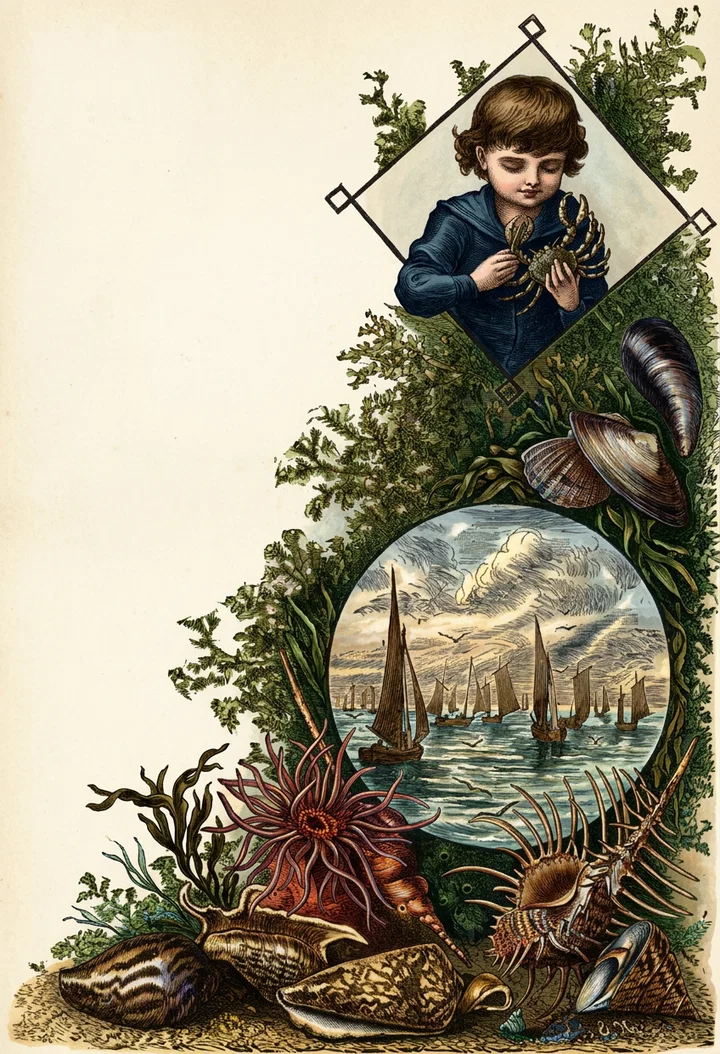

From the golden hours of the morning, when the king of day comes forth above its gleaming surface in his chariot of flame, all along the swiftly passing day, through the radiancy of the noontide and the luster of the purple sunset, burnishing the waters and transfiguring the neighboring islands, until the more distant objects on the horizon gradually fade from view in the deepening twilight, the sea is an unfailing source of pleasure alike to young and old.
But the wonders in the deep, both in number and variety, far exceed those upon its surface or along its shores. At low tide we may walk out over the rocks covered with the sea-weed, brown, and purple, and green, and explore the nooks and crannies and little caverns for the treasures under the sea. Drawing aside the sea-weed here and there, we find that we are treading under our feet myriads of tiny shells filled with life. By-and-by we discern the star-fishes clinging with their “five fingers” to the rocks, all so soft and jaunty in their shining coats of red.
Peering into a crevice of the rocks, we espy far down beneath the shelving, dripping roof of their “castle of the sea” a group of beautiful sea-anemones. There they are firmly fastened in their lowly home, and yet with each recurring tide their every need is supplied abundantly. If we watch them carefully, we observe that they throw out their tentacles like fringes, and that by the aid of these they can draw their food to their mouths. They exist in considerable variety, and in some instances are very gorgeous in their coloring.
If we capture a few of them and put them into glass jars filled with sea water over night, we shall find them in the morning, to use the words of one of our noblest naturalists, “a bouquet of chrysanthemums. Each will have expanded into a hundred-petaled flower, crimson, pink, purple, or orange. Touch one, and it shrinks together like a sensitive plant, displaying at the root of the petals a ring of brilliant turquoise beads.” Some are blood-red, others of a delicate sea-blue, striped with pink, as we learn from that close and reverent observer of sea and field and air, Charles Kingsley; but specimens of such brilliant anemones are found chiefly on the English coast. How strange it seems to us that these beautiful evidences of the Creator’s wisdom and skill should be hidden among the rocks and under the sea, almost entirely unseen by man. But in this, as in so many other things, God’s thoughts are not as our thoughts. His eye can see them. His care extends to them. They give pleasure to him, in whose infinite mind they were planned before they were created!
If the rocks along the shore teem with so much of life and beauty and power, what inestimable treasures must lie infolded in the depths of the ocean! As we gaze upon its vast expanse, and try to penetrate a little way below the surface, thep. 150 words of the Benedictine, so often used in the services of the Christian Church, come floating before the mind: “O ye seas and floods, O ye whales and all that move in the waters, bless ye the Lord; praise him, and magnify him forever!”
The reverent heart finds God in the infinitely little as easily as in the infinitely great. Witness to this truth is borne on every hand in earth and air and sky. But nowhere is that testimony more attractive in itself or more convincing in its character than on the sands and among the rocks of the wave-beaten shore.
“There is a Book, who runs may read, Which heavenly truth imparts, And all the lore its scholars need, Pure eyes and Christian hearts.”
—Christian Weekly.