Most people dislike spiders very much. Many think them as poisonous as snakes; but this is not so, though the bite of an angry spider is often very painful.
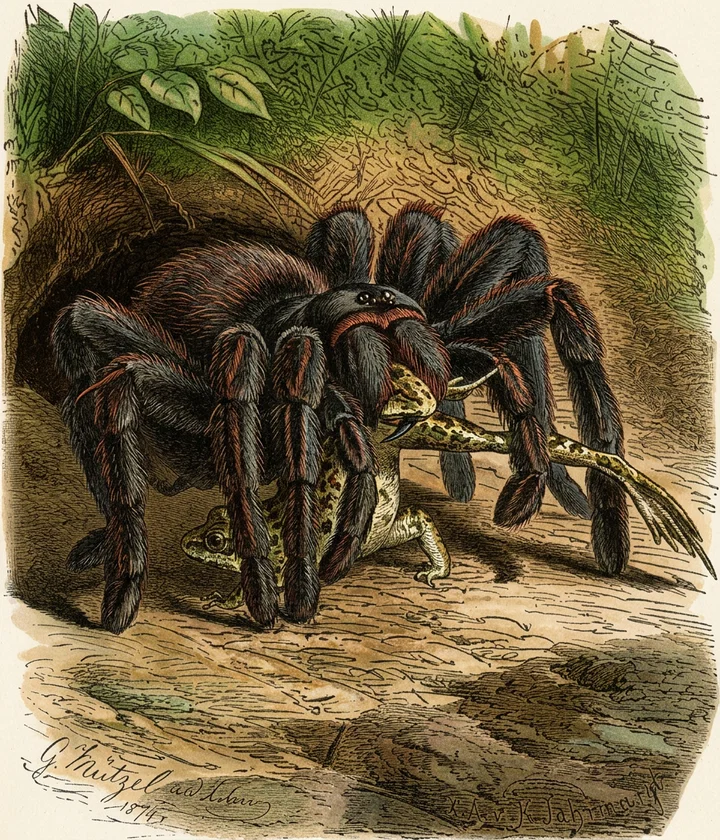
The spider in our picture could make a very bad wound. Do you see near his mouth a sharp claw? All spiders’ jaws have two of these claws in them. At the end of the claw is a little opening, through which the spider forces the poison. This poison is just like that of the rattlesnake; but there is so little of it that the bite does not often cause death.
This great spider in our picture is the largest in this family. When spread out, he is as large as a man’s hand.
He does not spin beautiful silk web houses, and live in them. He has a burrow in the ground, shaped like a pointed tube, and lined with a firm white tissue.
He lives on humming birds and tree-lizards. The one in the picture has a small frog to eat. These great crab spiders have a very bitter enemy. It is the red ant.
Spiders are very neat. They spend a great deal of time in brushing and combing the dust and dirt from their long, hairy legs.
They do not love each other very well. Often the larger spiders eat up the weaker ones. The mother spider, however, thinks a great deal of her little ones, who often eat her up. They are all fond of fighting.
But if they have some bad qualities, they have good ones as well. Did you ever brush down a spider’s web, and after a few hours find that he had spun another right where the old one was? He is a very persevering little fellow, and does not give up with once trying. You have seen spiders’ threads strung across the path on a dewy morning. These threads are little rope bridges, on which the spider can travel long distances without touching the ground.
Spiders have been tamed. A French prisoner once had a tame spider that would come every day for his meal of flies, when the prisoner played on his musical instrument.
Another Frenchman, who raised spiders for their silk, had eight hundred tame ones. The silk is sometimes used in making very delicate instruments. It takes four million spider’s threads to make a cord as large as one hair on your head. These are very fine threads, are they not?
W. E. L.