You have all heard of Egypt, that country over in the north-eastern part of Africa. You have read about it in your Bibles, if nowhere else, and have learned how Joseph was sold to a mighty captain who lived there; and how, for many long years, the Israelites worked very hard for the Egyptian king. You read about the River Nile, and how its waters were once all turned to blood, because Pharaoh would not let the Israelites go out from Egypt up to the promised land.
At that time, Egypt was a fine country, with busy towns and beautiful cities. Now all is in ruins. If you were to visit the places where these old towns stood, you could hardly tell what had been there; in most places, only heaps of rubbish mark the spot. But some of these ruins are the most wonderful in all the world, because they are the oldest.
If you will look on a map of Egypt, you will see, near the northern part of the Nile, a city marked Cairo. Just below this city, on the west side of the river, stand these wonderful ruins. They are nothing more than great hills of stone, built ages and ages ago, before Christ was born,—before the Israelites came down to Egypt; such a long while ago, that nobody can tell who built them, or when. There are seventy of these pointed, four-sided stone hills, or pyramids, at this place. They are made of great stones, so large that nobody can invent any machinery that can hoist such heavy stones so high, and hundreds of men could not pull them up. How these Egyptians got them up there is a wonder indeed. But they did their work well, else it could not have stood so many thousands of years. If the workmen had been careless, we might not have known anything about the pyramids.
What were they built for? I suppose the old kings meant them for tombs,—sepulchers where the royal families might be buried. The Egyptians had some queer notions about death. They thought that at death the thinking part of man went into some animal, and that after three thousand years it would come back to live in the old body. They took great pains to keep the body in some safe place and to preserve it with spices, so that at the end of this time, it could live again as before. But it was of no use, for we can read in our Bibles that dead people do not know anything, and never will till Jesus comes and raises them to life; and if these Egyptians had only had the Bible to read, they would have known better too.
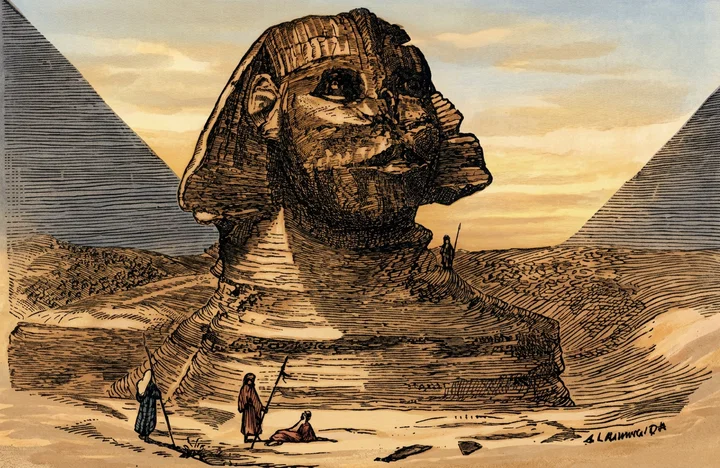
By the side of one pyramid is another monument, and nobody can quite make out what that was made for. You can see in the picture what it looks like. It is called the sphinx. It is a massive great image of solid stone. What a long time it must have taken to hew it out!
It is broken in a good many places now. Its head was like a man's. Once it had a cap on, but the top part of that is gone; and it has lost its long beard and its nose.
For many years it was buried up in the sands that the wind had blown upon it, and only its head could be seen, so that people thought that was all there was to it. At last somebody dug the sand away; then the great head was found to have a body like a lion's. Between its outstretched paws were the ruins of a large temple. No doubt the Egyptians once came here to worship, and the sphinx is an image of one of their gods. This picture of the sphinx must have been taken before the sand was dug away.
It is sad to think that the busy people who once lived in this country are all dead, and their cities in ruins, so that nothing but rubbish tells of what has once been.
W. E. L.