One of the most memorable spots on earth, the place on which, more than on any other, the glory of God through long ages rested, is Mount Moriah. Hither came Abraham, obedient to the voice of God, to offer, if need be, his only son upon the altar. Here, it is commonly believed, stood the threshing floor of Araunah the Jebusite, whereon King David offered burnt offerings, when the destroying angel, with uplifted sword, stood over the doomed city. And the Lord answered him “from heaven by fire upon the altar of burnt offering.” “Then David said, This is the house of the Lord God, and this is the altar of burnt offering for Israel; and he set to work hewing stone and collecting material for a house unto the Lord. David was a mighty captain, who “had shed much blood and had made great wars.” He had thus unfitted himself for this great work, and by divine command it was left for his son Solomon. On this ground, in after years, Solomon erected a house for the Lord, a temple “exceeding magnifical, of fame and of glory throughout all countries.” The plan of this temple and its surroundings has been so fully described in former numbers of this paper that a mere mention of it may be sufficient.
Moriah is one of the few places in Palestine that can with certainty be identified. Hence everything pertaining to its present condition is of interest to the Bible student. It is not a spot that the traveler may visit when he will, as he can most of the other places of interest in Palestine. The fanatical Moslems guard the place with great jealousy, and for years would not allow a Christain to enter, on pain of death. Now, however, it can be visited with suitable permits.
To obtain an area sufficiently broad for the temple and its courts, massive walls had to be built up from the sides of the mountain. In the space between the mountain and the walls, chambers were built. These chambers had very thick walls, and the roof was supported by many pillars. Then the remaining space was filled in with soil that had been scraped from off the mountain in order to bring the top of the mountain down level with the wall. In the midst of this broad space stood the magnificent temple of Solomon, that in later years was enlarged and beautified by Herod the Great.
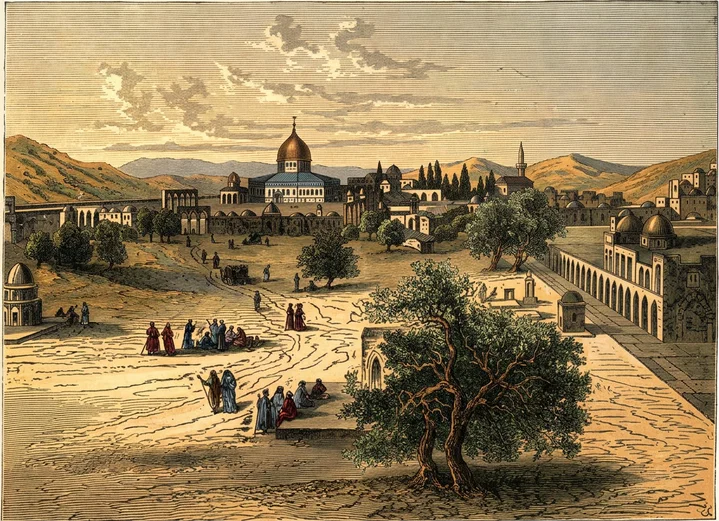
All this has passed away. In its place now stands an octagonal building surmounted by a dome. This is the Mosque of Omar, or the Dome of the Rock. A view of this building is shown in the center of our picture. The Mosque is over five hundred feet in circumference. On the outside it is covered with tiling and colored marble. Inside, the dome is covered with gold and delicate tracery. Beautiful mosaics and passages from the Koran everywhere cover the walls. The subdued purple light that falls slanting through the gorgeous windows to the floor, the sacred associations of the place, and the solemn stillness combine to move the imagination and touch the feelings of the visitor.
This building, however, is only a covering to the object of interest. Inside the twelve pillars that support the dome is a space sixty feet in diameter. This is inclosed by an iron railing and lattice work, and overhung with a fine canopy of crimson silk. Within this enclosure rests in solemn silence a huge rock, the bare summit of Moriah. On this rock, in the ages so long gone by, stood the altar of burnt offering, or, according to some authorities, the ark of the covenant. The visitor is not allowed to enter this sacred enclosure, but he may thrust his hand through the lattice, and touch the cold stone.
Doubly sacred is the place to the Mohammedan; for from this rock, we are told, the prophet Mohammed took his upward flight, when, one night, he ascended to heaven, and like the Apostle, beheld things unspeakable. And the traveler is shown the impression of a large hand said to have been made by the angel Gabriel, as he prevented the rock from following the prophet upward. Beneath this enclosure is shown the little cave where Mohammed prayed.
The grounds around this building, as you will see in the picture, are dotted with mosques, prayer-houses, and colonnades. The profound stillnessp. 186 that reigns throughout is in keeping with the sacredness of a spot, where, for long years, the only living and true God was worshiped.
W. E. L.