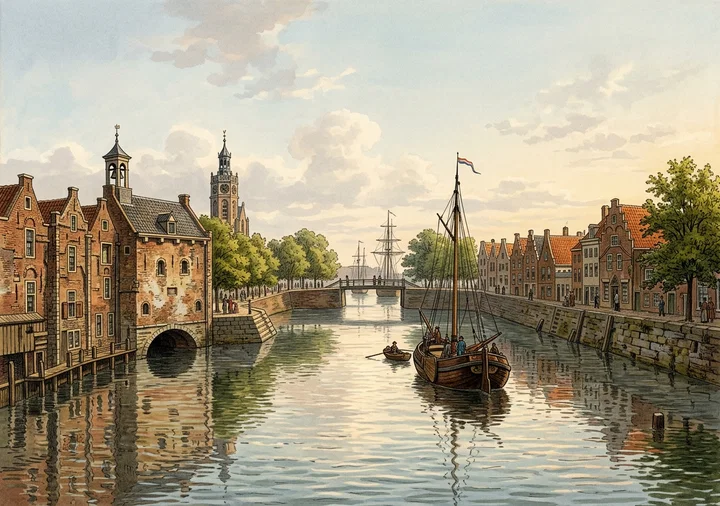
DELFT HAVEN, which is shown in the picture, is a spot memorable for an important event in the lives of the “Pilgrim Fathers,” who, to escape religious persecution, were compelled to leave their homes, and seek an asylum in a strange land. But the place is of no special interest to us only as connected with the lives of these persons; so it may be well to give you a bit of their history previous to the event referred to.
Immediately following the Reformation of the sixteenth century, the struggle in England was principally between Catholics and Protestants. When Edward VI., a Protestant, came to the throne, the religion of the state was revised, and the Church of England reformed in many particulars. A “Common Book of Prayer” was prepared, also a “Book of Homilies,” or sermons, to be read for instruction in the churches. The Bible was translated at this time, and copies procured at public expense, and distributed in the several places of worship, that all might have access to them. Articles were drawn up, defining the position of the Church of England, and setting forth their determination not to submit to the corruptions of the Catholic church.
Although the Reformed Church was in advance of the Romish church in point of purity of doctrine and morals, yet many errors still clung to her, which the more devoted Protestants realized. These contended for freedom, and simplicity in worship, and that her forms and ceremonies, so much like the Romish church, should be set aside. Because these persons thus urged reforms in the Protestant church, and a return to primitive simplicity in religious faith and practice, they were called Puritans.
But more serious difficulties were soon to occupy the attention of the Puritans; for at the death of Edward VI., which happened about this time, his sister Mary, a bigoted Catholic, ascended the throne. It was her constant aim to bring everything under Catholic rule, and to undo the good which had been accomplished by her predecessor. She punished as heretics all who would not bow to the Catholic yoke; and to save their lives, a number of Protestant ministers fled to Geneva, Switzerland. During her reign of five years, two hundred and eighty-five persons, including children, were martyred. Five of these were bishops at the time she took the throne.
But though the Puritans were at variance with the government in church matters, in its struggle with the Catholics during the reign of Mary, they were ready to help defend the country against the invader, and at once enlisted their sympathies in the government’s behalf.
“Bloody Mary,” as she was called, was succeeded by her half sister, Elizabeth, a Protestant. Elizabeth went right to work to restore what the Catholic power had overthrown during Mary’s reign. She re-established the Reformed faith and customs, their articles of faith, and “Book of Common Prayer.” The Protestant religion began once more to revive.
No immediate danger being feared from the Romish power, the Puritans redoubled their zeal in advocating their reform views, hoping to bring about what they termed a “Re-reformation.” By the aid of the printing press, they issued many tracts for distribution; and when refused the use of the public press, they purchased one for themselves, which they carried secretly from place to place.
The Protestant ministers who fled from Mary’s persecutions now returned to their homes. During their seven and a half years’ stay in Switzerland, with partial reformers, they had accepted views contrary to the system of church government adopted by the Established Church. Before this had become known, they were employed as clergymen, as of old; but they did not hesitate to advocate their new views, and consequently did not long retain their situations.
The persecution waged by the Reformed Church against the Puritans became more and more severe, and their only hope now was that when James I. should succeed Elizabeth upon the throne, he would in some way give them relief. But in this they were disappointed. The following extract will show the spirit he cherished toward them: “At a conference held in 1603, to consider the grievances of this class of his subjects, James I. boasted, in a letter to a friend in Scotland, that he had ‘kept such a revel with the Puritans these two days, as was never heard the like; where I have peppered them so soundly as ye have done the Papists.’”
Persecuted Puritans were scattered all through the kingdom, quite a number of them about London; but where the borders of the counties of Lincolnshire, Nottingham, and York united, there were several hundred, composed of “the great middle class of England, the firm foundation on which the state rested.” They were educated and intelligent, and their religious convictions were the result of careful and conscientious study and observation.
In North Nottinghamshire was the village of Scrooby, where a good many Separatists, or Puritans, resided. The principal one of these was William Brewster, a man of considerable note, and a particular friend of a distinguished Secretary of State in Elizabeth’s reign. He was postmaster at Scrooby, occupying the old manor-house belonging to the Archbishop of York’s estate. Here Brewster kept an inn, as was the custom for postmasters to do in England at that time; and this house he opened once every week for the meeting-place of the Scrooby Puritans, thus making the house of a first-class bishop in the Church of England free to those who bitterly opposed Church and state!
This company chose Brewster for their leader; but they were not long left undisturbed. Brewster was dismissed from his office, and with others would have been further punished had they not escaped before the officers had time to take action in their cases. From this time, Separatists were hunted, persecuted, and imprisoned; often having to leave all their possessions to save their lives. There seemed no way of escape from their afflictions other than by flight to another country.
Some years before, a party had fled from Gainsborough, in Lincolnshire, to Amsterdam, Holland. The Scrooby company now turned their eyes thither, where, they had been informed, they could serve God as one’s conscience said was right. But how to dispose of their property and get away unobserved, was a perplexing problem.
At one time a company attempted to leave Boston, Lincolnshire. During the night they got safely on board ship, but only to be treacherously turned over to the officers, who ransacked their goods and searched their persons for their money and other valuables. Being left destitute, they were led back to town amid the jeers and jests of a wicked crowd; and then, after being tormented and kept in suspense some time, they were imprisoned a month, when all but seven, who were kept for trial, were released.
This party, and others with them, in attempting to get away afterward, were worse dealt with than at first. They had engaged to be taken on a Dutch vessel between Hull and Grimsby. All arrived, as proposed, and one boat load of men had gone onto the ship, when suddenly a mob came rushing upon them, frightening the captain, who put off without the remainder of the party.
It is touching to read what befell these persons during the next few weeks. But their blameless lives attracted the attention and excited the sympathy of many citizens, who searched out their cause, and were instrumental in having them finally united with their friends in Holland.
In the winter of 1607-8 and the spring following, the Scrooby church, at different times and through much tribulation, came together at Amsterdam. But trials awaited them here. The country and language were new and strange to them; they were poor, so that it was only by the closest management and the strictest economy they could earn a livelihood. But a greater trial was in store for them. Tired of strife and turmoil, they had anticipated pleasant communion with those who had gone before them to Holland, when they should join them. But instead, they found the Gainsborough church, under a restless leader, one John Smith, at variance among themselves. The Scrooby church could not unite with this disaffected party, and after a year’s stay at Amsterdam, quietly withdrew to Leyden.
They lived in the city of Leyden twelve years; and byp. 74 hard labor made a comfortable living. They were very happy in their spiritual relations, and were favored with the labors of Wm. Brewster and other men equally talented, and devoted to the interests of religion.
But it began to be a question with them what the future demanded of them. There seemed to be no prospect that they should exert any great influence for good with those outside their own party should they remain in Holland; and as time passed on, the young, who did not realize what their freedom had cost, were yielding to the spirit and customs of the foreigners. Therefore, with the fathers, it seemed only a question of time that they would lose all they had gained by sacrifice and suffering for Christ’s sake, unless other advance moves were made.
Whither shall we flee? was the subject agitated. For a time, various opinions as to what was duty were entertained and discussed; but there is not space in this already long article to tell how it was decided where they should go, neither the long process of scheming and planning that was gone through before arrangements were matured which finally resulted in their departure for America.
Provision could not be made for all to embark at once, so it was decided who should go, and who should remain to follow afterward. They were to sail from the port of Delft Haven, which is located a little way south-east of Leyden, whither their friends accompanied them. They spent one night there, “not to sleep, but in friendly entertainment and Christian discourse;” for on the morrow the separation must be made. And it was indeed a sorrowful parting, and with many it proved to be the last.
You have learned that Delft is in Holland, that country the Dutch have made on the water. One writer calls Holland “a raft of mud and sand;” another says it is “an immense crust of earth floating on the water.” It is a country of windmills, and you would be interested to read how they will dry up streams that they may make use of the soil beneath.
The word Delft means ditch, so called from the water canal which leads to it from the Meuse River. Delft is one of the prettiest cities in Holland; but unfortunately it has met with some sad catastrophes. Once it was nearly destroyed by fire, and twice has been terribly shattered by the blowing up of powder mills. It was in this city that William the Silent, or the Prince of Orange, was so cruelly assassinated. Delft is not now a manufacturing or commercial city. It has a population of about twenty-two thousand inhabitants, who live very peacefully.
M. J. C.