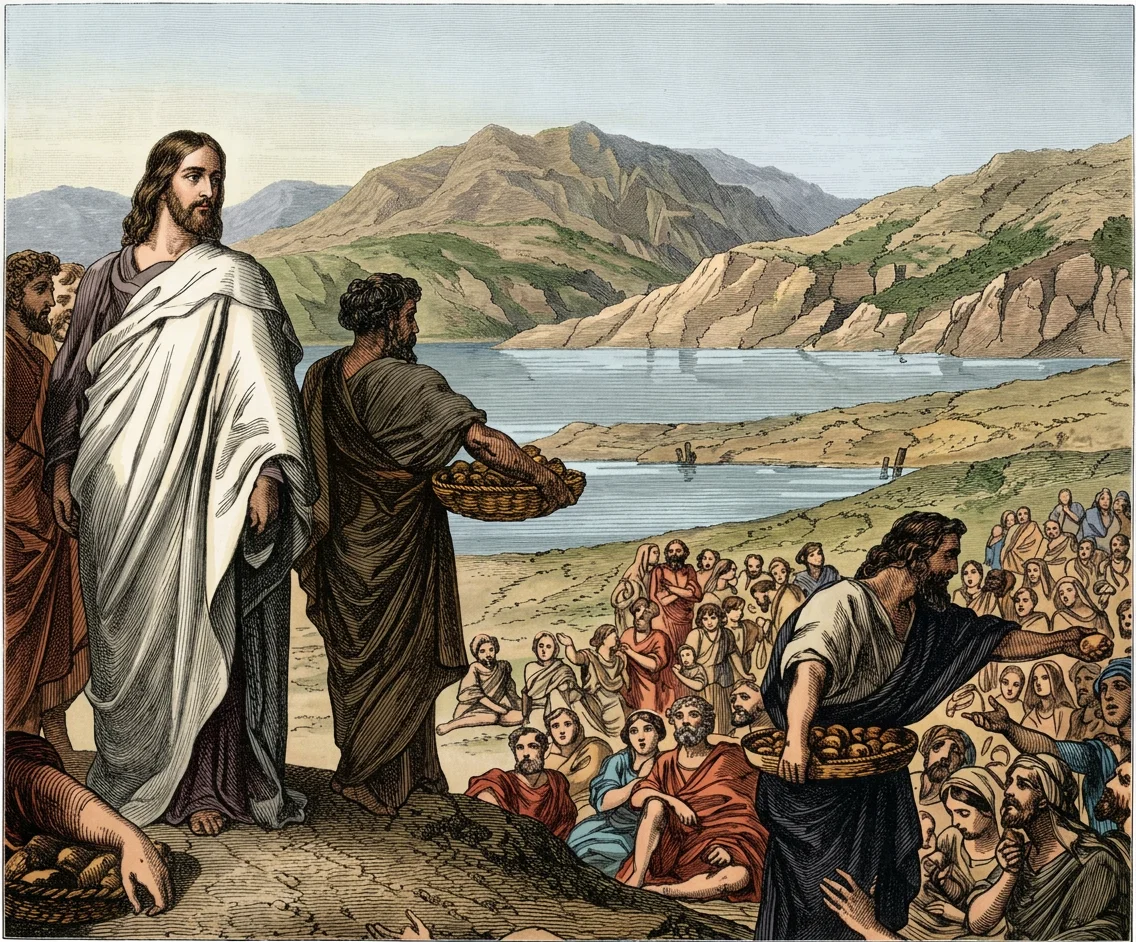
IN the picture we have a view of one of the most notable miracles that our Saviour performed while he remained here on earth. It is mentioned in all four of the evangelists, by Matthew, Mark, Luke, and John, which is remarkable of itself. The twelve apostles had just returned from their first missionary tour, where they had been sent by Jesus to teach and preach in the cities of their own country. See Matt. 11:1. Our Saviour knew that they now needed rest, and so he said to them, “Come ye yourselves apart in a desert place and rest awhile.”
There were many places suited for such retirement, but the Master told his disciples to take the boat and cross the head of Lake Tiberias to a retired spot which was some six miles away, not far from the city of Bethsaida. Luke 9:11. Anxious eyes were watching the movements of the wonderful Prophet; and as the great Teacher and his disciples sailed away from the wharf at Capernaum, the people anticipated his place of landing, and multitudes followed along the shore on foot, and outwent the boat.
Then as Jesus and his disciples came to disembark, instead of being alone, where he could instruct them privately about the gospel work, lo! a great multitude of people were ready to claim the attention of the mighty Healer. Hundreds of sick and maimed had been brought for Jesus to relieve, and were placed on the ground in positions to attract his attention. The Saviour could not obtain the retirement which he and his disciples desired. Stream after stream of people poured in, until many thousands were assembled. It was at the time of the Passover (John 6:4), and these Passover pilgrims were all anxious to listen to the wonderful Prophet.
Restored with AI
From the account, it seems that in this manner the blessed Redeemer spent almost the entire day. He taught, and healed, and comforted, and instructed as the anxious multitude had need. The narrative says, “He was moved with compassion toward them, because they were as sheep not having a shepherd.” At last the day wanes, and the shadows lengthen and deepen, but yet the people show no signs of weariness nor any intention to depart. They have listened to the precious words of life as they fell from the lips of the great Teacher, and they have seen his almighty touch, as the sick were healed, the insane restored, and the maimed made sound again.
But the setting sun warns them that night is approaching, and the anxious disciples come to Jesus and say, “This is a desert place, and the time is now past; send the multitude away, that they may go into the country round about, and into the villages, and lodge and buy bread for themselves, for they have nothing to eat.” The Saviour quietly replies, “Give ye them to eat.” Then turning to Philip, a native of Bethsaida, and therefore well acquainted with the surrounding country, Jesus said to him: “Where shall we buy bread, that they may eat?” This he said to prove Philip, for Jesus himself knew what he would do. John 6:6.
Philip’s eye ran over the large company, and making a rough estimate he answers, “Two hundred pennyworth of bread (about forty-six dollars’ worth) would not be sufficient for them, that every one might get a little.” Andrew, the brother of Simon Peter, another native of Bethsaida, said, “There is a lad here who has five barley loaves and two small fishes, but what are they among so many?” This was probably some Jewish lad who had barley cakes and dried fishes to sell.
Jesus now directs that the meager supply be brought to him, and then he says to the disciples, “Command the people that they sit down upon the grass in ranks by hundreds and by fifties.” This was to prevent confusion and oversight in distributing the food he was about to miraculously prepare, and also to secure easy passage-ways among that vast multitude.
The arranging and seating some ten thousand people into orderly groups of fifty and one hundred persons each consumed some little time; but it is satisfactorily accomplished, and all are arranged in the presence of the Saviour. Everything in nature now seemed in harmony with the occasion. It is spring, for the Passover is at hand, and the air is doubtless filled with the fragrance of flowers and blossoms; the heat of the sun has abated, and the still waters of Galilee are peacefully sleeping at their feet, while the eyes of ten thousand persons are wonderingly directed toward Jesus, in vague anticipation of what he is about to do.
Jesus, now in the quiet of that still hour, while all eyes were fastened upon him, looked toward heaven and gave thanks for the food. He blessed the repast which he was about to supply in the wilderness. The account says, “He blessed and brake.” The Jews did not cut their bread, but baked it in loaves of a cake-like thinness, suitable for breaking.
Having given thanks to God for the food, the Saviour took the loaves and fishes, and dividing them into suitable portions, passed them to the twelve, and directed them to distribute the same to the people. And now began that mysterious and wonderful repast! Whether the food multiplied in the hands of the Saviour as he passed it to the disciples, or in the hands of the apostles as they handed it to the people, the record does not say, but it is more reasonable to suppose that the miracle was wrought in the Saviour’s hands. One thing is certain: all partook of the meal; all ate until they were satisfied; and there was more than could be used. The account says, “They took up ofthe fragments that remained twelve baskets full.”
Our Saviour, in order to teach all a lesson of economy, said, “Gather up the fragments that remain, that nothing be lost.” The “baskets” here mentioned were a kind of satchel or traveling basket, holding about a peck, which the disciples generally carried about with them.
This mighty miracle of the Saviour’s convinced the people for the time that he was the true Messiah. But probably they had more enthusiasm than true faith. The crowd speedily decide that Jesus shall not remain in obscurity any longer, and they are about ready to bear him upon their shoulders and proclaim him king.
Doubtless the disciples partook of the same spirit. But the Saviour anticipates their unwise scheme, and at once directs the apostles to take the boat, and return immediately to Capernaum. He then turns to that company of five thousand men, who are about to take him by force and make him king, and dismisses them with an authority that none dare disobey.
There is but one more miracle like the foregoing in the New Testament. It is the feeding of the four thousand men, besides the women and children, and is found only in the Gospels of Matthew and Mark. At this time, also, there were taken up seven baskets full of the broken fragments which remained after the multitude had eaten a full meal.
Let us all more fully trust and love this mighty Saviour, who can provide a table in the wilderness, and who is ever ready to forgive the sins of all who humbly call on him.