THE Sabbath-school lesson in Mr. Farrand's class for the next Sabbath was about the widow's mite. The boys in this class always met at their teacher's house one evening early in the week to talk over the lesson. They were there now, and Mr. Farrand had been talking to them about the importance of giving, and reading them a few verses here and there in the Bible about it.
He had given them a talk about tithes some time before, and ever since, each boy had carefully saved out a tenth of his pocket money for this purpose. Now he went on to explain the difference between tithes and offerings, as the Bible calls gifts or presents.
“It is your duty to pay your tithes,” said he, “because they belong to God in the first place, and never are yours to give, only in the way that a person pays a debt; but it is your privilege to make offerings from anything that really is your own. This is not of necessity, for God says that it is not acceptable unless given willingly; and this is why I call it a privilege and not a duty. But I believe we concluded in one of our talks that God holds us responsible for the way in which we live up to our privileges.”
“But how can we give? and what will we give to? and where’ll we get the money?” said the boys all together.
“Only one question at a time,” answered Mr. Farrand, smilingly. “As for your having something to give to, I think you have a fine opportunity to live up to your privileges. You must have all heard the superintendent read that letter from a poor teacher out West who needs lesson books and papers in a mission Sabbath-school she has just started, where the scholars are too poor to buy their own. Here is a chance to send to other children the light of the gospel which you enjoy. I think it would be a good plan for you to each pledge something toward sending them these books and papers. And now about paying these pledges. I don’t think it would be just the right thing for you to ask your parents for the money. No doubt they would be willing to give it, but that would make it their offering, not yours. But I think there isn’t one of you but what can earn it in one way or another. Of course you will have to sacrifice some to do it, but that is what makes it acceptable to God, if done willingly. You will have to cut short your time for play, and for reading pleasant books; but it should not hinder your studying. Now how many can and will do this?”
Every hand was raised. It was then decided that the cost of the papers should be divided equally among them. Each pledged to pay his share, and then set to thinking of some plan to earn the money. The first thing that Tim Mills thought of was making brackets with his scroll saw.
“I can stain them nicely, and sell them. Aunt Hattie told me a long time ago that she’d pay me for two pair, if I’d make them. But there’s Jimmy Nichols,” and his face fell. “Jimmy’ll want to make brackets I know. He can make them as well as I can, and that’s all he can do, shut up in the house as much as he is.”
Jimmy was an invalid, and was only able to be outdoors in the best and brightest weather. Tim had quite a struggle to give up his plan; but he was glad afterward that he said nothing about it when it was his turn to speak, for Jimmy said on the way home, “I’m glad you other fellows didn’t say anything about brackets, because I can’t get along spry outdoors like the rest; but I can do that as well as not at home.” Tim even told him that he would help him sell them. He guessed his Aunt Hattie would take two pairs.
“I suppose I can sell the evening papers for Uncle Howard,” thought Tim, “but that will be such cold, sloppy work this wet fall; and when the snow comes, worse yet. Besides, it’s most dark when school is out, now.”
“But whatever you do, boys, do it as unto the Lord,” said Mr. Farrand, and Tim went on thinking. “Well, it won’t be doing it unto the Lord if I keep grumbling about it; but what will the boys at school think? They make so much fun of the newsboys, and they’ll think it’s queer work for me.” Presently he added out loud, “I’ve made up my mind, Mr. Farrand. You know my Uncle Howard is editor of the Evening Herald, and he always has a lot of boys to sell papers for him. I know he’ll let me if he sees I want to; and if mother’s willing, I’ll begin to-morrow.”
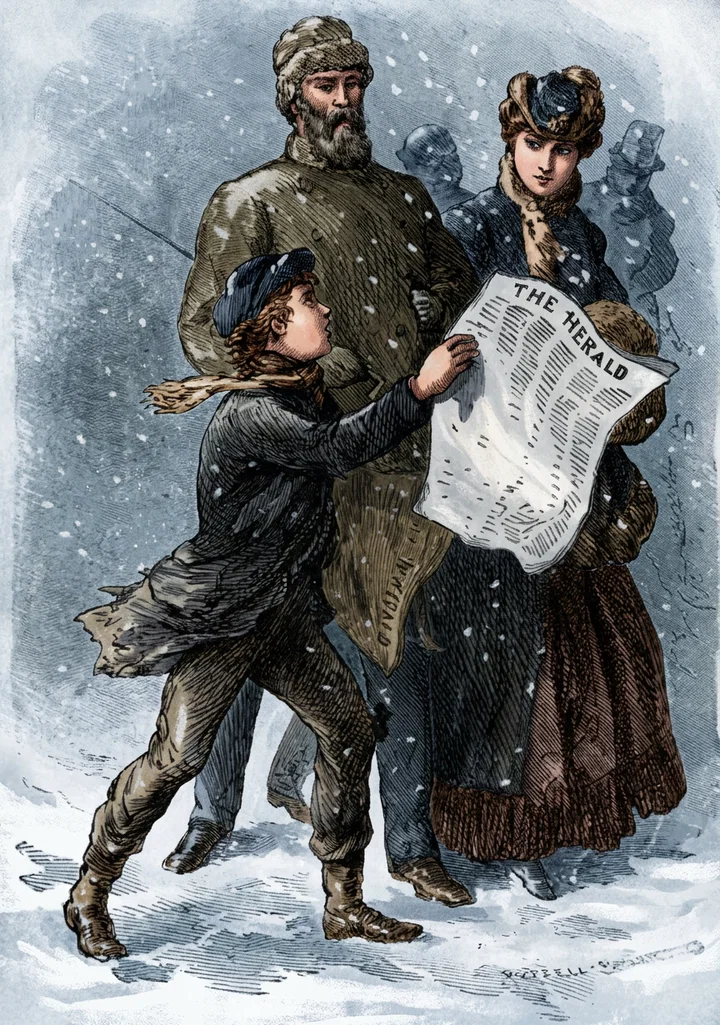
“Success to you,” said Mr. Farrand, “and you may bring me a copy of your paper every evening.”
Mother was willing when she heard all about it, though she cried a little bit, but I guess it wasn’t because she felt bad; and so every evening for nearly two long months, Tim walked up and down the streets, through rain or snow, crying, “Evening Herald, only two cents!”
Sometimes it took all Tim’s good resolutions put together to leave the cozy sitting-room with its bright fire, interesting books, and cheerful company for the dark, cold street outside; but he never failed. It was hard work, too, and sometimes Tim wished himself at home with the rest; but he found that when he felt discouraged, he did not have such good luck selling his papers. Then he would say, “I guess it was because I didn’t do it as unto the Lord.” This helped him many times. The best place on the route was Mr. Farrand’s, where he always stopped on his way home. He always had a cheerful word for Tim, and seemed to think the Herald was a very good paper, indeed; for sometimes, especially when Tim’s pile looked rather large, he would buy two or three papers.
The pledge was at last paid, and Tim could say with honest pride that he had earned every cent himself. He also helped Jimmy sell his brackets, which were finished very beautifully. The other boys did equally as well; and as the books and papers had been sent by Mr. Farrand some time before, with a letter telling how and by whom they were sent, they had the satisfaction of hearing from the West shortly after their pledges were paid, and to hear that the school was doing nicely, thanks to their self-sacrifice and industry. The teacher also stated that she read the letter to the school, which so encouraged the scholars that they were working in somewhat the same way to pay for their own books and papers in future.
S. ISADORE MINER.