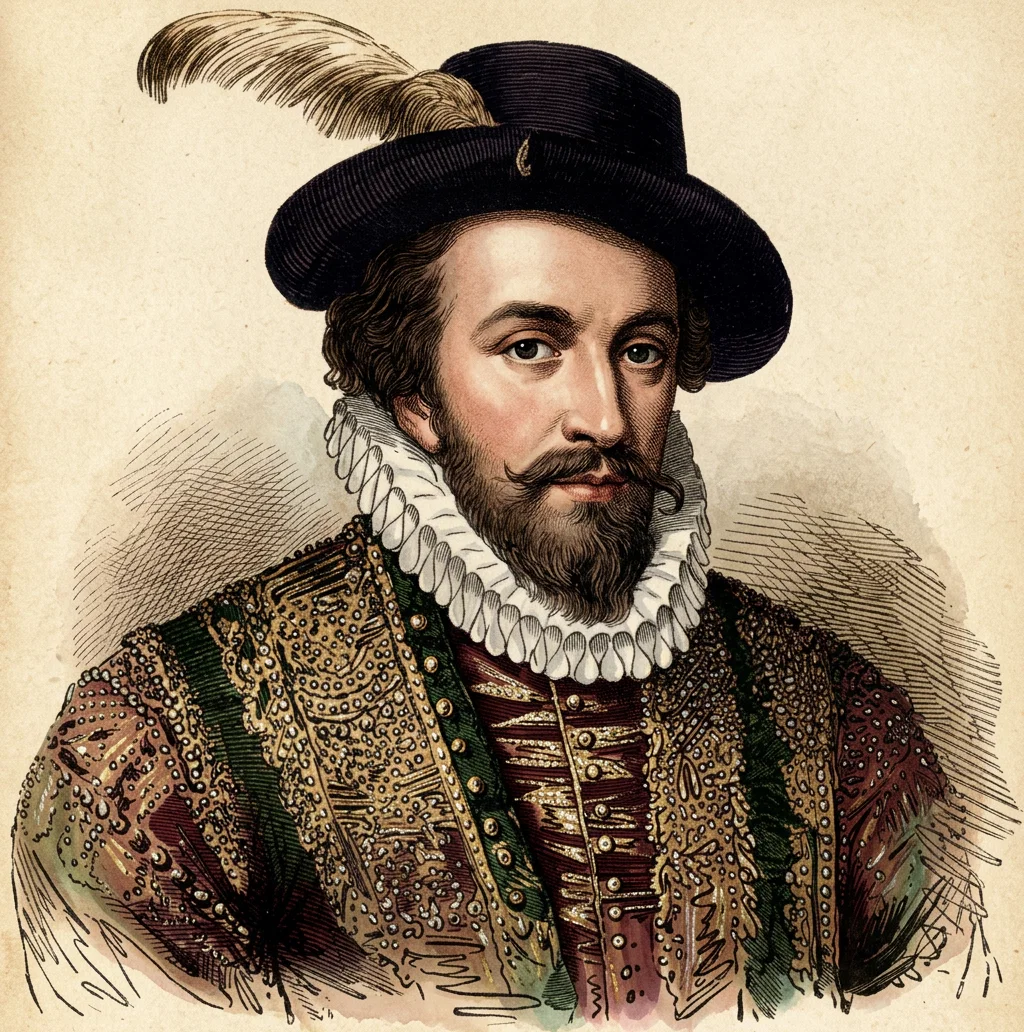
SIR WALTER RALEIGH

7%

S. D. A. Publishing Association · Battle Creek, Mich. · Dec 2, 1885

FromThe Youth’s Instructor, Vol. 33, No. 46.

Read the full edition

SIR WALTER RALEIGH.

As soon as you read that name, no doubt you remember a piece that you have read over and over again in your school readers about a daring young cavalier, who, when good Queen Bess was one day walking in the park, gallantly threw his richly embroidered cloak over a muddy spot in her path, that she might not soil her jeweled shoes. You remember how pleased the queen was at this marked attention from so handsome and richly dressed a young man, and how from that time he stood high in her favor at court; for she found that he was as wise and witty as he was handsome and gallant.
Restored with AI
Walter Raleigh’s boyhood home was in the south of England, in the county of Devon, close to the British Channel. The plain old farm-house in which he was born still stands amid the ancient oaks and orchard trees, where it has stood for at least four centuries. About thirty miles from Hayes—the name of Raleigh’s home—stood, in the midst of dense forests, the grim and hoary castle of Compton. To this castle, young Walter often galloped to see his two half-brothers, Humphrey and Adrian Gilbert. These young men had done some good military service, and were excellent navigators. Walter was a great favorite with them; and they never tired of telling, or he of listening to their tales of daring and adventure, and he longed for the time to come when he, too, could win renown. At other times he would dash over to the fisher’s huts on the Channel, and listen for hours with dilated eye and bated breath to the tales of wonderful voyages, and hair-breadth escapes, and the strange lands beyond the seas, till he came to love the ocean almost as well as the fishermen did.
At fifteen he went to college. Here, as at Devon, he was the leader in his classes and in the sports. His schoolmates all loved him, and his teachers were proud of him. But he did not stay long, for he had a chance to go to war with his cousin, to help the oppressed Huguenots of France,—a temptation that his ambitious spirit could not resist. We may believe he fought bravely in these wars, acquitting himself like a man. After six years he came home, no longer a slender youth, but a tall, broad-shouldered young soldier of twenty-four. Shortly after this he was made captain of a company to put down a rebellion in Ireland. He performed this duty with honor to himself and his country. The queen and all the great men of England were astonished that such a chivalrous youth could manifest such coolness and sound judgment.
From this time he rose rapidly in royal favor, no doubt owing as much to his courtly bearing, fine figure, and keen wit, as to any more manly qualities he might possess; for Elizabeth, although she ruled with as sound a head and firm a hand as ever came to the throne, was nevertheless a very vain woman, loving to have fine courtiers around her, who would flatter her beyond the bounds of truth. Raleigh was one of her principal favorites; yet at times I fancy he found it neither an easy nor a pleasant task to please his exacting and jealous mistress. One time he had the misfortune to fall in love with one of the queen’s maids of honor, whom he secretly married. When Elizabeth found out what had been going on behind her back, she was so angry with Raleigh for daring to fall in love with any woman but herself, that she put him in the Tower, where he was kept a prisoner for several months. She never quite forgave him.
But this court life was a very tame one for such an energetic man as Sir Walter to lead. So when he had endured it as long as he could, or when the queen frowned on him, and made it so disagreeable that he could not stay in the palace at London, he would either go to his beautiful country-seat at Sherborne, or else off to some war or sea voyage. Sir Walter never got over his passion for the sea. Just then the air was full of rumors of wonderful lands that lay on the other side of the world,—lands so rich that things grew without the trouble of cultivating them, and where gold could be picked up like stones in the streets. Sir Walter thought it would be a fine feather in his cap if he could find this land, and add it to the British crown. But of course he never could find such a country, because it did not exist.
He tried time after time to plant a colony in America, which was then an unsettled wilderness. I think it was his half-brother, Sir Humphrey Gilbert, who first put the idea into his head. But some misfortune attended every company that he sent over.
At last Queen Elizabeth died, and James, the son of Mary Queen of Scots, came to the throne. Then Raleigh’s happiest days were over. The new king hated him bitterly, and took every chance he could find to disgrace him before the court. Worst of all, he was, after a short time, accused of trying to dethrone the king, and place Arabella Stuart, a relative of James’s, on the English throne. This charge was false. The chief of the conspirators was an intimate friend of Sir Walter’s, but Raleigh had nothing to do with the plot. King James, however, chose to believe the false reports, and kept him in prison for twelve long years.
Finally he was granted his liberty on condition that he would go to Guiana, subdue the country, and annex it to the English crown. Raleigh, glad to obtain his freedom at any price, very eagerly accepted the proposal. He spent the last of his princely estate in fitting out this fleet, and his wife gave him all the money she had from her own property. It was with high hopes that Sir Walter set out on this last voyage, taking with him his oldest son, a fine young man of twenty-three.
But I dislike to tell you how this expedition turned out; how the Spaniards, who had been there before him, entangled him in constant broils, and how in one of these skirmishes, his noble son was killed! At last he had to go back without finding the country, with half his gallant followers killed, and his fleet in a disabled condition.
Of course James was very angry with him when he reached England, and immediately shut him up in prison. He was anxious to get rid of him, and at last hit upon the plan of trying him for his old offense that by this time most everybody had forgotten. In the trial, Raleigh was not allowed to defend himself, but was accused in the most abusive language, and finally sentenced to the block. You may be sure that by this time he had learned that “it is better to trust in the Lord than to put confidence in princes.” And that you may know how he felt about it, I shall give you a good part of the last letter he ever wrote on earth:—
“You shall receive, my dear wife, my last words in these my last lines; my love I send you, that you may keep it when I am dead, and my counsel, that you may remember it when I am no more. I would not with my will present you sorrows, dear Bess; let them go to the grave with me, and be buried in the dust. And seeing that it is not the will of God that I shall see you any more, bear my destruction patiently, and with an heart like yourself. . . . To what friend to direct you, I know not, for mine have left me in the true time of trial. Most sorry am I, that being thus surprised by death, I can leave you no better estate; God hath prevented all my determinations,—that great God which worketh all in all; and if you can live free from want, care for no more, for the rest is but a vanity; love God, and begin betimes—in him you shall find true, everlasting, and endless comfort; when you have travailed and wearied yourself with all sorts of worldly cogitations, you shall sit down by sorrow in the end. Teach your son, also, to love and fear God whilst he is young, that the fear of God may grow up in him; then God will be a husband to you, and a father to him,—a husband and a father that can never be taken from you.”
His remains lie in Westminster Abbey; and years after his burial, there was placed near the spot a brass tablet, with this inscription:—
“Within the chancel of this church was interred the body of the great Sir Walter Raleigh, on the day he was beheaded, in Old Palace Yard, Westminster, October 29th, 1618. Reader, should you reflect on his errors, remember his many virtues, and that he was mortal.” W. E. L.