DRY-DOCKS

11%

S. D. A. Publishing Association · Battle Creek, Mich. · Jan 20, 1886

FromThe Youth’s Instructor, Vol. 34, No. 3.

Read the full edition

DRY-DOCKS

ONE of the many interesting things to be seen in our large ocean harbors, where the great ships that traverse the mighty deep are anchored, is the dry-docks, by means of which these vessels are taken out of the water for inspection, and for the purpose of making any necessary repairs. In ancient times these docks were not known; and it is only of comparatively recent date that they have become necessary. As the commerce of the ocean has increased, and the size of the ships of necessity been enlarged, some powerful and expeditious means had to be devised for this purpose.
Liverpool was the first city to construct these docks, and for a long time they were unrivaled in size and magnificence; but ere long other important harbors were building and employing them. The dry-dock at the Brooklyn navy yards is the finest structure of the kind in the United States. It was ten years in building.
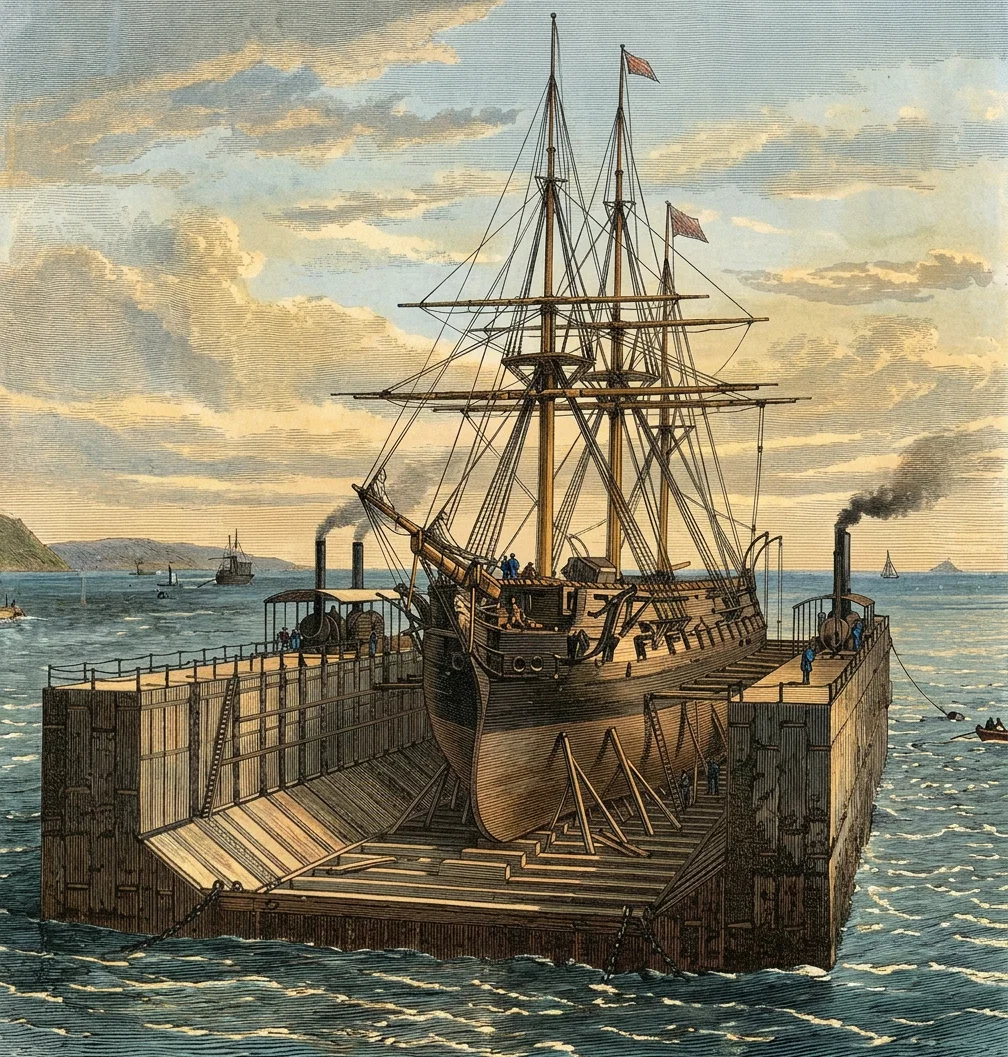
One of the most common of these docks is the floating or balance dock, shown in the accompanying engraving. It is so constructed that the bottom and sides are composed of many separate compartments. The whole is securely anchored by strong chains at each corner. On the top of the walls along the sides, are placed large pumps, operated by steam engines, by means of which any or all of the compartments may be filled with water, for the purpose of sinking the platform to a sufficient depth to allow the vessel to be floated over it. When the vessel has been placed in the desired position, it is securely “shored,” or braced, on either side with heavy timbers. The water is then pumped out of the compartments in the bottom and sides, which allows the platform to rise, of course raising the vessel with it.
This style of dock received the name of balance dock from the facility with which an exact equilibrium is preserved by means of the water pumped into or out of any separate compartment. Two of these are owned by the New York Balance Dock Company, the smaller one being 210 feet long, 70 feet wide, and 30 feet deep; the larger one is 325 feet long, 100 feet wide, and 40 feet deep. The lifting power of the larger one is immense, it being capable of raising 8,000 tons. An evidence of its power, and the facility with which it is operated, can be seen from the fact that on Nov. 20, 1858, the Russian frigate, General Admiral, an immense vessel of 6,000 tons’ burden, and weighing 3,680 tons, was taken out of the water on this dock in the very short space of one and one-half hours. Docks of this description are now in use at the Portsmouth navy yard, and at Savannah, Mobile, Charleston, and New Orleans; also at Havre and Marseilles; and the Austrian government is now building one at Trieste equal in dimensions to the larger New York dock.
Other kinds of docks are used, as the sectional dry-dock, which is similar to the balance dock, having its bottom, or caisson, constructed of separate sections, which may be raised or lowered independent of the others, thus giving the required pressure upon any part of the bottom of the ship, which is often necessary in case of damage or breakage to the bottom of the vessel.
Restored with AI
There is also the hydrostatic screw dock, consisting of a platform which is suspended from strong beams on each side, laid on the walls of the quay or slip into which the vessel is floated. These beams, from which the platform is suspended, are raised and lowered by means of heavy screws, thus lifting the vessel from the water. It is then properly braced to keep it level.
In all the great harbors of the world these docks are seen, of various construction and size, in which are handled the monster ships with the most apparent ease and safety; but in the United States are to be found the largest and finest dry-docks in the world. J. W. B.