FAMOUS COASTING

9%

S. D. A. Publishing Association · Battle Creek, Mich. · Jan 20, 1886

FromThe Youth’s Instructor, Vol. 34, No. 3.

Read the full edition

FAMOUS COASTING.

If you will look at a map of the Old World, you will find between Sweden and Russia a great body of water called the Baltic Sea. On its eastern side a long arm of the sea runs inland, and at the end of the arm is the city of St. Petersburg. This is the capital of Russia; and here the Czar and all the great men of the empire live, and make the laws for the Russians, just as the President and Congress make the laws for Americans in the city of Washington. St. Petersburg is a very large city, and in 1870 it had about 667,000 inhabitants.
Now I want to tell you about some of the good times that the little boys and girls in St. Petersburg have,—a merrier time than you have at Christmas, because it lasts for a whole week. I was going to say, for a whole long week, but it is all too short to suit the little Russians.
This good time comes in February, and it is called the “butter-week!” You wonder why it has this name? Every morning in this week the Russian mother serves up for breakfast a queer kind of pancake baked in butter, and covered with melted butter. The people are very fond of this dish. It is cooked at no other time of the year. If the poor peasants are half-starved for most of the time, they are sure to have all they want to eat during the “butter-week.” Then everybody eats all he can.
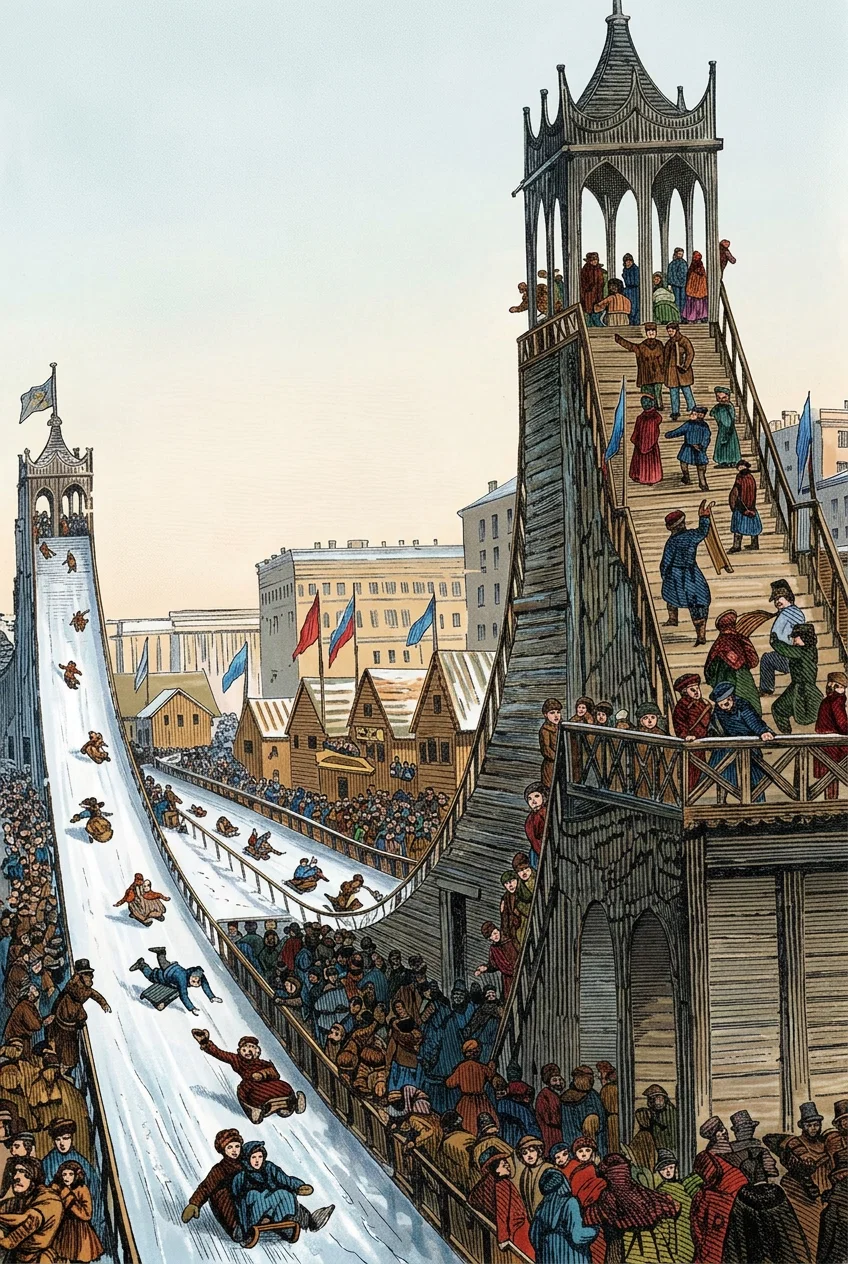
But they do something besides eating. For several days before the feast begins, sledge after sledge, loaded down with beams and planks, are seen going toward the large, open square in the city. Then the workmen with their hatchets and hammers make the frosty air echo with their hearty blows; and soon over all the square, booths and eating-houses are seen springing up, with gay flags flapping in the wind, just as you see them in the picture.
Restored with AI
They build something else too, as you will see, and that is a hill. All around St. Petersburg the country is flat and often marshy. There is not even a high mound, and the little people have no place for coasting. So just before “butter-week” comes, the fathers and brothers put up some hills of stout beams and planks. The slide is covered with cakes of ice, and the whole is cemented together with water, that freezes as fast as it falls on the ice. The hills are built facing each other. They are very steep at the start, so that the sledges go a long way after they reach the level. On the first morning of the week the fun begins. Rich and poor, nobles and peasants, old and young, all take part in the sport together. Toward the close of the week, business stops, and merchants and business men join in the sport.
In the dooryards of the rich, ice-hills are often built, where the children can slide down hill as much as they wish. Sometimes the slides are built inside the houses; and then, instead of ice, they use polished mahogany wood to slide on.
The next morning after the feast ends, the gay square looks gloomy enough, and so do the people; for now they are to have a seven weeks’ fast. The square is all covered over with boards and rubbish strewn about in tearing down the buildings, and the workmen are quietly clearing things up. All through the seven weeks, the Russian mother uses oil instead of butter in her cooking, and allows no meat, except a little fish, to be eaten in her house. You may be sure the children do not like the fast very well.
The Russians are very strict in keeping their fasts. I suppose they hope in this way to make up for their sins. But no amount of good deeds that any one can do, will atone for the wrong things he does. These can be blotted out only when God, for Christ’s sake, forgives us.
W. E. L.