THERE does not seem to be much in a name now-a-days. In the good old times, when folks lived more simply, children were given names that had some meaning to them; and frequently after-life proved them to be most fitting. Let us see how one name got its meaning.
As the legend runs, Offerus, a great giant, who was stronger than all men living, determined to work for no one who acknowledged a superior. He served in turn all the kings of the earth, but he found the mightiest of them afraid of the devil. And the devil trembled at the name of Christ. So Offerus searched the land for Christ, whom all powers revered; but he could not find him, for there were few who had the love of him in their hearts. He at last built him a hermitage by a deep, swift river, and tried to serve the Christ by carrying weary pilgrims across the bridgeless stream. One wild night, he heard a plaintive voice calling. He crossed the swift torrent, to find on the farther side a fair-haired child, holding in one hand a cross, and in the other a globe. Lifting the little one up on his broad shoulders, the kind-hearted giant started across. The light burden grew heavier and heavier, till it seemed that both must perish in the flood. As he staggered up the bank, he found that he had borne on his shoulders the master he had so long looked for,—the Saviour of the world. Then men called him no more Offerus, but Christopher, or Christ-bearer.
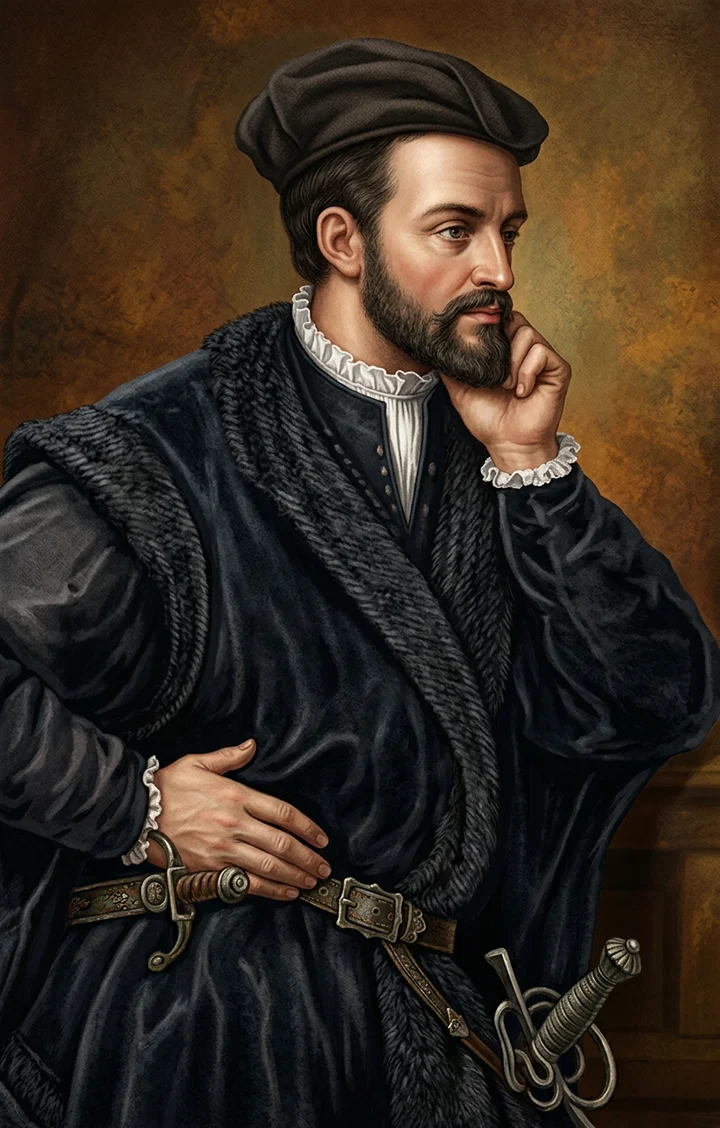
In a magnificent seaport of Italy, called Genoa the Superb, was born in the early part of the fifteenth century a boy named Christopher Columbus. Now we will find out how he exemplified the meaning that attaches to the name Christopher, and how he made it famous for all time.
He had learned from the few voyagers who had ventured around the southern point of Africa, that to the far east lay a country of exceeding magnificence. The half of its riches could not be told. There were said to be mountains of turquoises, lakes of pearls, and rivers whose beds were spangled with gold. Such was the far Cathay,—the land from which Columbus thought Solomon must have obtained his wealth.
Everybody believed that there was such a land. The great problem to be solved was to find a short and easy way to this wealth. Most people thought that the world was flat, and that if any one traveled far enough, he would come to the end of it. “If the world were round,” they sneeringly said, “the men on the opposite side of the globe would of course have to walk with their heels above their heads; trees would grow downward; and rain and snow fall upward. Such things were impossible.”
But Columbus had broader views; he firmly believed that the earth was round, and that if he sailed westward, he would a great deal more quickly reach this land of promise than by sailing east.
He was exceedingly anxious to reach this country. The fabulous wealth had some attractions for him; but it was not alone the love of gain or the hope of glory that impelled him to so hazardous an undertaking as to sail in the frail crafts of those days across unknown seas. He was a very devout man, and a diligent student of the Bible. He believed that there were millions of souls on the other side of the wide waters, who were wholly ignorant of Christ; and that God had laid on him the burden of carrying to them the glad tidings of a Saviour born. He was to be the “Christ-bearer” to those who had no knowledge of Him.
His share of the wealth that he hoped to find was all to be used in raising armies to rescue the holy sepulchre from the hands of the infidel Mohammedans. “Before the end of the world,” he said, “all the prophecies must be fulfilled, the gospel must be preached all over the world, and the holy city restored to the Church.”
It was this faith that made him persevere in the face of ridicule; this faith that sustained him while a humble suppliant at the courts of kings. In poverty and obscurity he toiled on for eighteen years. When one court refused to listen longer to his appeals, or to grant him aid, he turned, undaunted, to another. He would not give up. He had faith of the kind that removed mountains.
He did not find the eastern coast of India, neither did he find the wealth he looked for. He found, instead, a land rich in resources, but uncultivated, and inhabited by wild savages whose language he could not understand. He was a “Christ-bearer,” but not in the sense that he expected to be. There were no highly civilized people, waiting for some one to bring them the Light of the world—only the savages, and an unknown country. But he opened the way for others to follow, and lay the foundations for a broad republic, where liberty of conscience might be vouchsafed to the people.
W. E. L.