While traveling in Europe last year, our party took a trip through Switzerland, starting from Bâle one beautiful morning in June, in company with two friends, who spoke French fluently, and would be of service to us, our knowledge of that language being very limited.
We had decided to go to Mt. Blanc, so we had a long journey before us. Soon Bâle was left in the distance, and we were riding through a beautiful country. We started off in good spirits, feeling exhilarated by the fresh morning air, as it came in through the open window.
Our train glides slowly around a mountain; then over a bridge, from which we have a fine view of the valley below, crossed by the broad river; and now it enters an enormous tunnel. So the scene is constantly changing, until, after a few hours, we reach Berne, where we have half an hour to wait, and we will improve it by looking around the city. Berne is situated on a peninsular, around which the river Aar flows. This place is full of interest to travelers, as it is different from other Swiss cities, having preserved the quaint customs of former years. The houses are built in arcades, forming a covered walk, with shops on one side and pillars on the other. The inhabitants of Swiss cottages do not often live in the first story, as that is used for a shop or store-room. The windows of the dingy-looking houses are made bright by flowers, and pretty little red cushions on the window-sills, about five inches wide, upon which the women can rest their elbows, and watch the doings of their neighbors.
Bears are carved everywhere in wood and stone, ornamenting public buildings, dwelling houses, gate-posts, and hitching-posts, and every other object worthy to be beautified by the figure of a bear. There are also several bear pits here, where live, performing bears are kept. The Swiss costume is worn here, though it is out of fashion in other parts of Switzerland, and is seldom seen except on fête days, or holidays.
But we must leave this picturesque little city, and resume our journey. We soon reach Freiburg, where we have some little time to wait before changing cars, so we will see what there is here. We pass over the two renowned suspension bridges, and all around the city, then, wishing to purchase some stereoscopic views, direct our driver to take us where we can obtain them. He drives out about a mile in the country, though it seems strange such pictures are not kept in the city.
Stopping at a sort of way-side inn, an old man hobbles out to see what we want. After considerable time has been wasted, it dawns upon his mind that we are in search of pictures of the city. Turning his head to one side, and placing his forefinger on his forehead, he seems suddenly to recollect that he has a few somewhere. We wait impatiently while he goes in search of them. He returns after a long time with some pictures, but we cannot succeed in making a bargain with him, for he keeps changing and raising his price, and will take nothing less than the last-named; so we drive off without them.
Restored with AI
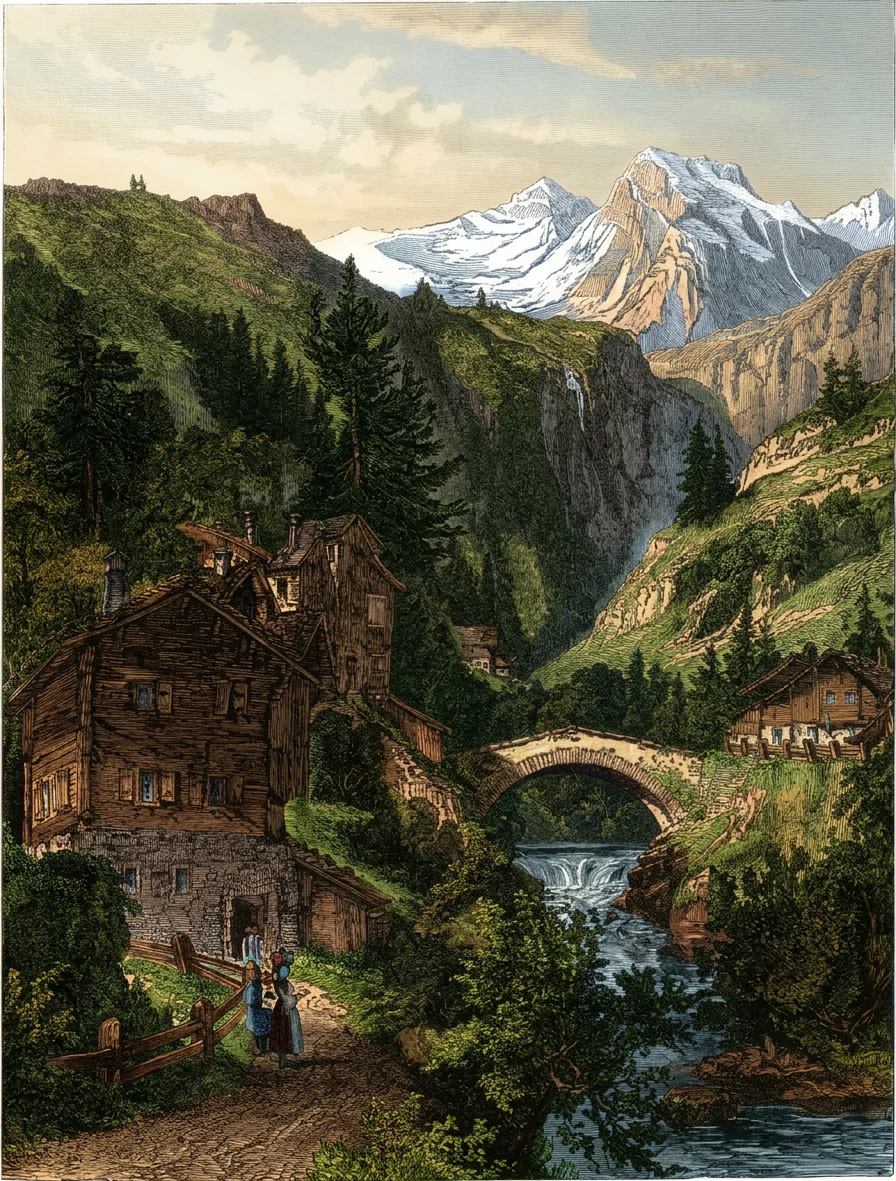
We would be glad to stay here until evening, and hear the great organ of Freiburg, but our train is already due, and we must hasten. We are soon comfortably settled in the cars once more, and are riding through beautiful scenery. Fields radiant with flowers, brooks sparkling in the sunlight, with cattle at their edges, lazily drinking the cooling water; rounded hills, covered with green verdure, snow-capped peaks, with Mt. Blanc in the distance,—all combined make a striking picture. After miles of such scenery as this, all is lost to our vision for a few moments, as we pass through a long tunnel; and, as we near the end, our train slightly slackens its speed, and there before us lies Lake Geneva, in all its beauty, just as the sun is setting. The many-hued174waves are gently rocking to and fro, and everything is so quiet that we scarcely notice the rumbling of the cars, as we ride slowly along the edge of the lake. As we round a curve, we see we are nearing the Castle of Chillon, which looks dark and gloomy even in the sunlight. It is built on a huge rock, several rods out in the water. We just get a glimpse of the ruins of an old abbey, completely covered with ivy, when our train suddenly begins to make up for lost time, and we ride along in the fast-deepening twilight, thinking of the picture we have just seen.
Almost before we are aware of the time that has elapsed, we have arrived at St. Maurice, a little tumble-down town among the mountains, where we are to spend the night. We have a good night's rest, and the next morning take the cars for Martigny, where we are to travel over the mountains in a different manner. The train suddenly stops, and it is made known to us that we are at Martigny, though we cannot see in just what direction it is, as we stand by the side of the railroad track, baggage in hand. We can see no depot, no houses, no people. Almost in despair, one of our party starts off down a little beaten path, in search of something. He soon returns with a man who brings a cart for our baggage. He leads us down the path, round a hill, where we find a large hotel and several houses. We order horses and a carriage for our ascent over the mountains to Mt. Blanc; and while waiting for them, visit a beautiful gorge close by. When we return, we find three saddled horses waiting for us, and we look around for the carriage. Here comes a man running at full speed toward us, with a horse hitched to a stout little dog-cart, that he says is to carry two of our party and the baggage. We are soon nicely settled in the dog-cart and on horseback, with two guides to lead us. Just before reaching Martigny, we had noticed an immense cascade falling thousands of feet over a mountain. Our guides take us directly to this place, and lead us across a narrow bridge over the foot of the cascade; then we turn around, and cross another bridge a little higher up. So we go zig-zagging along till we have crossed thirty bridges, and are at the top of the mountain, where we have a magnificent view of the Rhone valley. Leaving this behind us, we travel up and down mountains all day, sometimes stopping to rest in a little Swiss village, which consists of a few black looking houses huddled up together, with roofs reaching almost to the ground, giving them very much the appearance of “huge toadstools.” Sometimes we see a Swiss cottage built two or three stories high, but not often. The people are very tender-hearted and unselfish, giving their cattle one side of their house, while they occupy the other. We frequently meet a peasant woman, with a tub of butter or other produce on her head, plodding slowly down the mountain, to some town, where she is taking it to sell.
Almost every traveler among the Alps has his adventure, and we had ours as well. Twice during this day's journey, accidents occurred which frightened our horses badly,—when we were riding along the most dangerous places of the whole route, a great mountain of solid rock on one side of us, and a dark ravine thousands of feet below. And, without doubt, we would have been hurled down the abyss, had not our guides come quickly to the rescue. We could not quiet our horses by speaking kindly to them, for they could not understand one word of English, and the only French word we knew which they understood was hue! which was to urge them forward.
When it was almost dark, we reached a little village three or four miles this side of Chamouny, where there was a suspicious looking old building called a hotel. Here our guides urged us to stay all night, telling us that it would be impossible for them to take us on to Chamouny that night, as it would be dark soon, and the road was very dangerous. We had almost decided that we must spend the night here, when we saw a party of English travelers talking together. They beckoned to one of our party and told him not to stay, as it was an old trick of the guides to urge people to stay, for they were well acquainted with the keepers of the hotel, and wanted to have a good time. Besides that, they told us that the building was soaking in water, it having rained the night before. All of their things were wet through, so they had to stay there. After much urging on our part, and gesticulating on the part of the guides, they were prevailed upon to take us on to Chamouny. They drew a large carriage from under a shed, hitched our horses to it, and soon we were riding on the best road we had yet gone over among the mountains.
The finest view of Mt. Blanc is from Chamouny, a little village which gets its living off travelers who throng the place. Here we found a very large hotel, having all the modern improvements. It was too dark to see the mountain that night, so we went to some of the shops in search of curiosities to take home. In one shop we found some beautiful shells, which the clerk said came from the “Mer de Glace.” It would indeed have been a curiosity had this been true, but we happened to know that the Mer de Glace was one of the glaciers we had passed in coming to Chamouny, and was a sea of ice.
We could not find many genuine curiosities, and as we did not intend to take home any sham articles, bought some pieces of fine wood-carving, which we knew to be no imitation.
We were glad to find a good resting-place for the night after such a tedious journey, and went to bed with excited hopes of seeing Mt. Blanc the next morning. But we were doomed to be disappointed. It was so foggy in the morning that we could not get a good view of it. We were not sorry that we had made such a long journey, however, and set about making plans for a pleasant homeward trip. C. B. K.