Papa, my school-teacher says that a whale doesn’t have a throat any larger than my arm. How could the whale swallow Jonah?” so said a little boy to his father, a few weeks since, as the family had come together for worship, and a chapter from the book of Jonah was about to be read.
“But, my boy,” said his father, in attempting to explain the difficulty in the child’s mind, “the book of Jonah does not say that it was a whale which swallowed the prophet. It simply says, ‘Now the Lord had prepared a great fish to swallow up Jonah.’ And in the three other texts where it is referred to in the same book, it simply calls it ‘the fish.’”
“But, father,” said an older sister, taking sides with the little boy, “the New Testament does say that it was a whale which swallowed Jonah. ‘For as Jonah was three days and three nights in the whale’s belly, so shall the Son of man be three days and three nights in the heart of the earth.’”
“My daughter,” said her father, more fully realizing the difficulty of the situation, “the words that you have quoted from the twelfth chapter of Saint Matthew, are not, in the absolute sense, the words of our blessed Saviour. The Redeemer, when he was in this world, did not use the English language. Indeed, the English language was not then even in existence. Christ’s words are in the ancient Greek language, and we now have them in the Greek New Testaments. But before we can understand them, they have to be changed into our language. This change of words from one language to another is called a translation. Our English New Testament is simply a translation of the words of Christ and those who wrote the New Testament in the Greek language. But translators are not inspired to do their work. They translate as nearly according to the original as they are able; but sometimes it is difficult to fully translate the exact meaning of one language into another.”
“But why does the New Testament say it was a whale, if it was not surely one?” chimed in both the children.
“The Saviour,” their father continued, “did not say a whale. The word which he used in Matt. 12: 40, was Ketos. Now this Greek word Ketos does not necessarily mean a whale. But the translators of the New Testament have by their language restricted this word Ketos to a whale, or to the whale species.”
“To help you to understand the matter more clearly, I will state a few facts: All languages have their lexicons, or dictionaries, which define, or give the meaning, of the words. Thus we have Greek dictionaries. These dictionaries are prepared by scholars, who know the meaning of all the words in at least two languages, often many more. One author of a Greek dictionary, Mr. Robinson, defines Ketos in this way: ‘A huge fish, sea monster. See Matt. 12: 40.’ Another, a classical lexicon, by Messrs. Liddell and Scott, defines Ketos, the word Jesus used in Matt. 12: 40, thus: ‘Any sea monster, a huge fish.’ And Mr. Parkhurst, another author of a lexicon, in writing about this matter says, ‘There is the highest probability that the fish in question was not of the whale, but of the shark species.’”
“Will you tell us, then, something about the shark?”
“I can give you a few facts in regard to the shark; but if you want full information, you must go to the encyclopædia, or to some book on zoology. ‘The Sea and its Wonders’ will be a most interesting book for you to read.”
“But I can say, in a general way, that the fiercest, the most to be dreaded, and the most hateful of all the monsters of the deep is the shark. There are many species of them, as the white shark, the blue shark, and other kinds. The white shark is sometimes nearly forty feet long. He can swallow a man whole with ease. They follow in the wake of vessels to pick up what is thrown overboard. And woe betide the man who falls into the sea; for he is almost sure to be caught in the jaws of these voracious monsters. The Mediterranean Sea is particularly full of sharks; but they are found in every part of the great ocean, and often come into harbors when the ships are at anchor. The shark has six rows of teeth nearly two inches in length, and shaped like saw teeth. They are sharp as the sharpest knife. The shark’s mouth is on the under side of the neck, like some kinds of sturgeon, so that when it seizes its prey, it has to turn over on its back.”
“But, strange as it may seem, some seamen are so bold that they are not afraid to jump into the deep ocean, with a knife in hand, and attack these ugly sea monsters.”
“I may also add,” continued he, in explanation of the animal that swallowed Jonah, “that many New Testaments do not say that it was a whale. The Revised Version; which all can consult, reads sea monster in the margin. A late Swedish translation reads, ‘den stora fiskens,’ the large fish. One German New Testament says, ‘Seeungeheuer,’ that is, sea monster. And a French Testament has it, ‘grand poisson,’ a great fish. So you see that good scholars and translators do not think that the word Jesus used necessarily means a whale.”
“But could not the Lord have made a whale with a throat large enough to swallow Jonah?”
“Oh, yes. Indeed, it says in Jonah 1:17, ‘Now the Lord had prepared a great fish.’ But from the fact that whales have very small throats, and do not get into the Mediterranean Sea except by storms or accident, it is best to understand the language to mean some huge sea monster.”
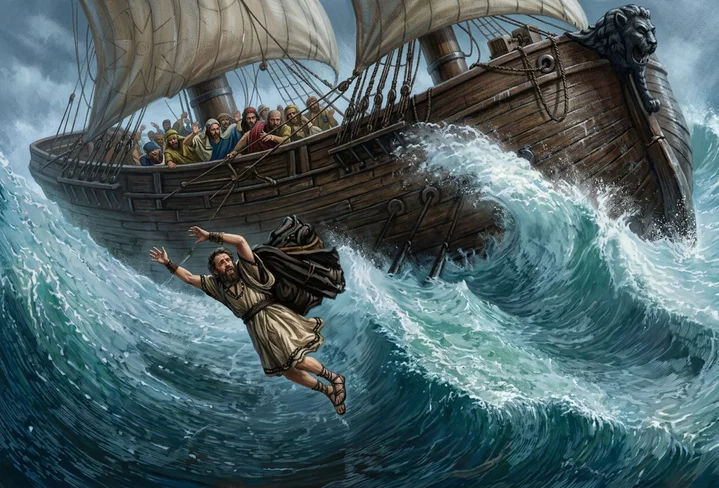
In the illustration we have a thrilling view of the wayward prophet, as the heathen sailors were committing him to the bosom of the great deep. A full history of Jonah is given in the book which bears his name. It will be interesting to all the readers of the INSTRUCTOR household. This prophet is once mentioned in another part of the Old Testament. See 3 Kings 14:25. Jonah lived and had his most singular experience some eight hundred years before the birth of Christ. G. W. A.