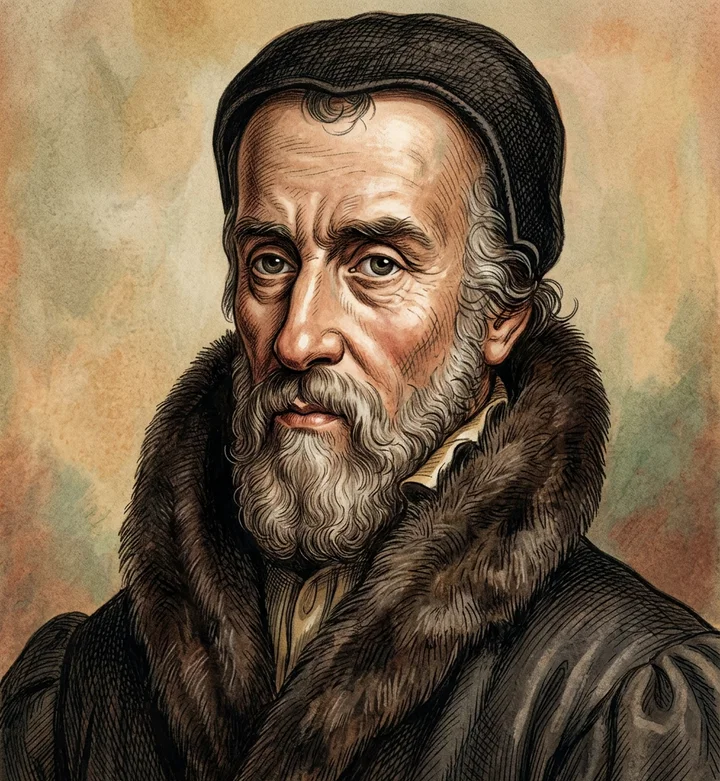
ABOUT the time of the Great Reformation, when Luther was diligently at work in the castle at Wittemberg, translating the Bible from the Latin into the German, the Lord put it into the heart of an honest and pious young priest of England to do a similar work for the benefit of the English people. This man was William Tyndale. He was born at North Nibley, Gloucestershire, England, somewhere between the years 1480 and 1484, though the exact date of his birth is unknown. About this time, Luther was born in Germany.
Tyndale received his first education at Oxford. He afterward went to Cambridge, where he made great progress in his studies. After he took the order of priest, he engaged himself as tutor in the house of Mr. Welch, a knight of Gloucestershire.
Mr. Welch was a very hospitable gentleman, and used frequently to invite to his table, abbots, deans, and other clergymen. The sun of the Reformation had already shed its first clear beams athwart the land, exposing the foul unsightliness of the Romish church and her prelates. The conversation of the day very naturally turned on religious subjects; and especially at such gatherings as these that met at Mr. Welch’s table would the Scriptures and other religious themes be considered. Tyndale entered warmly into these discussions, heartily upholding the doctrines advanced by Luther, and always bringing forward Scripture to confirm his position. As he was a learned man, and well versed in the Bible, these abbots could not gainsay his words, and finally they became very envious of him. They talked bitterly about Tyndale in the ale-houses and other public places, and tried to convince Mr. and Mrs. Welch that he was wrong.
Not a great while after this, he got into a dispute with a very learned doctor. As Tyndale was continuing the argument, getting the better of the doctor, the old divine burst out in a passion, and said, “We had better be without God’s laws than the pope’s.” Tyndale was shocked at such a blasphemous speech, and boldly replied, “I defy the pope and all his laws. If God spare my life, ere many years, I will cause a boy that driveth the plow to know more of the Scriptures than you do.”

After this, the priests grew more and more bitter, until Tyndale decided it was unsafe to remain longer in that place; and taking leave of his kind friends, Mr. and Mrs. Welch, he went to London, where he preached awhile. Here he began the work of translating the New Testament. But he was again compelled to flee; and judging that in England there was no place for him to continue this work, he went to Germany. He made a short stay here, and finally went to the Netherlands, taking up his abode in the town of Antwerp.
In the year 1525 the first two editions of the New Testament were put to press at Worms, the same place where, but a little while before, Luther had been called before the Diet. These editions had a rapid circulation in England. So incensed were the bishops and clergy, when they found out about it, that they cried out against the work, saying there were a thousand errors in it, and that it was not possible to translate the Scriptures into English. They did not rest until they had got the king to issue a proclamation that all Tyndale’s works should be suppressed and burnt.
Nothing daunted, the good man set to work to make a more correct translation, which was printed at Antwerp in 1534. He also translated the first five books of the Bible.
This translation formed the basis for King James’s version, the one we now use. You will see by the following quotation from Tyndale’s Testament, that, aside from the quaint spelling of that day, very little change has been made in the text: “Oure Father which arte in heven, holowed be thy name. Let thy kingdom come. Thy wyll be fulfilled, as well in erth, as hit ys in heven. Geve vs this daye oure dayly breade. And forgeve vs oure treaspases, even as we forgeve them which treaspas vs. Leede vs not into temptacion, but delyvre vs from yvell. Amen.”
Tyndale’s translation is justly considered the grandest literary work of that age. It greatly enriched the language of the common people, by introducing into homely English the apt figures and phrases of the Bible.
However, the clergy were not contented to have Tyndale’s works burned; they thirsted for the blood of the good man himself. Through the treachery of a man whom Tyndale had supposed a good friend, he was arrested and carried to Velvoorden, where there was a strong prison. In the year 1536 he was led from the prison to the stake, where he was first strangled and then burned. As he was about to die, he cried with a loud voice, “Lord, open the king of England’s eyes!” Thus perished a learned and godly man, to whom, more than to any other, is due the light and liberty now enjoyed by the English-speaking people.
W. E. L.